


Canberra - Mirion Technologies, Inc products
Detectors - High-Purity Germanium Detectors
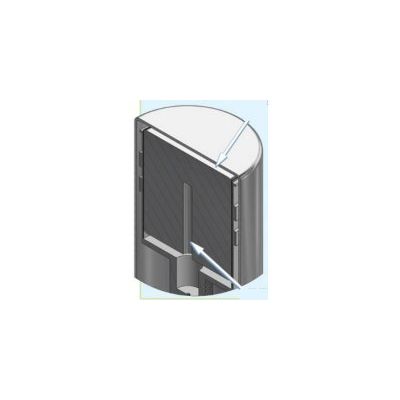
Standard Electrode Coaxial Ge Detectors (SEGe)
The conventional coaxial germanium detector is often referred to as Pure Ge, HPGe, Intrinsic Ge, or Hyperpure Ge. Regardless of the superlative used, the detector is basically a cylinder of germanium with an n-type contact on the outer surface, and a p-type contact on the surface of an axial well. The germanium has a net impurity level of around 1010 atoms/cc so that with moderate reverse bias, the entire volume between the electrodes is depleted, and an electric field extends across this active region. Photon interaction within this region produces charge carriers which are swept by the electric field to their collecting electrodes, where a charge sensitive preamplifier converts this charge into a voltage pulse proportional to the energy deposited in the detector.
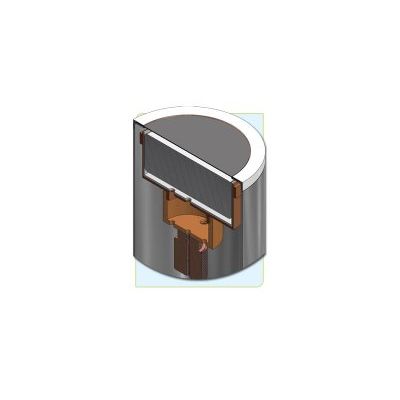
Broad Energy Germanium Detectors (BEGe)
The CANBERRA Broad Energy Ge (BEGe) Detector covers the energy range of 3 keV to 3 MeV like no other. The resolution at low energies is equivalent to that of our Low Energy Ge (LEGe) Detector and the resolution at high energy is comparable to that of good quality coaxial (SEGe) detectors.
Detectors - Cryostats, Coolers
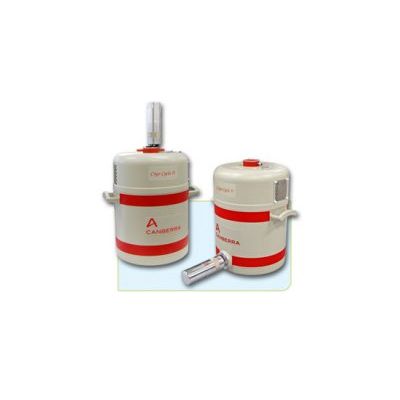
Cryo-Cycle - Model II - Hybrid Cryostat Cooled Radiation Detectors
The CANBERRA Cryo-Cycle II is a unique offering in the field of cryogenically cooled radiation detectors. The Cryo-Cycle II is described as a “hybrid” cryostat because it combines the advantages of electric cooling with the reliability of liquid nitrogen. The long-life Pulse-Tube cryocooler, condenses the boil-off N2 gas back into the 25 liter Dewar. This unique capability provides the convenience of operating a detector for 12 to 18 months before LN2 needs to be added, but at the same time keeps the detector cold in case of power failure.
Radiochemistry Lab- Alpha Spectroscopy
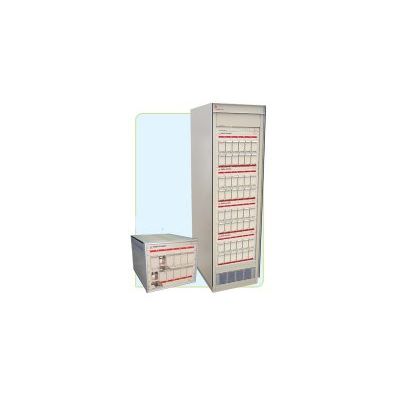
Alpha - Analyst Integrated Spectrometer
CANBERRA`s Alpha Analyst along with Apex-Alpha software is the complete solution for both routine and non-routine alpha spectroscopy applications. This flexible Alpha Spectroscopy System is designed to operate the way you do – whether that`s counting samples in a production `batch mode` environment or one sample at a time in a research type environment.
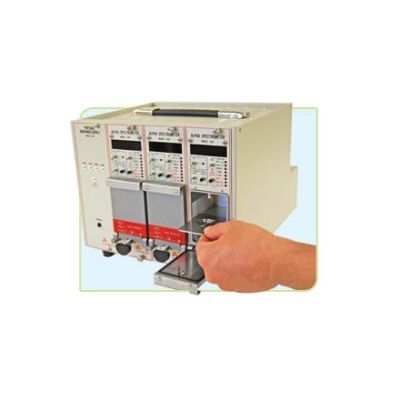
Alpha - Model 7401 - Alpha Spectrometer
The CANBERRA Model 7401 is a comprehensive alpha spectrometer that can accommodate samples up to two inches in diameter in a double- width NIM package. The versatile sample chamber and instrument electronics support CANBERRA`s own PIPS Detectors, which combine high resolution and low backgrounds in a rugged alpha detector with active areas up to 1200 mm 2 . In addition, the alternative use of most charged particle detectors is also supported. The Model 7401 fully integrates into one package a stainless steel vacuum chamber for low backgrounds and ease of cleaning, a vacuum gauge, detector bias supply, preamp/amplifier, pulser, discriminator, counter, and digital display. A stainless steel shelf and sample holder are included with each spectrometer, for reproducible detector/sample spacing, which is user selectable from 1 to 49 mm, in 4 mm increments.
Radiochemistry Lab- Gamma Spectroscopy System
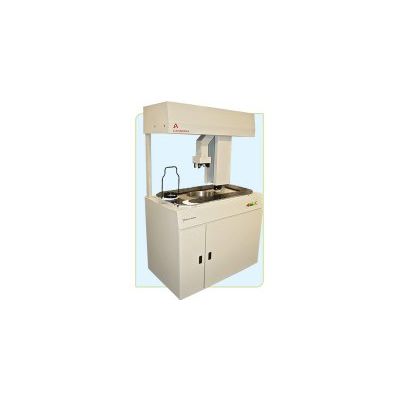
Gamma Analysis Spectroscopy
Counting laboratories involved in the routine qualification and quantification of gamma emitting nuclides are burdened with the often overwhelming problem of sample management. How can sample throughput be maximized while addressing the need to meet stringent detection limits and quality standards? The normal approach is to utilize one or more technicians to manually load and count successive samples to a fixed counting time. However, this is very labor intensive and not an extremely efficient solution to the problem.
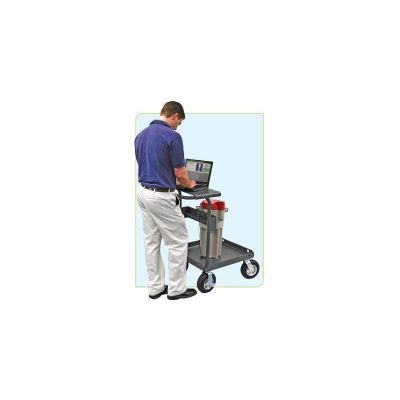
FoodScreen - Radiological Food Screening System
The CANBERRA FoodScreen Radiological Food Screening System is a complete, transportable food analyzer for quickly determining whether raw or processed food has become contaminated from a radiological event. A sample is placed into the shield, a count is initiated and a final report is generated. The report lists activity or minimum detectible activity concentrations found in the sample for the key nuclides of interest for food products: Iodine-131, Cesium-134 and Cesium-137. Based on nuclidespecific limits pre-determined by the system manager, the report will also state whether the sample is `Clean` or `Above Limit`. Above limit samples may need to be investigated further in a higher resolution detector system such as the CANBERRA FoodSpec™ Radiological Food Analysis System.
Radiochemistry Lab- Digital Signal Processing
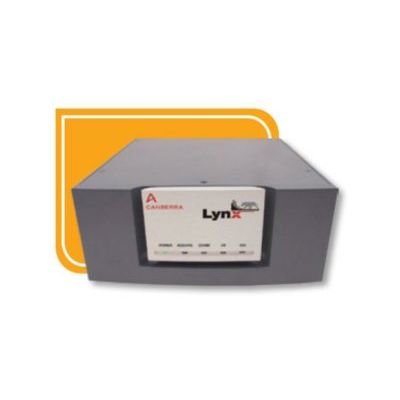
Model Lynx - Digital Signal Analyzer
The Lynx is the most advanced, full-featured Multichannel Analyzer ever offered. It is a 32K channel integrated signal analyzer based on advanced digital signal processing (DSP) techniques. When paired with the computer of choice, the Lynx becomes a complete spectroscopy workstation capable of the highest quality acquisition and analysis. The instrument supports a wide range of spectroscopy detector technologies such as HPGe, NaI(Tl), Lanthanum Halide, Si(Li), PIPS® , X-PIPS™ CdTe and Cd(Zn)Te. It also supports the unique energy ranges of all these detectors from 1 keV on up.
Radiochemistry Lab- Signal Processing(NIM) - Preamplifiers
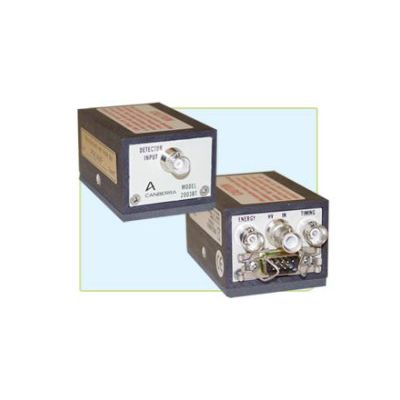
Model 2003BT - Silicon Detector Preamplifier
The CANBERRA Model 2003BT charge sensitive FET input preamp is designed for optimum performance with Silicon detectors such as the CANBERRA Passivated Implanted Planar Silicon (PIPS®) detectors and legacy Silicon Surface Barrier (SSB)detectors. Operating as a charge to voltage converter, the unit accepts charge carriers produced in the detector during each absorbed nuclear event. The output then provides a voltage in direct proportion to the collected charge at the rate of 0.45 V per pC. This translates to a gain of 20 mV per MeV for room temperature silicon detectors.