


Cell Technology products
Cell Viability Assays Caspase - Oxidative Stress Detection
Model NOS-200 - Oxidative Stress Detection
Key Benefits: Cell permeable. No wash homogenous assay. Adaptable to High throughput assay platforms. Real time detection of NO activity. Applications - Flow Cytometry, Fluorescence Plate Reader, Fluorescence Microscopy.
Cell Viability Assays Caspase - Mitochondria Membrane Potential
Model JC1 - Mitochondria Membrane Potential
Key Benefits: Cell permeability allow direct measurement of apoptosis and mitochondrial potential in live cells. Applications - Cells can be analyzed by Flow Cytometry, Fluorescent plate reader or Fluorescent microscopy. Incubate for 15 minutes, wash and measure. Add this reagent directly to live cells in your media of choice.
ELISA Products - Blocking Buffers

Model EBB100 - General-Purpose Blocker
Bottle Size: 100 mL, 500 mL, 1 L, 10 L. Increases the Sensitivity of the Assay. This is done by stabilizing the antigenic and functional regions of the absorbed protein. Reduces Background Noise. Block buffers inhibit nonspecific binding to uncoated regions of the plate and non-specific binding sections of the absorbed proteins. This leads to lower background noise and high specific signal. Increases Efficiency and Extends the Shelf-Life of the Coated Plates. With a longer shelf-life, plates may be prepared in large batches to be used over time. Large batch sizes will increase efficiency and reduce plate-to-plate variability to increase consistency. Conserves Valuable Reagents. By promoting a higher specific signal, less protein may be needed to coat the plate and less of the detection molecules may be needed to generate a signal when the proper blocker is used.
ELISA Products - 5x Coating Buffers
Model ECB100 - 5x Universal Plate Coating Buffer
Bottle Size: 100mL, 500mL, 1L, 10L. Saves valuable reagents. By promoting a higher specific signal, less protein may be needed to coat the plate and less of the detection molecules may be needed to generate a signal when this buffer is used. Increases the shelf-life of your plates. Depending on the activity of the coated protein, plates may be stored at room temperature or 2°-8°C for several months, or even years under proper conditions. Increases reproducibility. By using consistent reagents from a reliable source, your ELISAs may become more reproducible. Increases the signal of the ELISA. If the antibody or antigen is not sticking to the plate, or unwanted proteins are interfering with binding, the plate will have an overall low specific signal. CB1 may foster adsorption and reduce interference.
ELISA Products - 5x Conjugate Diluents
Model ECD605 - Conjugate Stock Stabilizing Reagent
Bottle Size: 100 mL, 500 mL, 1 L, 10 L. Increases the Sensitivity of the Assay. Decreases Backgrounds. Stabilizes Newly Conjugated Proteins. Also reconstitutes lyophilized conjugates and diluents concentrates conjugates. Prolongs the Shelf-Life of HRP-conjugated proteins and enhancing their utility in ELISA applications. Extends the Useful Titer of the conjugate. Conserves Valuable Reagents. By promoting a higher specific signal, less conjugate may be needed to generate a signal when a stabilizing conjugate diluent is used. Lengthens the Shelf-Life of conjugated antibodies for future use. With a longer shelf-life, conjugates may be prepared in batches for use in future plate coating runs. Using conjugates from the lot generally reduces inter-assay variability and increases consistency.
ELISA Products - Sample Diluents
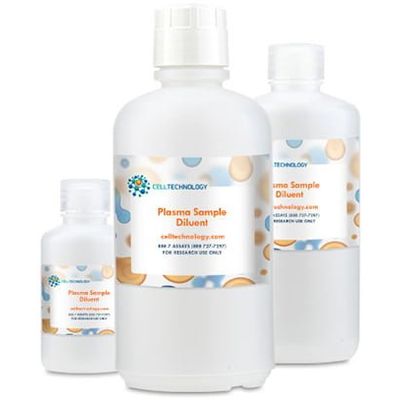
Model ESD200 - Plasma Sample Diluent (Antigen-Down SD)
Bottle Size: 100 mL, 500 mL, 1 L, 10 L. By accurately reading and quantitating high-titer samples. High-titer samples may overload the finite binding capacity of the coated ELISA plate surface, thus requiring dilution prior to testing in the assay.