


Ceramic Instruments s.r.l. products
Screening - Refining
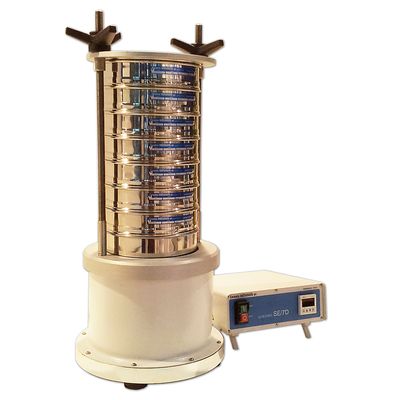
Ceramic - Model SE/7D - Laboratory Electromechanical Screener
Designed to carry out wet or dry screening tests. 3-D movement. Calibrated at 3000 strokes/minute Contains 7 screens, Ø 200 mm, 50 mm high plus bottom and cover (the number of screens can be increased by using 25 mm high formats). Control station in painted metallic container with general switch, on/off button, 0+99 min. electronic timer. Power input 230 V, single-phase, 50 Hz.
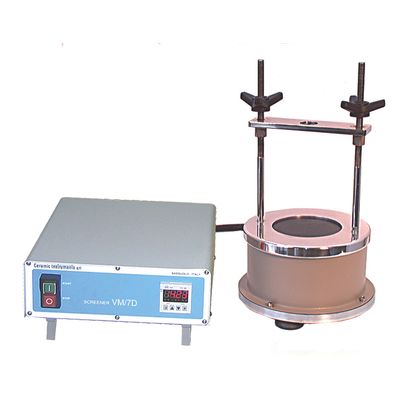
Ceramic - Model VM/7D - Laboratory Electro-Mechanical Screener
Small-size screener for wet and dry screening tests. 3-D movement. Calibrated at 3000 strokes/minute. Contains 7 screens, Ø 120 mm, 25 mm high, plus bottom and cover. Control station in painted metallic container with general switch, on/off button, 0+60 min. timer and signalling lamps. Power input 230 V, single-phase, 50 Hz. Other features: Base and internal mechanics in galvanised steel. Safety guard in stove-enamelled sheet metal, screen support in aluminium, columns in brass. Overall dimensions: 45x28x42 cm. Weight 16 kg.
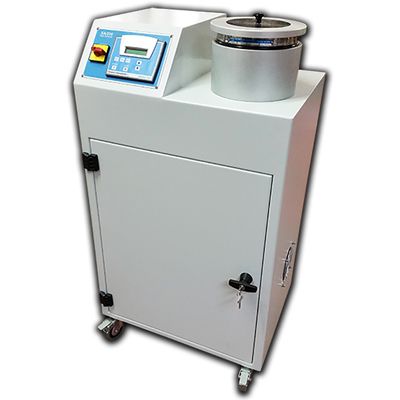
Ceramic - Model SA/200 - Laboratory Airjet Screener
This machine features an air flow which stirs the material while keeping the screen meshes constantly free. No mechanical action is used. The air flow is created by an electric extractor fan. A rotating bar located under the screen directs the flow onto the test material. The flow automatically seals the screen and the cover which are both fitted with suitable rubber gaskets. The material passing through the test screen is extracted and taken to the electric extraction fan filter. The screener works just with one 1 screen, ø 200 mm, 25 mm high (Supplied on request).
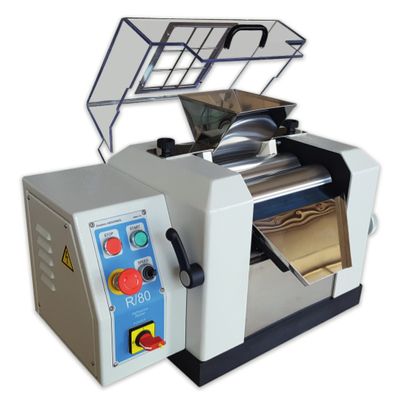
Ceramic - Laboratory Refining Machines With 3 Rollers
These refiners are suitable to prepare glaze mixtures for the ceramic industries or, for example, inks for silk-screen printing, but also widely used in various productive fields (chemestry, cosmetics, etc). The material is loaded in the hopper "4". After that, it is pulled through the gap between the rollers "1" and "2" where will be a first rough crushing owing to an increase of the speed. The material will be caught from the central roller "2". Subsequently the material will be crushed from the second pair of rollers "2" and "3": the raw product remains lodged against the roller "3" due to a further increase of the speed. A steel scraper "5" removes the material from the third roller transporting it through the slide where will be collected from a suitable container.