


- Home
- Companies
- City Makine
- Products
City Makine products
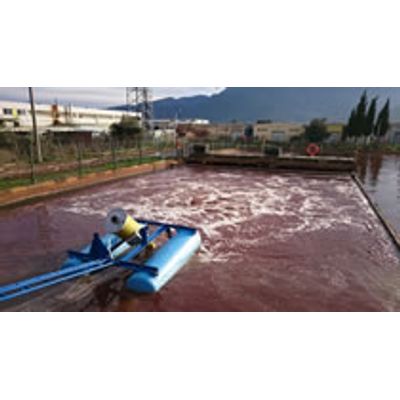
Aspirating Aerators
Aspirating aerators provide oxygenated air required for treatment in biological treatment units for domestic or industrial wastewaters. In recent years, aspirating aerators are more commonly used in our country than their equivalents such as brush aerators, surface aerators, or blower-diffuser systems. In typical projects of Ministry of Environment and Urbanisation (previous Ministry of Environment and Forestry), aspirating aerators are mostly preferred among aeration equipments. Aspirating Jet aerators (aerojet type) are quite efficient equipments compared to their equivalents due to their advantages in energy consumption, operating costs, and ease of operation etc. aspects. The aspirating aerators produced by City Makine are designed in accordance with our experience in biological treatment plants and they are manufactured together with the suitable apparatuses for the plant to be built.
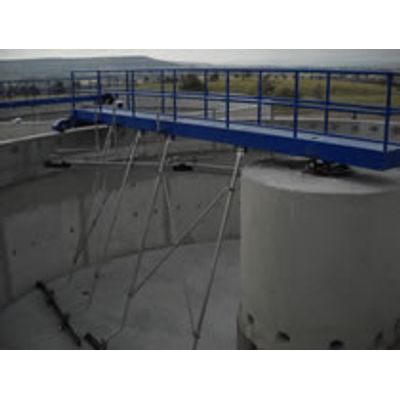
Rotating Half Bridge Scraper
Rotating bridge scrapers are used in preliminary settling and final settling tanks in order to prevent the settling chemical and biological sludge (activated sludge) from accumulating at the bottom of circular settling tanks and removal of the scum from the clarifier surface. Rotating bridge scrapers are also used for removing the layers of oil formed on the surface. Rotating bridge scrapers usually operate at a speed between 2-8 cm/second. Their reducer speeds and motor outputs should be selected appropriately. Our rotating bridge scrapers can be manufactured based on the diameter or the radius of tanks. Rotating half bridge scrapers consist of a central bearing, a bridge, scrapers, scraper pallets, and a drive group. The central bearing are equipped with ball-bearings that can carry all kinds of static or dynamic loads. Two types of rotating bridge scrapers can be manufactured, which are centrally-driven and peripherally driven scrapers.
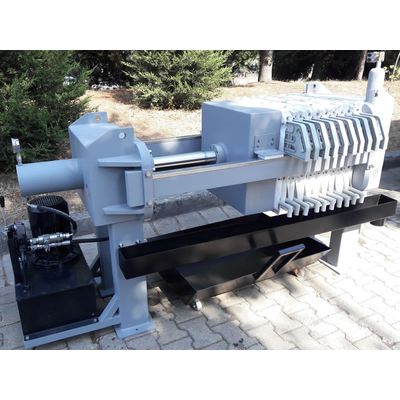
Filter Press
How Filter Press Works? Filter press operates by filtering of solid-liquid mixture sludge, fed by high-pressure pumps, through filter cloths covered over filter press plates, and thus accumulation of solid particles among filter plates and removal of the liquid phase out of the equipment. The cloths used in filter press equipments can be made of polypropylene, cotton, chopped fibre, or other raw materials according to the physico-chemical properties of the solid-liquid mixture to be filtered. The high-pressure pumps that feed materials to the filter press can be selected from air diaphragm pumps, mono-pumps, oil gear pumps, or lobe pumps. Pumps operating via centrifuge are usually not preferred in filter press systems. Dewatering ratio is higher in filter press equipment compared to its equivalents such as decanter and belt press equipments. Feeding is made by pressurizzed pumps in the form of plates compressed by high hydraulic pressure.
Primary Treatment
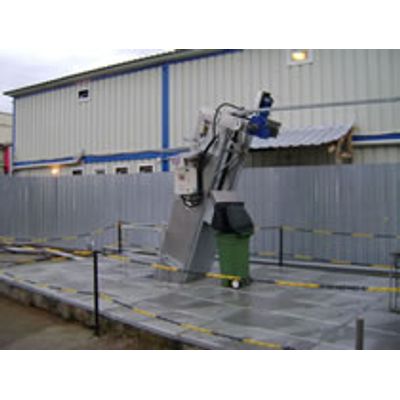
Mechanical Bar Screen
The equipment used for safely removing coarse & fine contaminants (dust, garbage etc.), in sewage treatment by screening, that are big enough to damage plant equipment is the bar type mechanical screen used at the water intake structures of treatment plants. Rake bar type screens are categorized into two classes as mechanical screens and manual screens according to working principle. Mechanical screens are called as fine screens and coarse screens according to the openings between bars. Besides wastewater treatment plants; mechnical screen is used in pumping stations and water supply structures. The equipment is mounted in open channels by an angle of 70-75 degree. While screens having 15 mm or less bar opening are called as fine screens, the screens having 15 mm or more bar opening are called coarse screens.
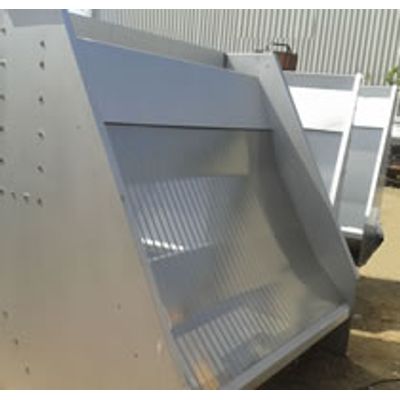
Sieve Bend Screen
Static sieve (static screen) also known as sieve bend is one of the fine screen equipments used in treatment plants. It is a physical treatment equipment operating by gravity, without the need for electrical energy, and used for separating 0.5-10 mm size of fine contaminants from wastewater coming from a location with potential energy difference or a pressurized pump line. For treatment of contaminants larger than 5 mm size, please visit our mechanical screen page. Instead of domestic wastewater treatment plants, it substantially prevents organic or inorganic contaminants originating from industrial wastewater treatment plants from entering into treatment plants and causing possible pump, equipment, and lifting/elevation malfunctions. It is especially used in wastewater treatment plants of recycling, food, textile, and paper&pulp industries.