


- Home
- Companies
- Comsol Inc.
- Software
Comsol Inc. software
Chemical Engineering Modules
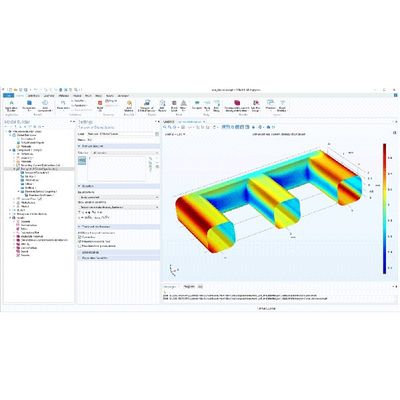
Fuel Cell & Electrolyzer Software Module
The Fuel Cell & Electrolyzer Module is an add-on to the COMSOL Multiphysics software for gaining a deeper understanding of fuel cell and electrolyzer systems, which is useful for designing and optimizing the electrochemical cells. The types of systems that may be studied include proton exchange membrane fuel cells (PEMFCs), hydroxide exchange (alkaline) fuel cells (AFCs), molten carbonate fuel cells (MCFCs), and solid oxide fuel cells (SOFCs), as well as the corresponding water electrolyzer systems. However, the module accommodates all types of fuel cells and electrolyzers.
Chemical Reaction Engineering Module Software
Mathematical models help scientists, developers, and engineers understand processes, phenomena, and designs of reacting systems. The Chemical Reaction Engineering Module, an add-on to the COMSOL Multiphysics® software platform, provides a user interface for creating, inspecting, and editing model equations, kinetic expressions, functions, and variables. After developing a validated model, it can be used for different operating conditions and studies, leading to new ideas as a result of the intuitive understanding of the relation between hypothesis and results. Solving the model equations over and over for different inputs leads to a true understanding of the studied system. Additionally, the Chemical Reaction Engineering Module, along with other tools in COMSOL Multiphysics®, is developed with optimization in mind, providing state-of-the-art mathematical and numerical methods adapted for chemical systems.
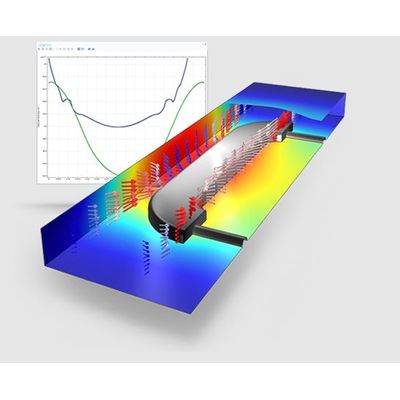
Comsol - Electrodeposition Module Software
Model and Control Electrodeposition Processes with the Electrodeposition Module. Decorative electroplating assuming secondary current distribution with full Butler-Volmer kinetics for both the anode and the cathode. The deposited thickness on the front and the backside of the piece is shown.
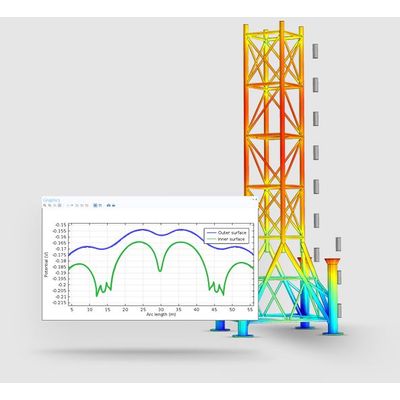
Comsol - Corrosion Module Software
Model Electrochemical Corrosion Processes and Cathodic Protection Designs with the Corrosion Module. A steel structure immersed in seawater is protected from corrosion through 40 sacrificial anodes. This example models the potential distribution at the surface of the protected structure assuming a constant limiting current for oxygen reduction at the protected surface.