


Custom Conveyor, A Division of Schwing Bioset products
Material Handling
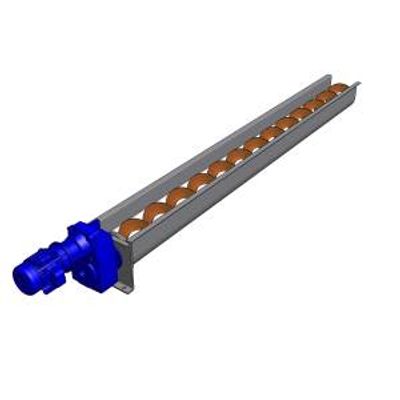
Shaftless Screw Conveyors
Shaftless spiral conveyors eliminate the central shaft and allow a much higher fill rate resulting in lower rpm’s, more efficient conveying and consequently less wear. Without a shaft, no intermediate or end bearings are required. The trough liner is the spiral’s replaceable bearing surface. The only machined bearings in a shaftless are in the gear reducer. This allows for direct connections and optimizes layout design flexibility. End-to-end and side connections not possible on shafted screw conveyors are common solutions available in the shaftless design. Vertical shaftless conveyors are available in a single unit up to 50 feet and systems in excess of 100 feet in elevation gain.
Shaftless Vertical Conveyors
Shaftless Screw Conveyors are ideal for vertical conveying. Since they do not require a non-drive end bearing this eliminates the need for high maintenance bottom shafts and seals on a pulling shaftless vertical conveyor. A shaftless vertical feed is obtained by directly connected pushing shaftless conveyor which optimizes layout design flexibility. Vertical shaftless conveyors are available in a single unit up to 50 feet and systems in excess of 100 feet in elevation gain. Our vertical shaftless conveyors are ideally suited for waste water dewatered sludge with dry solids content of 18% or greater.
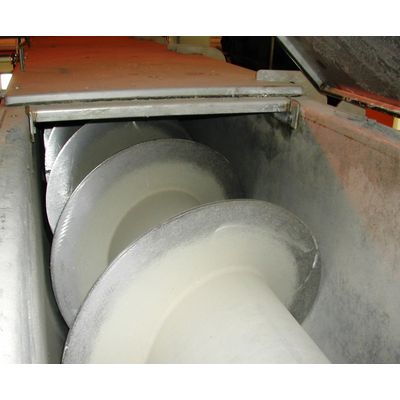
Shafted Screw Conveyors
Shafted Screw Conveyors date to Archimedes and are still one of the most widely used and simplest devices for the movement of material. Shafted screw conveyors are compact and easily adapted to congested layouts. Our Shafted Screw Conveyors efficiently convey dry to semi-fluid and free-flowing to sluggish materials. Screw conveyors are available in a wide variety of materials and US Conveyor Equipment Manufacturers Association (CEMA) sizes. Horizontal and inclined shafted conveyors are available. Special configurations include leveling, load-out, pivot and stacker designs.
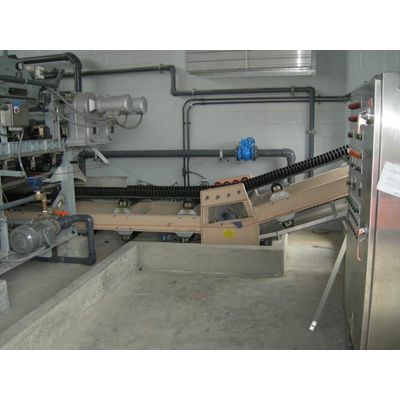
Trough Belt Conveyor
Trough Belt Conveyors are designed to leverage the open frame and trough effect of the rubber belt to fully contain the load of materials. Trough belt conveyors are the most widely used and efficient means of moving bulk materials because they are manufactured to: Convey high tonnage of materials. Handle a gradual curved concave or convex incline path over long runs. Convey horizontal and up to 28° straight incline depending on product. Require very little maintenance.
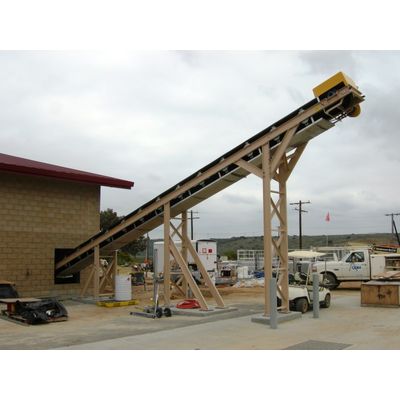
Sidewall Belt Conveyors
Sidewall Belt Conveyors feature integral corrugated sidewalls that keep the product on the belt. Multidirectional sidewall belt conveyors are an option to utilize one conveyor drive that changes from horizontal to an incline plane and back to horizontal.
Storage Systems
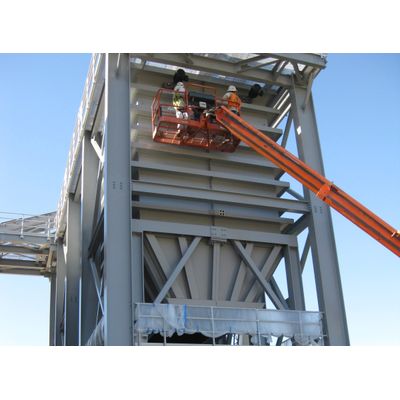
Hoppers for Storage System
Hoppers are free standing square or rectangular in shape. Hoppers vary in size from small to very large capacity. Elevated Storage type live bottom conveyors are utilized for truck load out or process distribution. eceiving type are usually below grade to receive product dumped by truck and utilize live bottoms feeding a vertical or inclined conveyor to move product to a higher elevation.

Silo for Storage Systems
Silos are cylindrical in shape. Silos are usually large volume vessels and often have to be delivered in sections for site assembly due to shipping limitations. Live bottom conveyors are utilized for truck load out or process distribution. Dry lime utilizes volumetric or rotary feeders with a screw or pneumatic conveyors.
Gates
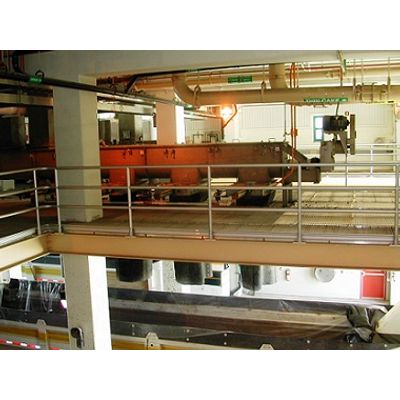
Load-out/Transfer Gate
Load-out gates are used for overhead, live bottom hoppers or screw conveyors where there is low overhead pressure. Typically, they are discharging into a storage device or another conveyor. They incorporate a minimum 1/4” gate blade. They may utilize ROLLER-cam followers with a compression seal to control material flow or alternately SLIDE on UHMW Polyethylene guides and seals.
Centrifuge Drain Gate
Centrifuge Drain gates permit diversion to drain of centrifuge low solids flow upon start up, then open to allow discharge of dewatered solids to the conveyor inlet. They incorporate a minimum 1/4” blade riding on roller cam followers with a compression seal to control material flow. The centrifuge drain gate is typically controlled with electric or pneumatic actuators.
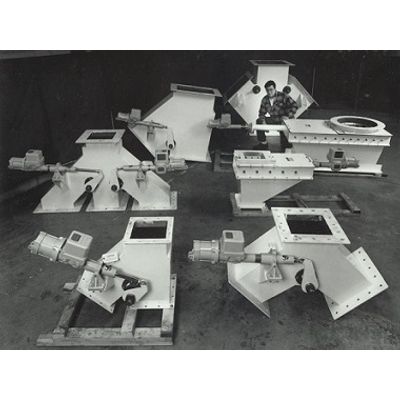
Bifurcated Diverter Gate
Bifurcated Diverter gates typically divert vertical free flow of material from one source to a choice of two other points. It is often utilized in redundant or multi-destination conveyor systems. Because this is usually achieved with a 90o flap type gate blade, an electric one quarter turn actuator is often used for simplicity.