


- Home
- Companies
- Datawell BV
- Products
Datawell BV products
Mooring
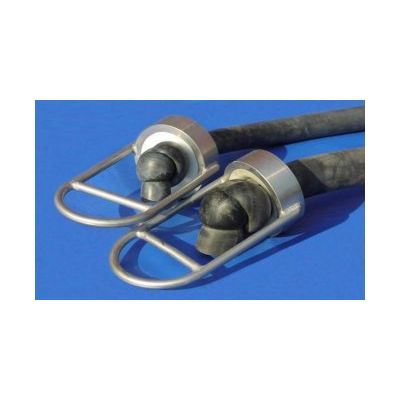
Datawell - Rubber Cords
The Datawell rubber cords originally designed to make a flexible mooring for the Datawell Waverider and Directional Waverider buoys have found many maritime applications. Nowadays rubber cord mooring ranges from small spar buoys via large navigation buoys to pontoons. Keeping pace with the extension of application the variety of diameter and elasticity of the rubber has been expanded over the years. All rubber cords are made of natural rubber, known for its excellent abrasion, tear strength and creep properties. The standard rubber cord is made of rubber with a hardness of 45 Shore A, a maximum elongation of 400 % (resulting in a total length of 5 times the original length λ = 5). The rubber itself has a maximum elongation of at least 500 %. Datawell has rubber cords of different diameters (27 and 35 mm) with a hardness of 45 Shore A.
Datawell Motion Sensors
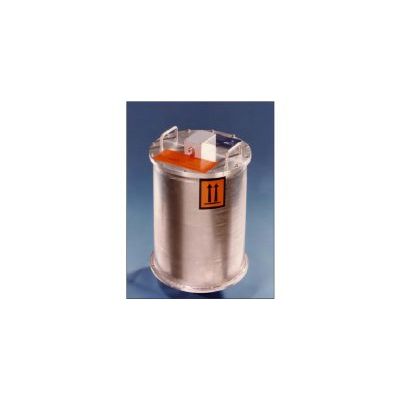
Datawell - Wave Unit
The Datawell Wave unit is an OEM version of the well-known Directional Waverider Mklll for measuring wave-motions in three directions. The unit gives out the real time heave, north and west displacements as well as common wave parameters like Hs and Tz and spectral data.The Wave unit is built around Datawell`s accurate and well-proven stabilized platform sensor, enabling wave height measurements by a single accelerometer. For the wave direction, direct pitch and roll measurements are performed needing no integration. In combination with horizontal accelerometers and a compass this forms the complete sensor unit, the heart of the Wave unit. The Wave unit is essentially a DWR-MKIII Waverider buoy in an OEM package. It is meant to be integrated as a complete sensor package in oceanographic and meteorological buoys.
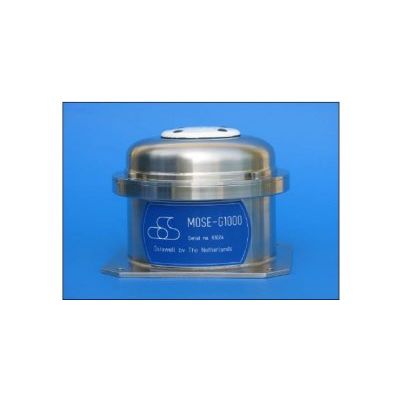
Datawell - Model MOSE-G1000 - GPS Based Motion Sensor
The MOSE-G1000 measures its three-dimensional motion in 3 frequency regimes where each regime has its own precision. Centimetre precision is achieved in the high frequency regime (1-100 s periods). Here the MOSE-G1000 works just like the Datawell DWR-G directional wave buoys. For very low frequencies the GPS position is output every 10 seconds with a precision of several meters. In addition to these high and very low frequency regimes the MOSE-G1000 covers the low frequency regime (10-1000 s periods) in between. In this regime the precision amounts to several centimetres depending on the filter selected.
Receiver
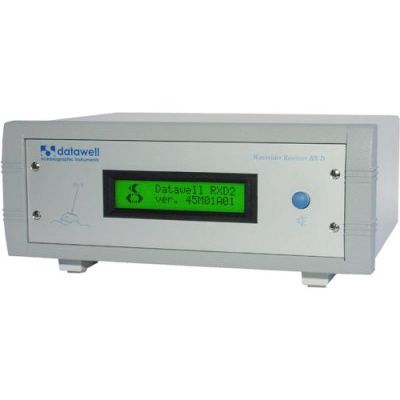
Datawell - Model RX-D - Directional Waverider Receiver
Receiver for the Directional Waverider® and the WR-SG, compact: 230 x 100 x 200 mm (W x H x D), dedicated, and transparent data transfer, backlit LCD display shows signal quality, increased dynamic range and more forgiving to noise and interference, crystal tuned, radio range 50 km, RS232 interface for connection with a PC
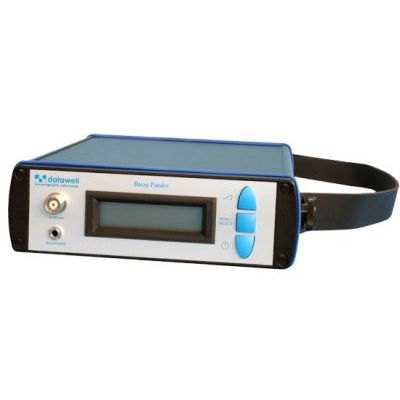
Datawell - GPS Buoy Finder
Receiver for the Directional Waverider® and the WR-SG, portable, specially designed for buoy rescue operations, based on the RX-C receiver, operates from four standard 1.5 V AA-batteries, 25.5 - 35.5 MHz, electronically tuneable reception frequency (PLL + DDS), special data collection algorithm for high reliability, displays GPS position of buoy on a 32 character LCD display, radio range line of sight (max 10 km) with flexible short antenna, and 50 km with standard receiving antenna, headphone output for listening to HF audio signal, possiblity for tracking a Waverider without GPS when using a directional antenna
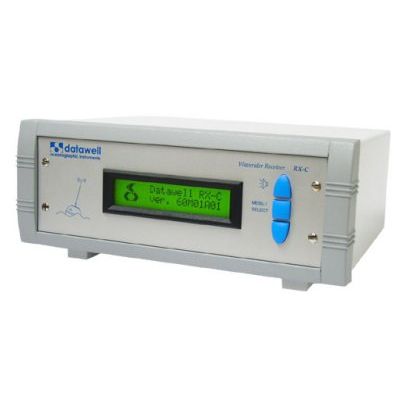
Datawell - Model RX-C - Directional Waverider Receiver
Receiver for the Directional Waverider® and the WR-SG, in addition to the serial port, featuring an Ethernet network port, for direct connection to a corporate LAN or an internet router, a built-in embedded web server enables remote monitoring and configuration, compact: 230 x 100 x 200 mm (W x H x D), dedicated, and transparent data transfer, backlit LCD display shows signal quality, increased dynamic range and more forgiving to noise and interference, 25.5 - 35.5 MHz, electronically tuneable reception frequency (PLL + DDS), memory for 6 different buoy frequencies, radio range 50 km, RS232 interface for connection with a PC, low power makes battery supply practical (optional)
Buoys
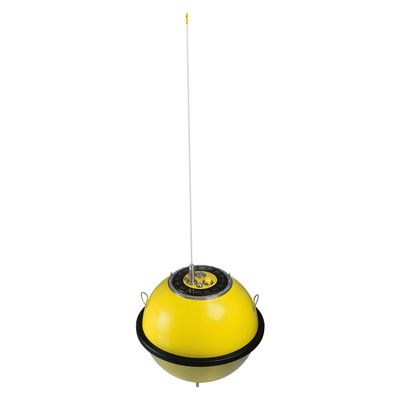
Datawell - Model 4 - Directional Waverider
The Directional Waverider that integrates wave and current measurements. The wave sensor of the Directional Waverider equipped with the Acoustic Current Meter option (DWR4/ACM for short) is identical to the sensor in the well-known Directional Waverider MkI, II and III. Processing of the measured data is now performed at the doubled sample frequency of 2.56 Hz. The high frequency limit of the heave and direction signals is shifted from 0.58 to 1.0 Hz. With this choice, the high frequency limit of the wave buoy is determined by the hydrodynamic response of the hull, not by the onboard instrumentation.
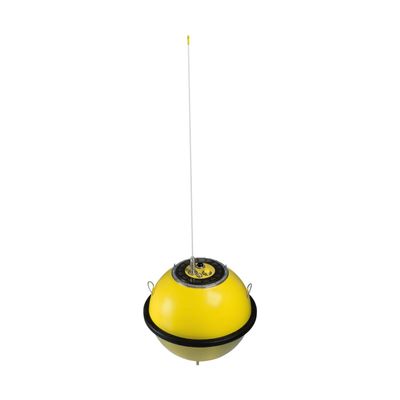
Datawell - Model MkIII - Directional Waverider
The Directional Waverider DWR-MkIII: Three years of continuous operation. The Directional Waverider hardly needs any introduction: it is the world’s standard for measuring wave height and wave direction. Its success is due to the proprietary well-proven and accurate Datawell stabilized platform sensor, enabling wave height measurements by a single accelerometer. For the wave direction, direct pitch and roll measurements are performed needing no integration. In combination with horizontal accelerometers and a compass this forms the complete sensor unit, the heart of the instrument.
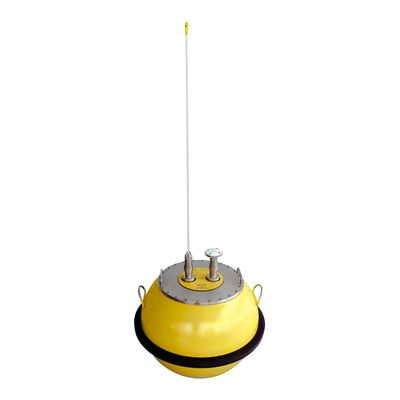
Datawell - Model DWR-G - Directional Waverider Buoys
Measuring waves with GPS. The DWR-G wave buoy measures waves with help of the Global Positioning System (GPS) only. It features a patented algorithm and custom-made GPS receiver. With a single stand-alone GPS receiver it can measure directional waves, up to 100 s periods, without any calibration ever, and even in the middle of the ocean.
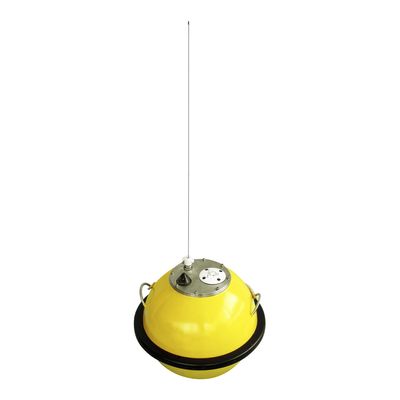
Datawell - Model DWR-G4 - Wave Monitoring Buoys
Datawell’s smallest directional wave measuring buoy. With a 0.4 m diameter mini-buoy version Datawell completes its range of GPS buoys: DWR-G9, DWR-G7 and DWR-G4, with 0.9 m, 0.7 m and 0.4 m diameters, respectively. Just like its larger equivalents the DWR-G4 relies on the Datawell principle of measuring waves with a single Global Positioning System receiver (GPS). By now this technique is well-established in oceanography as evidenced by several publications and well-pleased users in the field.