


Ebner GmbH & Co. KG products
Crystallization Plants
Cooling Crystallization Plants
Cooling crystallization is mainly used for salts with a decreasing solubility at decreasing temperature. An almost saturated solution enters the crystallizer K or its circulation line. Here, it mixes with the circulated solution and is only slightly cooled in the cooler WT, so that spontaneous germ formation and encrustation of the tubes is minimized. In the crystallizer K, supersaturation is then reduced by crystal growth. From there, the suspension is pumped to the cyclone ZY with the suspension pump SP for thickening. The liquid is then separated in the centrifuge Z. The salt is dried in dryer T.
Vaporization Plants and Evaporation Plants
Ebner - Vapour Compression Evaporation Plant
Flash Evaporation Plants
The vapour steams produced in the evaporator when the solution is flashed are used to preheat the circulating solution. At the end of preheating, the energy is supplied in the form of exhaust steam and/or live steam.
Truebner - Builds Evaporation and Vaporization Plants
EBNER builds evaporation and vaporization plants for the concentration of highly corrosive salt solutions, acids, alkalis, production waste waters and organic liquids. EBNER has valuable experience gained with various media.
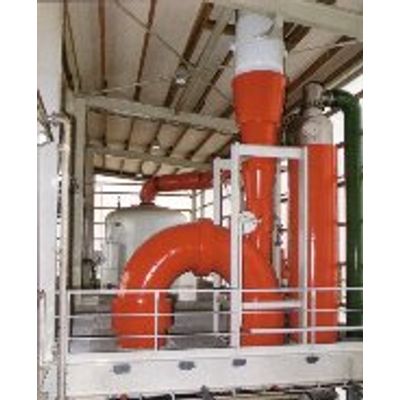
Evaporation Crystallization Plant
If the solubility of the salt changes only a little at fluctuating temperatures the evaporation crystallization preferably finds application. This process is the crystallization of a solution by vaporizing the solvent by the supply of heat. The special design of the evaporation chamber makes is possible to operate the evaporation crystallizer as classifying crystallizer. In this case the crystals are separated by classification according to size in a sedimentation zone. The coarse portion may be discharged through an extra outlet while the fine portion remains in suspension.
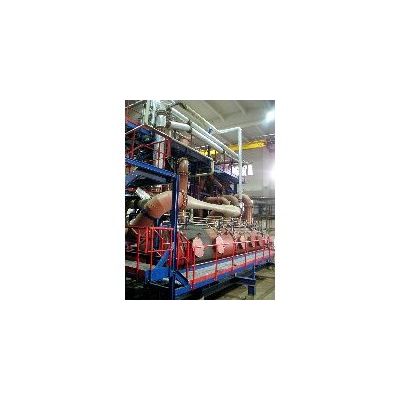
Vacuum Crystallization Plant
In this type of crystallizer the crystallization is effected by cooling a solution or melt by the adiabatic evaporation of the solvent at pressure decrease. Hence no surfaces to serve the heat exchange are needed which are susceptible to incrustation in case solutions, separating salts, are handled and thus the performance of the plant decreases. Consequently the demand for an operation with large cleaning intervals is met. Vacuum crystallization plants may be designed single-stage and multi-stage. Application of steam ejectors, application of refrigerating agents (refrigerating machines), use of sulfuric acid of soda lye as condensation agent.
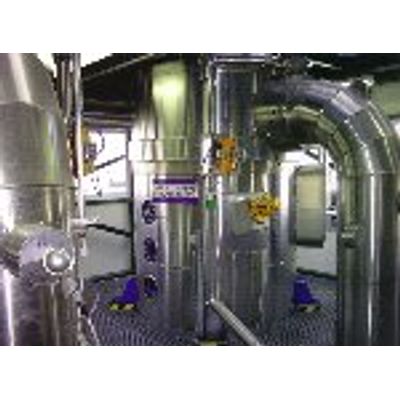
Melting Crystallization (Calcination) Plant
At crystallization a number of salts which precipitate contain crystal water, i.e. water molecules are included in their crystal system. These molecules have to be removed in order to allow a further utilization of the salt. A typical example is glauber`s salt (Na2SO4 x 10H2O). Under normal pressure it melts already at low temperature in its own crystal water.
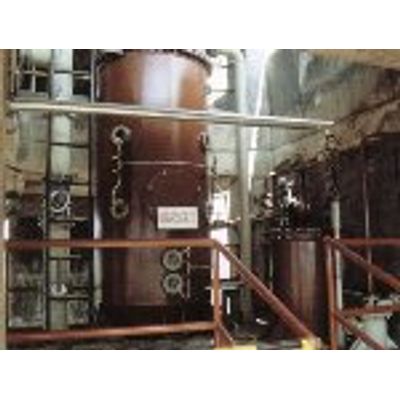
Degassing Plant
In many processes of the chemical industry hydrous solutions are enriched with gas which is found to be troublesome when re-using the solution (e.g. spinbath in viscose fiber factories). There are different methods of degassing solutions. Ebner developed the degassing in vacuum being one of the optimum variants.
Steam Ejectors / Steam Jet Pumps
EBNER manufactures steam ejectors and steam jet pumps which find application in their own plants and in plants of other plant constructors.
Plant System