


- Home
- Companies
- Fox Equipment, LLC
- Products
Fox Equipment, LLC products
Dampers

Louver Dampers
Louver Dampers are used for two functions; control and/or isolation. There are four standard types: Parallel, Opposed, Double, and Tandem Louvers. Each louver has a row of blades that are used to control or isolate the gas flow of any process system. The key advantages of the louver damper include its fast operating speed and minimum perimeter clearance requirements.
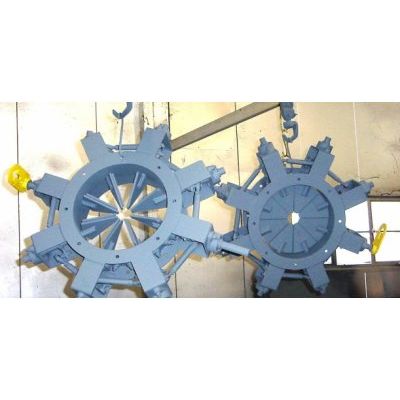
Fox Equipment - Radial Vane / VIV / IVC Dampers
Radial Vane /VIV /IVC Dampers provide additional flow control for fan inlets. Radial Vanes also provide pre-spin of the air into the fan. Starting the fan while the damper is in the closed position allows for a low horsepower startup. Fox Equipment supplies all radial vane dampers with a cantilevered blade design complete with two external bearings thus eliminating the need for blade support and bearings in the gas stream. Fox Equipment also has a cantilevered conical design for FD fan applications.

Poppet Dampers
Poppet Dampers are ideal for applications that require quick cycling time and tight shut-off. Poppet dampers provide isolation capabilities for bag house applications and incineration systems. Poppet dampers are used for multi-directional airflow control. They are engineered to control the reverse gas flow, outlet flow, and bypass flow of gases, in turn enhancing filtration, eliminating gas starving and reducing bag wear.
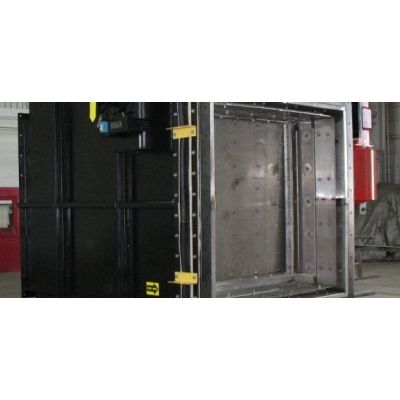
Diverter / Flap Dampers
Diverters /Flap Dampers are primarily used in gas turbine applications with heat recovery steam generators (HRSG). A diverter damper is designed with one inlet and two outlets. The outlets are normally at right angles from each other. The blade pivots from one end rotating 90 degrees to close off one of the two outlets. This system always allows for an escape route for the flue gas, therefore protecting any upstream equipment from bottlenecking the turbine. Diverters can be supplied in a low leak or zero leak application. They are perfect for clean applications that require low-pressure drop and good isolation.
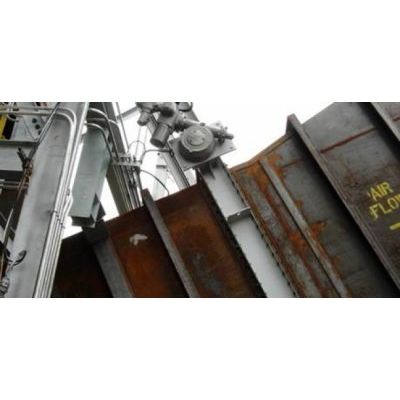
Guillotine / Slide Gate Dampers
Slide Gate or `Guillotine` Damper are most commonly specified when isolation is the primary function of the damper. Guillotines are classified in two styles: Low Leak and Zero Leak. Both styles are ideal for a high degree of isolation while providing low pressure drop when the dampers are in the open position.
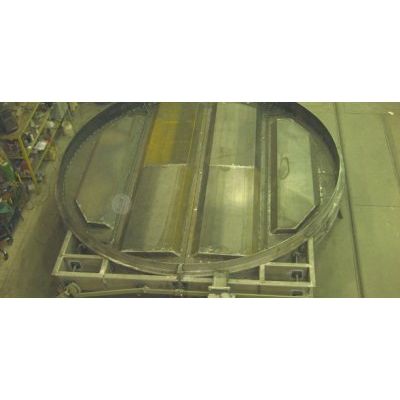
Stack Isolation Dampers
Stack Isolation Dampers provide accurate airflow and isolation at extremely elevated temperatures. These dampers function to reduce the stack effect of a system when it is off line and to protect ductwork from the elements, such as rain water.
Fox Equipment - Fabric Expansion Joints
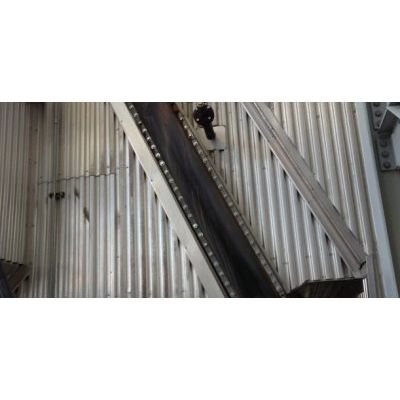
Fabric Expansion Joints are primarily used to relieve the stress caused by constant or enduring system movement. Fox Equipment manufactures a complete array of fabric expansion joints. Our expansion joints can be mounted directly on our dampers, when shipping, to minimize field erection cost.

Fox Equipment - Noise Consulting & Sound Enclosures
Fox Equipment`s Engineers have the capabilities to design custom noise reduction solutions. These solutions have been incorporated into Firing Ranges, Testing Rooms, and Engine Enclosures. With the use of passive silencer technology, the Fox Equipment Engineers can reduce noise levels to meet the environmental requirements of your area.
Industrial Louver Dampers
Fox Equipment - Parallel Louvers Dampers
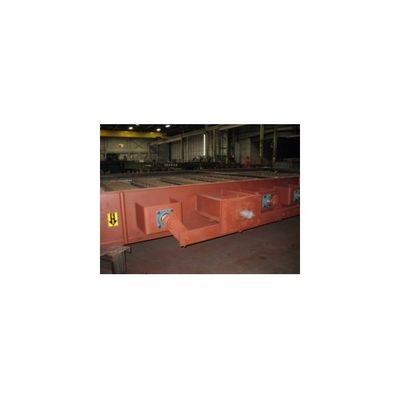
Parallel louver dampers are primarily used for isolation applications. All of the blades rotate in the same direction. With the addition of blade seals, this damper can achieve better than 99% shut off. Parallel blade louvers are also used on inlet boxes of large industrial fans to promote pre-spin to the in rushing air, thus enhancing fan performance.
Fox Equipment - Opposed Louvers Dampers
Opposed louver dampers are used for process gas control. The louvers function by rotating adjacent blades in opposite directions. (One clockwise, the next blade counterclockwise) Operating the blades in this manner gradually decreases or increases the cross-sectional area between the blades during operation. This gradual change in area allows this louver to have reasonably good air control features.