

- Home
- Companies
- gempa GmbH
- Software
gempa GmbH software
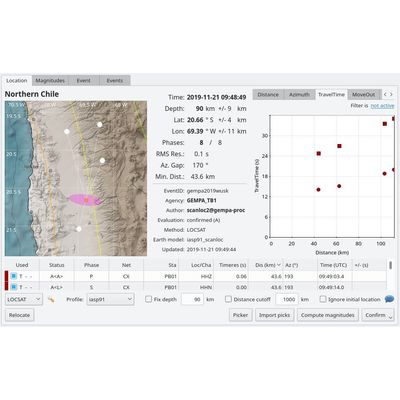
SeisComPro - Professional Monitoring of Local, Regional and Teleseismic Seismicity System
SeisComPro provides extensions to the SeisComP community package distributed by gempa GmbH and GFZ Potsdam to fulfill the requirements of earthquake and industrial microseismicity monitoring. It ships with modules tailored to enhance monitoring of local, regional and teleseismic natural earthquakes, explosions and induced seismic events: scanloc: for cluster-search based monitoring of earthquake in high-seismicity regions. Unlike scautoloc scanloc considers picks from P and S phases. ccloc for detecting and discriminating events applying template-based cross-correlation of waveforms sceval for discriminating real seismic events from erroneous or fake events which may occur during very-low threshold monitoring. GAPS / WebApps for accessing SeisComP system through a web browser from any system anywhere on Earth. GAPS allows to process waveforms and to visualize events, monitoring networks and data replacing the standard SeisComP GUI applications.
Compute and Analyze Moment Tensors
The focal mechanism of an earthquake describes the inelastic deformation in the source region that generates the seismic waves. In the case of a fault-related event it refers to the orientation of the fault plane that slipped and the slip vector and is also known as a fault-plane solution. Focal mechanisms are derived from a solution of the moment tensor for the earthquake which itself is estimated by an analysis of observed seismic waveforms. The moment tensor solution is typically displayed graphically using a so-called beachball diagram. The pattern of energy radiated during an earthquake with a single direction of motion on a single fault plane may be modeled as a double couple which is described mathematically as a special case of a second order tensor (similar to those for stress and strain) known as the moment tensor. Our moment tensor inversion technique uses a combination of several seismic wave types, time windows and frequency bands carefully chosen based on event magnitude and station distance. Wave types include body waves, surface waves, mantle waves as well as the so-called ‘W-Phase’ (Kanamori and Rivera, 2008).
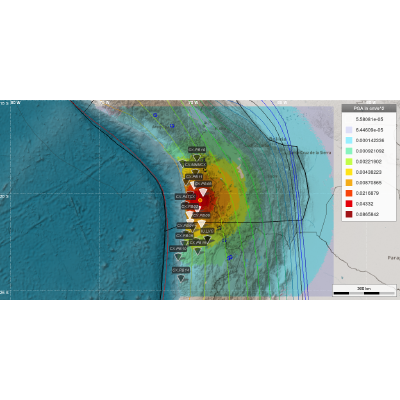
SIGMA - Intensity and Ground Motion Analysis
SIGMA and AUTOSIGMA compute and visualize strong ground motion parameters for earthquakes. The calculated parameters can be stored as incidents in a database and used to create customized reports. While AUTOSIGMA computes the strong motion parameters automatically based on a static configuration, SIGMA provides a highly flexible user-interaction through a modern and user-friendly graphical user interface (GUI).
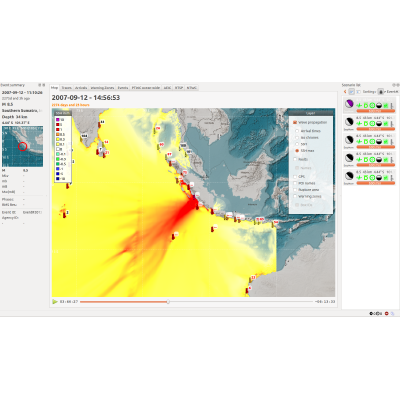
Toast - Tsunami Observation and Simulation
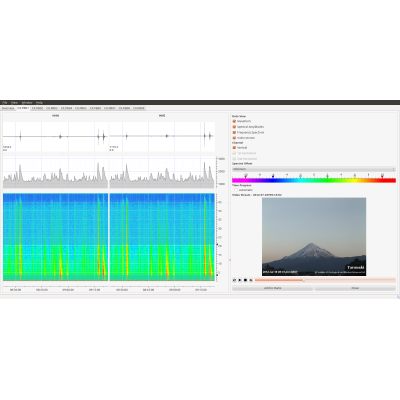
Vortex - Volcano Monitoring
VORTEX is our package for Volcano observation combining some of the most useful techniques of volcano monitoring like RSAM and SSAM. RSAM stands for Real-time Seismic-Amplitude Measurement. It represents the overall signal size over periods of 10 minutes. In situations when the number of earthquakes is so high that individual earthquakes can’t be seen, or the level of volcanic tremor is such that seismograms no longer show a change in signal level, then RSAM is an excellent way of showing changes with time. SSAM stands for Seismic Spectral-Amplitude Measurement. It shows the relative signal size in different frequency bands. Using SSAM it is possible to get an idea of whether a signal is produced by earthquakes, by wind or traffic noise, or by volcanic tremor. Earthquakes, wind and traffic noise all tend to have energy at a wide range of frequencies (a wide-band signal), while volcanic tremor tends to have energy in a more limited range of frequencies (a narrow-band signal). In addition to these two techniques VORTEX integrates also other sensor data like video data to provide a more complete picture of the ongoing situation.