


General Rubber Corp products
Single & Multiple Arch

General Rubber - Model Style 1101 - Single Wide Arch
General Rubber`s Style 1101 single (1) wide arch rubber expansion joints are designed to absorb large all-directional movements, reduce noise and vibration, have a cycle life in the tens of millions, compensate for misalignments, provide access to piping and equipment and relieve pipe and anchor stresses. Its spool type body is constructed with full rubber flanges, a high-grade leak-proof tube, multiple layers of high-strength tire cord, high tensile steel reinforcement, a seamless cover, and hot dip galvanized steel retaining rings. This construction, as a standalone expansion joint, represents the most cost-effective arrangement when used in rigid piping systems with main anchors (MA) and numerous guides at specific spacing. Control units can be externally or internally attached and used as limit rods for secondary restraint, or as tie rods when the support structure or adjacent equipment have load limitations.
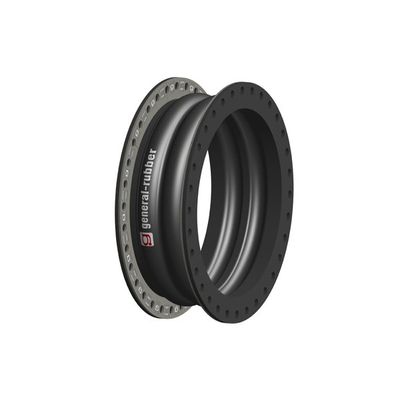
General Rubber - Model Style 1102 & 1202 - Double Wide Arch
General Rubber`s Styles 1102 and 1202, double (2) wide arch rubber expansion joints have twice the all-directional movement capabilities with half the spring rates of our single arch design. Additionally, they are designed to reduce noise and vibration, have a cycle life in the tens of millions, compensate for misalignments, provide access to piping and equipment and relieve pipe and anchor stresses. Its spool type body is constructed with full rubber flanges, a high-grade leak-proof tube, multiple layers of high-strength tire cord, high tensile steel reinforcement, a seamless cover and hot dip galvanized steel retaining rings.
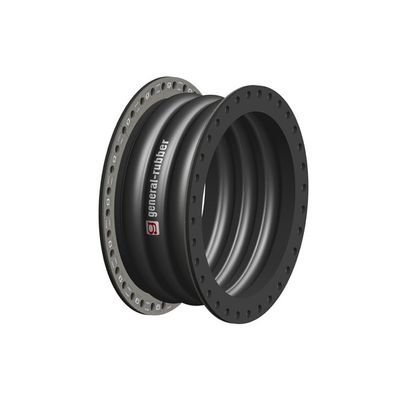
General Rubber - Model Style 1103 & 1203 - Triple Wide Arch
General Rubber`s Styles 1103 and 1203, triple (3) wide arch rubber expansion joints have triple the all-directional movement capabilities with one-third the spring rates of our single arch design. Additionally, they are designed to reduce noise and vibration, have a cycle life in the tens of millions, compensate for misalignments, provide access to piping and equipment and relieve pipe and anchor stresses. Its spool type body is constructed with full rubber flanges, a high-grade leak-proof tube, multiple layers of high-strength tire cord, high tensile steel reinforcement, a seamless cover and hot dip galvanized steel retaining rings.
General Rubber - Model Styles 8101, 8102, 8103 - Rubber Slip-On Sleeve
General Rubber`s Style 8101 single (1) arch sleeve type rubber expansion joints are designed with lower spring rates for reduced reaction forces and greater movement capabilities within a compact body. This optimally designed slip-on and lightweight construction represents the most cost-effective arrangement for low pressure applications. Mating flanges and hardware are not required, adding to the cost-effectiveness of this arrangement. The construction includes a high-grade leak-proof tube, a seamless cover, multiple layers of high-strength tire cord and stainless steel screw clamps. Additionally, they are designed to absorb large all-directional movements, reduce noise and vibration, have a cycle life in the tens of millions, compensate for misalignments, provide access to piping and equipment and relieve pipe and anchor stresses.
Completely Versatile

General Rubber - Model 1101CR and 1201CR - Concentric Reducing
General Rubber`s Styles 1101CR and 1201CR concentric reducing rubber expansion joints are an economical way to combine a reducing pipe fitting with an expansion joint. The two different flanged diameters have a common centerline. Additionally, they are designed to absorb large all-directional movements, reduce noise and vibration, have a cycle life in the tens of millions, compensate for misalignments, provide access to piping and equipment and relieve pipe and anchor stresses. Its spool type body is constructed with full rubber flanges, a high-grade leak-proof tube, multiple layers of high-strength tire cord, high tensile steel reinforcement, a seamless cover and hot dip galvanized steel retaining rings.

General Rubber - Model Style 1101ER - Eccentric Reducing
General Rubber`s Styles 1101ER and 1201ER eccentric reducing rubber expansion joints are an economical way to combine a reducing pipe fitting with an expansion joint. The two different flanged diameters have an offset centerline. Additionally, they are designed to absorb large all-directional movements, reduce noise and vibration, have a cycle life in the tens of millions, compensate for misalignments, provide access to piping and equipment and relieve pipe and anchor stresses. Its spool type body is constructed with full rubber flanges, a high-grade leak-proof tube, multiple layers of high-strength tire cord, high tensile steel reinforcement, a seamless cover and hot dip galvanized steel retaining rings.

General Rubber - Model Style 1100 - Rubber Flanged Pipes
General Rubber`s Style 1100 rubber flanged pipes are designed to absorb all-directional movements, reduce noise and vibration, have a cycle life in the tens of millions, compensate for minor misalignments, provide access to piping and equipment and relieve pipe and anchor stresses. Its archless spool type body is constructed with full rubber flanges, a high-grade leak-proof tube, multiple layers of high-strength tire cord, high tensile steel reinforcement, a seamless cover and hot dip galvanized steel retaining rings. This construction, as a standalone expansion joint, represents the most cost-effective arrangement when used in rigid piping systems with main anchors (MA) and numerous guides at specific spacing. Control units can be externally or internally attached and used as limit rods for secondary restraint or as tie rods when the support structure or adjacent equipment have load limitations.
Control Units

General Rubber - Control Units, Limit Rods & Tie Rods
Control units can be designed as limit rods or tie rods depending on the application. Their designs are based on the calculated thrust force of the rubber expansion joint at the specified pressure and can be attached to the external or internal hardware of the expansion joint. The arrangement can also include a combination of rubber grommets, flat or spherical washers, as well as internal limits for specific applications. The standard gusset plates are high-grade carbon steel with a hot dip galvanized finish, and the standard rods are high tensile steel with a hot dip galvanized finish. Stainless steel control units are also readily available, as are those made of alternative materials including, but not limited to, aluminum, bronze, and Teflon-coated hardware.
Advanced Restrained Expansion Joint Styles

General Rubber - Model Style 5100D - Dismantling Rubber Expansion Joint

General Rubber - Model Style 5100U - Universal Rubber Expansion Joint
General Rubber`s Style 5100U universal rubber expansion joints feature two resilient arch sections separated by a straight section to facilitate greater lateral movement capability. This single unit arrangement represents an effective solution for absorbing axial thermal movements from adjacent pipe runs. Additionally, they are designed to absorb large all-directional movements, reduce noise and vibration, have a cycle life in the tens of millions, compensate for misalignments, provide access to piping and equipment and relieve pipe and anchor stresses.