

HAMSAGARS software
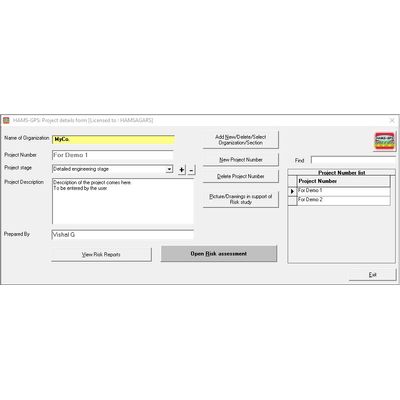
Machinery Risk Assessment Software
Machinery risk assessment is to locate and identify hazards, estimate and evaluate risks that may be reduced as much as possible. There are methods and tools available. The method or tool chosen will largely be a matter of industry, company or personal preference. The choice of a specific method or tool is less important than the process itself. The benefits of risk assessment come from the discipline of the process rather than the precision of the results: as long as a systematic approach is taken to get from hazard identification to risk reduction and all the elements of risk are considered. Adding protective/risk reduction measures to a design can increase costs and can restrict the facility of use of the machine if added after a design has been finalized or the machinery itself has already been built.
Dispersion with PROBITS
Plume, Puff, Spill Dispersions with tabular and graphic display with 5-User defined Isopleths in XY-Slice and Isoelevets in XZ-Plane at Y-Cross wind distance. Full 3-D “CAT-Scan” output possible with dispersion “Cake slicing in XY (Isopleth) and XZ (Isoelevet) Graphs. Graphics are in colour as Custom colour, Default colour or BW. It is a complete CAT-Scan with Probits (PROBIT short for Probability Unit, is the percent Fatality and Injury due to exposure to any hazardous agent.). This Advanced Dispersion provides for Mass and volumes of various concentration zones and concentration zone shells of Plumes, Puffs and Spill pool evaporation dispersions. Options for Conc. Conversion, computing: mol. Wt., IDLH-TWA & LEL-UEL of mixtures, LEL-UEL at any temperature, LC-50 of man from animal data, LC/RIC of mixtures, Weighted average, Temperature conversion and calculator.
Explosion Module
UCVE, Under Ground Explosions, Mechanical Explosions-Cylindrical Vessel, Spherical vessel, Pipe line ruptures, Inerting of flammable vapours, Vacuum purging, Pressure purging, Sweep purging, Static charge in Pipelines, Static charge on Persons, Dust explosion, Fire Balls with PROBITs, Ignition/No-Ignition and Explosion Chances onsite, offsite, TNT-Equivalent and Heat of Combustion of Dusts, Energy per Mass in different units, Explosion mass of Plumes, Puffs and Spill Pool Evaporations, All Graphic Displays are in colour as Custom colour or Default colour or BW. Options for TNT-Equivalent, Weight conversion and Calculator.
DOW / MOND-Index
This Module covers both DOW and MOND Indexing Software. These constitute a system of indexing the Fire & Explosion and Toxicity levels so as to categorize plant sections in to different Levels of Hazard Zones involving Fire & Explosion and Toxicity hazards. These software make use of Operational, Storage Quantities and Parameters like Temperature, Pressure etc. and the Hazardous Properties on Fire/Explosion and Toxicity of the individual Chemicals handled and provides for Penalties for each Parameter of Operation/Storage and Handling of the Chemicals. The Penalties are grouped in to General Process Hazards (GPH), Special Process Hazards (SPH) etc. These Penalties are then Reduced to a Standard Index for comparing the relative levels of Hazards of different sections of Plants.
SWOT Analysis
SWOT short for Strengths, Weaknesses, Opportunities and Threats is a well-known Top management strategy building technique that has been widely used in marketing, administration and production. This technique is applied for the first time in EHS Management very successfully and widely tested and results applied with excellent effects. The SWOT programme has built in parameters of EHS-Excellence and rating controls. The output is quantitative rating with MIS-Reports for EHS-Strategy building
Safety-Audit
|
International Standard Scale Safety Performance Rating (ISSPR) based on the model developed by the Chemical Industries` Association UK. Six-Sigma Accident Prevention. on the model developed by the Chemical Industries` Association UK. |
Environmental Impact Assessment (EIA)
|
Environmental Impact Assessment (Gaussian dispersion air modeling) fully conforming to “Assessment of Impact of Air Environment: Guidelines for Conducting Air Quality Modeling”, Programme Objective Series: PROBES/70/1997-98. The Program has 2-[Options: 1. Hourly EIA and 2. Long Time EIA. The Hourly EIA covers Stack Dispersions under Stability Class for data used and includes 11-Stack Gases covered under Ambient air Quality Monitoring Standards Published in Gazette No-660 dated 16th November, 2009 namely: SO2, CO2, NO2, CO, CH4, SPMOptions for Temperature conversion and Calculator. |
High Way Pollution.
| Enables computation of High way Pollution based on Number of 2-Wheelers, 3-Wheelers, 4-Wheelers, 6-Wheelers passing through at a given stretch of a High Way. |
Advanced Air Dispersion Modeling
Advance Air, stack gas dispersion (Gaussian dispersion air modeling), fully conforming to “Assessment of Impact of Air Environment: Guidelines for Conducting Air Quality Modeling”, Programme Objective Series: PROBES/70/1997-98, The Program -[Options: any Time EIA. covers Stack Dispersions under Stability Class for data used and includes Stack Gases covered under Ambient air Quality Monitoring Standards Published in Gazette No-660 dated 16th November, 2009 namely: SO2, CO2, NO2, CO, CH4, SPM<=10 mcr, SPM<=2.5 mcr, Pb, O3 with Standards under Industrial, Domestic and Sensitive locations