


In-Tox Products, LLC products
Aerosol Conditioning
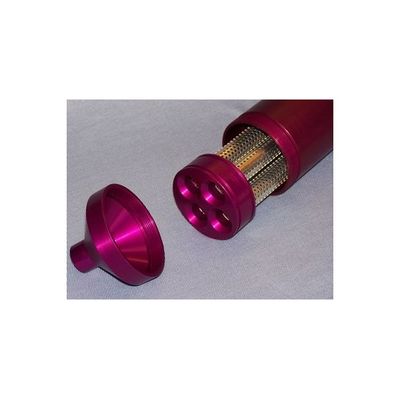
Quad-Track Diffusion Dryer
Many test articles are solubilized or suspended in an aqueous vehicle for aerosolization with nebulizers and other atomizing devices. This may produce larger than desired particle size distributions and increase the relative humidity in the inhalation exposure chamber or aerosol sampling system. To mitigate these phenomena, In-Tox Products developed the Quad Track Diffusion Dryer.
In-Line Mixer for Aerosol Conditioning Device
The In-Line Mixer is an aerosol conditioning device that introduces clean, compressed air into the aerosol stream in a laminar manner. As air is added, it dilutes and gently mixes the aerosol. The aqueous fraction of the test article is driven into the vapor phase resulting in a dryer, more stable aerosol. The In-Line Mixer is an excellent choice to use in conjunction with the Quad Track Diffusion Dryer to remove the vaporized aqueous fraction and reduce the relative humidity in the system.
Radial Mixer for Aerosol Conditioning Device
The Radial Mixer is an aerosol conditioning device that introduces clean, compressed air into the aerosol stream in a rotating manner. The Radial Mixer provides more mixing action than the In-Line Mixer and it also produces a dry, stable aerosol by driving the aqueous fraction of the test article into the vapor phase. To avoid turbulent flow, the Radial Mixer should not be operated at a volumetric flow rare greater than approximately 10 L/min.
Dry Powder Aerosol Generators
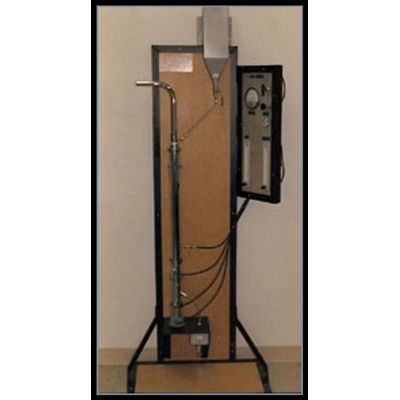
Fluidized Bed Aerosol Generator
The Fluidized Bed Aerosol Generator (FBAG) has been a useful method of generating aerosols from powders or dusts. Observations of particle deposition patterns in inhalation exposure systems with and without a Kr aerosol discharge device suggested that the aerosolized particles may carry a large number of electrostatic charges. Measurements of average charge carried by aerosols generated from an FBAG were performed for a variety of aerosolized materials. It was found that average charge per particle was higher for insulators than for metals and increased with increasing fluidization airflow for most materials. Also, the charge level was found to be changed with the length of operating time.

Venturi Dry Powder Dispensor
The Venturi style dry-powder generator has air entering into one end of the venturi. The powder is fed into the narrowed throat of the venturi by the pressure differential. A funnel that is attached to the body of the venturi holds the powder supply. Then, shear flow disperses the powder into an aerosol in the expansion section. The total flow and the feed flow are functions of the compressed air pressure. The flow rate downstream of the Venturi tube is measured using a dry test meter.

Reciprocating Dry Powder Aerosol Generation System
The Reciprocating Dry Powder Aerosol Generation System uses a pneumatic driven device that can be operated in continuous or single puff configurations. A slide bar is actuated into fill, load, and dispersion positions. The actuation rate, volumetric airflows and pressures are set and monitored using a differential pressure orifice meter and a LabVIEW-based Control Platform.
Exposure Equipment Options
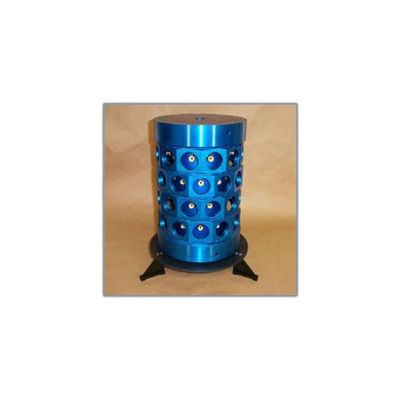
Nose Only Exposure Chambers
In-Tox Products (ITP) designs and manufactures nose-only inhalation exposure chambers used in research facilities throughout the world. Our chambers have demonstrated a superior performance that includes a rapid time-to-99% equilibrium concentration (T99), the lowest dead space (a measure of test article mixing) available, and an unmatched port-to-port (spatial) variation. Nose-Only inhalation exposure chambers manufactured by ITP were the first design to incorporate completely compartmentalized inlet and exhaust plenums. This directed flow feature eliminates “shared atmospheres” and minimizes rebreathing. They are recognized for their ability to deliver stable, well mixed test articles directly to the breathing zone of the test system.
Filtration
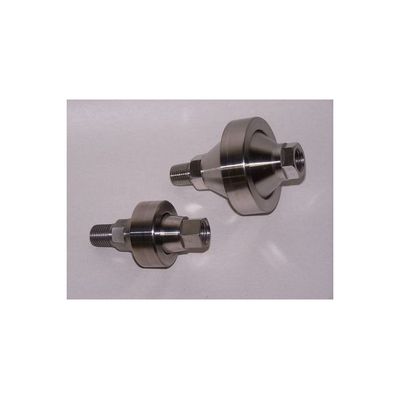
In-Line Filter Holder
An in-line filter holder holds either a 25 mm or 47 mm filter, depending on the model, in a fixed sample line. Filters are the primary standard used for determining aerosol concentration. Filters collect particulates by interception, inertial impaction, and diffusion as the aerosol is drawn through them. The sample flow rate is a calibrated flow. Filters are weighed before and after sample collection. The weight differential is determined: post sample weight – pre-sample weight. The volume of air sampled is calculated: sample flow rate x sample time. The quotient of differential weight and sample volume is the mass per unit volume aerosol concentration. Sample weight differential can also be determined by chemical analysis rather than gravimetrically.
Particle Samplers
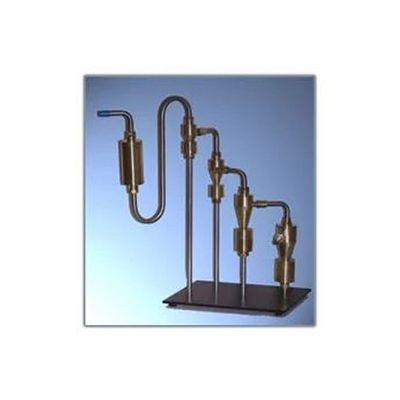
In-Tox Products - Cyclone Train
The In-Tox Products Cyclone Train is used to determine the particle-size distribution in process streams and to bypass the limitation of Impactors. Cyclone Samplers are advantageous for collecting large samples and in sampling aerosols of high particulate concentration. Cyclones are available in Brass or Stainless Steel and available with a Regular or Elongated Cup. The Cyclones may be purchase individually. A single Cyclone can be used as a pre-cut for a Cascade Impactor.
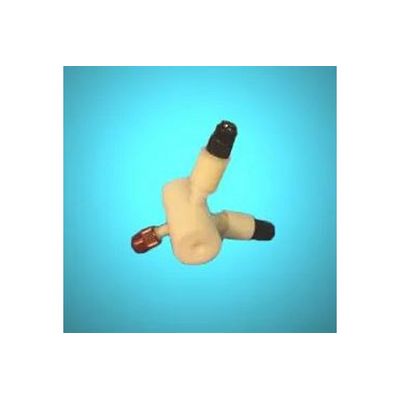
In-Tox Products - Combination Electrostatic Precipitator
The Combination E.S.P. has two collection grids and uses an electrode like the Point-to-Plane model. It uses the same standard transmission electron microscope grid as one collection surface and a 3/8” carbon planchet as the second collection surface for scanning electron microscopy. By symmetrically placing the electrode and collection surfaces, the single needle electrode charges particles to both collection surfaces. The recommended current charge and flow rate is the same, 3 microamperes and 100cc/min., as with the Point-to-Plane.