


JOMESA North America Inc. products
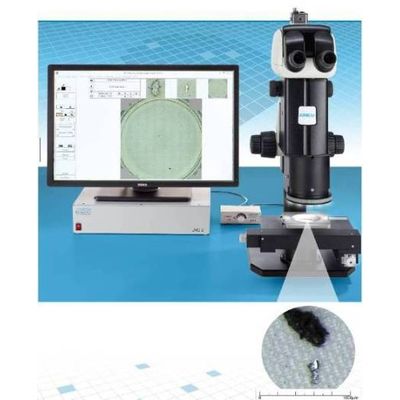
JOMESA - Model HFD - Automatic Filter Analysis System
Advanced technical products in automotive, aircraft and medical industries require clean components. Industrials standards like VDA Vol. 19 and ISO 16232 are the frameworks for cleanliness analysis.
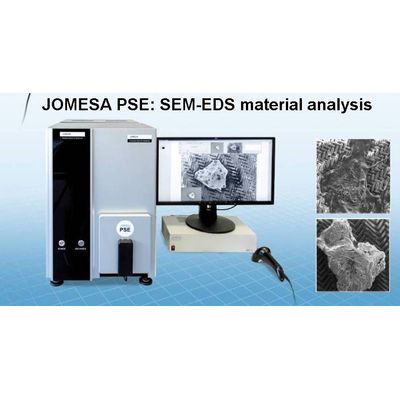
JOMESA - Model PSE - SEM-EDS Material Analysis
Advantages of correlative microscopy: Optical analysis is fast and cheap and shows the relevant particles. Optical system and SEM-EDS system use a common database. Both systems use the same software, the same user interface. Using the optical results a material (spectral) analysis of the relvant particles can be quickly achieved. Anaysis reports contain results of both systems.
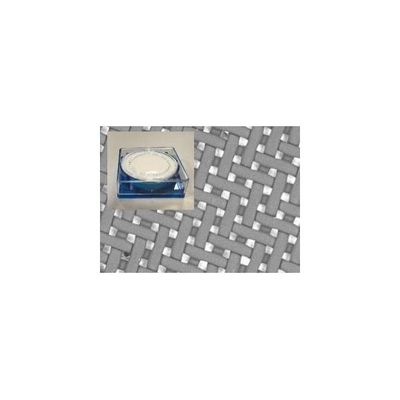
JOMESA - Lasercut Mesh Filter
Lasercut Mesh filter products: PET Filters, Polyamid (Nylon) Filters, Filter Dispenser.
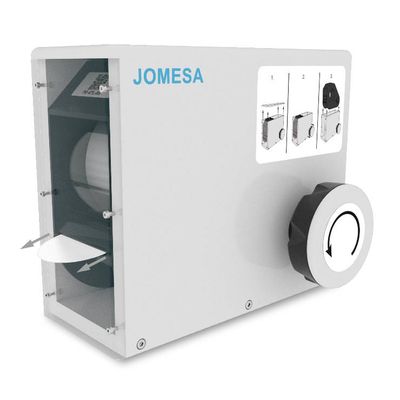
JOMESA - Filter Dispenser
Pulling out an individual filter from a stacked pack can be a fiddly work. The JOMESA Filter-Dispenser provides an user-friendly, safe and easy way to remove individual filters out of a cartridge. The cartridges are assembled in a cleanroom. After assembly there is no way of pollution the filters until dispensing.
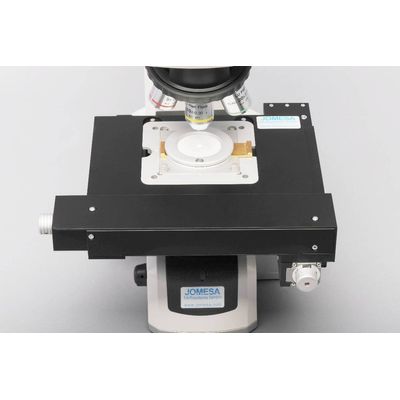
JOMESA - Model MAT3 - Automatic Filter Analysis System
It is widely known, that the cleanliness of modern oils for automatic transmission units and high power engines cannot be measured by optical extinction counters. The neccessary additives which are present in these high-tech oil confuse the optical (laser) based detection principle. Therefore the cleanliness analysis via filter and microscope is the only way. The old ISO 4406/4407 standard does not make any significant prescription concerning method and equipment. As a consequence, no wonder, analysis results from different labs, using different equipment and counting methods can differ in orders of magnitude. To end this unacceptable situation a workshop of car manufacturers, oil suppliers and measurement equipment manufacturers started in 2009 to set up a new standard. JOMESA was an active participant of this workshop. The result of this workshop is a new DIN standard: DIN 51455: Liquide mineral oils - determination of particle number and particle size in oils.
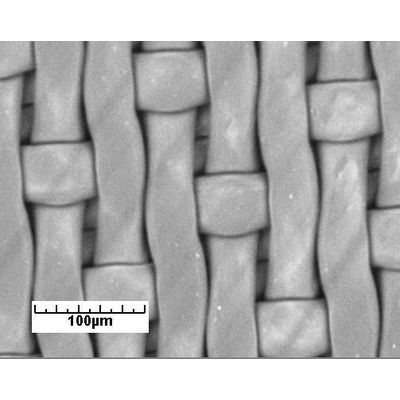
JOMESA - Closed Mesh Filter
Closed mesh filters are the finest fabric possible. No measurable pore size. Different binding (1 µm, 5µm, 10µm Mesh Filter) in Filtration Tests.
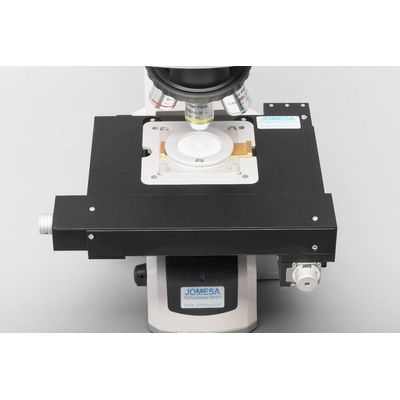
JOMESA - Model MAT3 - Oil Cleanliness Analysis
It is widely known, that the cleanliness of modern oils for automatic transmission units and high power engines cannot be measured by optical extinction counters. The neccessary additives which are present in these high-tech oil confuse the optical (laser) based detection principle. Therefore the cleanliness analysis via filter and microscope is the only way.
Accessories
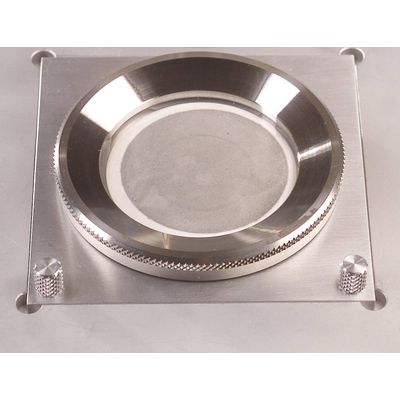
JOMESA - Filterholder for Standard Filtermembranes (Diameter up to 50mm)
Easy and quick fixating tool for filtermembranes. After drying, filtermembranes are no more flat. However each microscopic system is limited in focal depth. Even HFD (High Focal Depth) systems cannot cope with height variations of mm size. On our standard filterholder, a glass cover is placed above the filtermembrane to flatten it. This also ensures that the filter will not slip during measurement. When removing the glass cover, particles from the membran will stick to the glass: The particle content of the membrane is altered and therefore this membrane cannot be measured again.
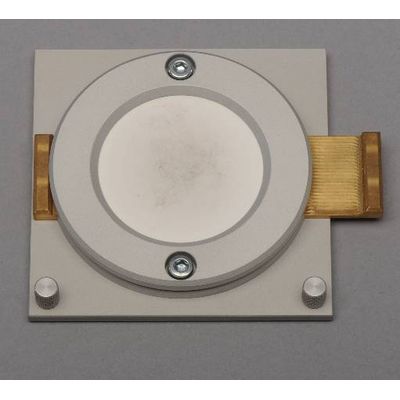
JOMESA - Drum Stretch Filterholders
This type of filterholders flattens the membrane and secures it against slipping. By a smart mechanical trick the membrane is clamped and stretched on this holder (similar to a skin on a drum). Therefore a glass cover is not neccessary and the membrane can be transported to other analysis instruments (e.g. REM-EDX). Drumstretch for optical HFD applications: Filtermembrane background is plastic, thus mesh filters can be evaluated without background interferences.
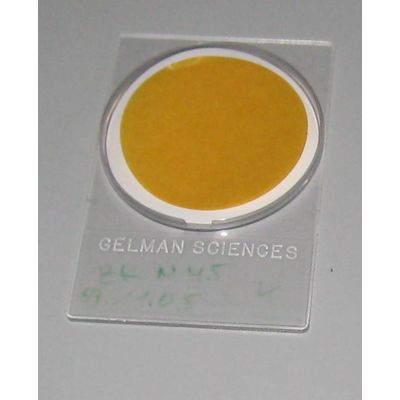
Holder for Particle Traps
Particle traps are used to determine the cleanliness of (production) environment. Basically a particle trap is a sticky surface. In its original (delivery) state, the sticky surface is covered by a protection foil or paper. When exposing the particle trap to an environment, this cover is removed. From that moment on, all particles falling on this sticky surface are trapped. After exposure time, the trap is again covered by a protection plastic cover. The particle trap is then inserted into the particle trap holder and analyzed on the JOMESA HFD system.