


K K Enviro Tech Pvt Ltd. products
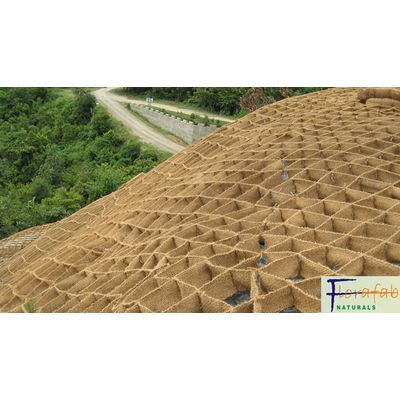
Coir Geocell
On steep barren slopes it is difficult to place top soil. CoirGeo-cell is 15cm wideband of tightly woven coir geo-textile bound in a honeycomb cell like structure. They are laid on steep slopes using steel pins or natural. The honey comb shaped structure can then be filled with soil and saplings planted in them.
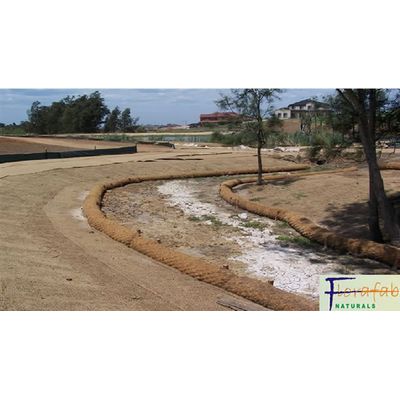
Coir Log
COIR LOGS are made from coconut fibers bound together with biodegradable netting. Florafab coir gabions are either cylindrical or cuboid in shape, they can be made to various lengths and diameters as per site requirement.
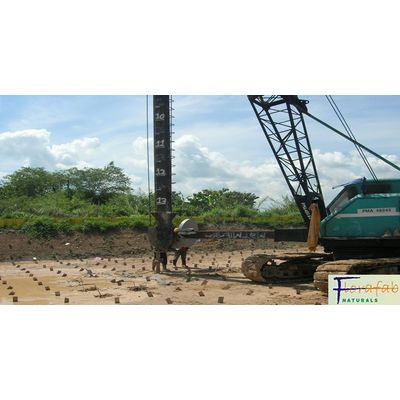
Model JCPVD - Floradrain for Clay Soil
Clay soil has a low permeability and hence pore water trapped in the soil cannot come out in a short time period. Floradrain (FFD-8) prefabricated drain can be installed vertically to depths as great as 40 m. Water, under pressure in excess of hydrostatic pressure, flows through the Jute filter sheath and into the core coir channels where it is led vertically out of the soil. This may be either up or down to intersecting natural layers or to the surface where a sand drainage blanket or Jute-coir prefabricated strip drains are provided. The water in the soil has to travel the distance to the nearest drain to reach a free drainage path. The drains are usually placed in a triangular configuration of 1 to 10 metres - depending on the desired consolidation time. As a result of this method of accelerating the consolidation process, uneven post-construction settlements can be virtually eliminated.
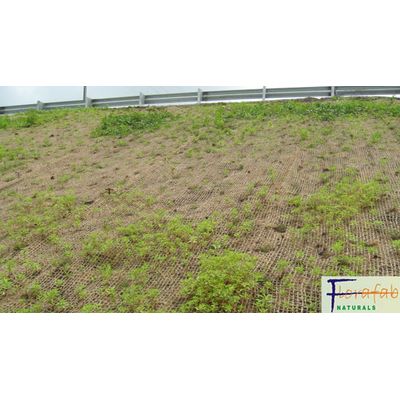
Coir Erosion Control Blanket
Coir erosion control blanket can be either woven or non-woven. Woven ECB is an open weave structure with large / small open mesh. Non-woven ECB is either needle punched or stitch bonded.These materials are useful in erosion control and re-vegetation on slopes less than 50 degrees or in channels, where water flow rates are between 1 and 4 m/s. The hairy nature of the yarn used for making the blanket breaks the falling raindrop into droplets, thus decreasing their erosive action. The material absorbs water, around 3 times its own weight. Coir geotextile lasts for 3 to 5 years and degrades to form humus which is useful for plant growth.

Jute Geo-Textile Products
Jute Geotextile is a kind of natural technical product, laid in or on soil to improve its engineering properties. Jute soil savers dissipate kinetic energy of raindrops and control surface runoff. They also help in precipitation of detached soil particles and aid in faster growth of vegetation. They absorb water up to 5 times their own weight. They degrade faster and so are used in areas conducive to growth of vegetation. They are cheap compared to coir products.

Non-Woven Geotextile
Non-Woven Geotextile are needle punched fabrics made from polypropylene. The dry laid needle punch technology is based on a two step process. Firstly, polypropylene resin is extruded into fibres. Secondly, the fibres are carded and needlepunched. Finally, some types are added thermal treatment. Weights range from 100 g/m2 up to 1200 g/m2.
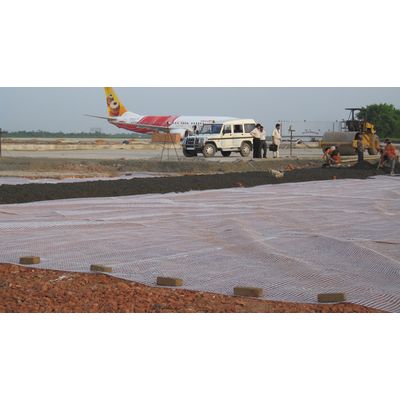
Geogrids
Geogrids are polymeric products formed by joining intersecting ribs. They have large open spaces known as "apertures". The directions of the ribs are referred to as machine direction (md), orientated in the direction of the manufacturing process or cross machine direction (cmd) perpendicular to the machine direction ribs. Geogrids are mainly made from polymeric materials, typically polypropylene (PP), high density polyethylene (HDPE) and polyester (PET). Geogrids are manufactured as either biaxial or uniaxial. Biaxial geogrids are those that exhibit the same strength in both the machine and cross machine directions while uniaxial geogrids exhibit the primary strength in the machine direction with minimal strength, enough to maintain the aperture structure, in the cross machine direction.
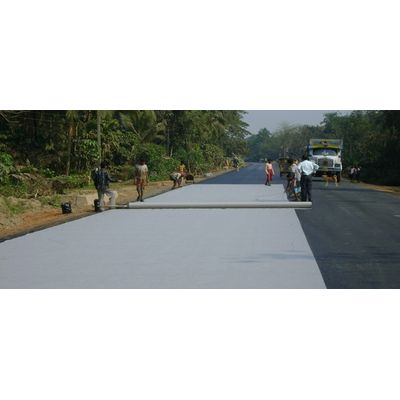
Asphalt Overlay Paving Fabric
Paving fabrics are widely used in both new road constructions and in road maintenance to reduce reflective cracking in the pavement. The purpose is to distribute stresses originated from cracks in the lower part of the pavement by creating a stress relieving and/or waterproofing interlayer membrane system. Paving fabrics made from polypropylene fibres is a flexiblepre-compressed needle punched nonwoven fabric added thermal bonding on one side only.
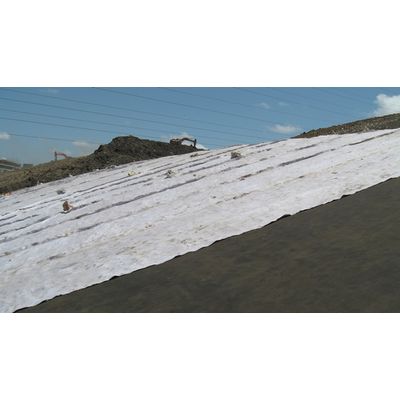
Drainage Composites
These are highly robust which allows them to withstand high degree of stress during installation, it adapts perfectly to uneven surfaces due to its light and flexible make and are easy to transport and store. These drainage composites are long-lasting as they are imperishable, chemically inert, resistant to microorganism, resistant to oxidization, insensitive to atmospheric agents, insensitive to salt water etc. These usually comes as drainage nets which are both biaxial and triaxial, both these net comes with geotextile on one side, on both sides, geotextile on one side and impermeable membrane on the other side, which act as waterproofing material.
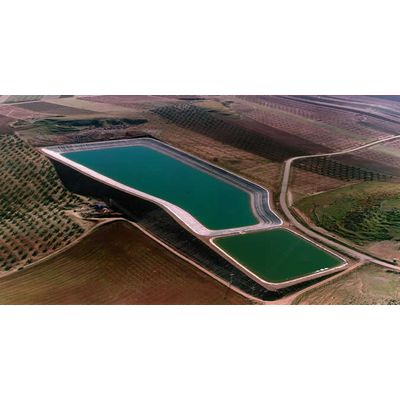
Geomembrane Using High Density Polyethylene (HDPE)
Geomembranes are manufactured using high density polyethylene (HDPE). These are of various thicknesses and with either smooth or textured surfaces (for steeper slopes). The product is suitable for sealing landfill caps and base liners, secondary containment, potable water and non-toxic containment applications such as water conveyance structures, canals or ponds.