

MaxTon Industrial Company LTD products
Briquette Press
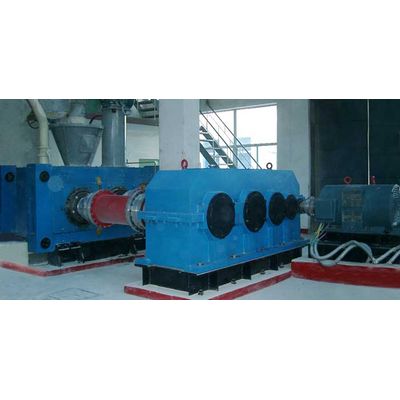
MaxTon - Cold Briquette Roller Press Machine for Industrial Applications
The cold roller briquette machine by Maxton Industrial Co., Ltd. is designed for the efficient briquetting of materials across various industrial sectors. This roller press is essential for transforming powdery materials, waste for furnaces, and fuel compositions into compact shapes like balls or pillows, facilitating enhanced heating and utilization. It employs a pair of pressing rollers with ball-pockets that exert maximum pressure to form briquettes when the pockets coincide. The press operates using either binder or binder-free techniques, depending on the material’s natural binding properties. Materials such as bentonite, clay, and quicklime can be briquetted without binders, while coal and charcoal generally require binder integration. The machine offers versatile feeding options, including gravity and force feeding systems, each tailored to specific processing needs to ensure uniformity and efficiency. Its hydraulic system allows for precise pressure adjustments, enhancing operational flexibility and safety. The machine supports various materials and is available in several pressure configurations, from medium to extremely high, catering to different industrial requirements.MaxTon - Hot Briquette Roller Press for High-Temperature Material Processing
The hot briquette roller press is an industrial solution designed for the conversion of direct reduced iron (DRI) into hot-briquetted iron (HBI) by utilizing high-temperature processing. This technology addresses the challenge of binding characteristics activation at elevated temperatures, making it suitable for materials like steel mill residue and lignite. The system typically includes high-temperature resistant materials, water-cooled components, and inert housings to prevent oxidation. Hot briquetting reduces the specific surface area of DRI, minimizing reoxidation and overheating risks. The process is reliable for shipping HBI without special precautions, as confirmed by the International Maritime Organization (IMO). Configurations are customizable with modular constructions, including cooling and recycling systems as needed, and utilize specialized roller presses and auxiliary equipment like briquette string separators and hot screens.
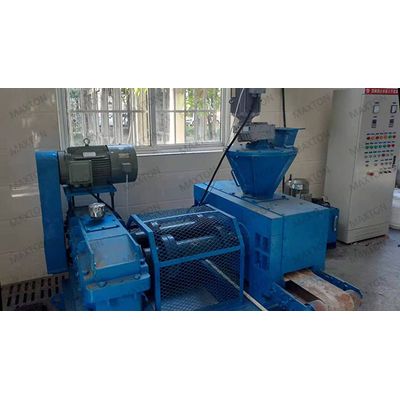
MaxTon - Model YS170 and YS300 - Lab Scale Roller Briquette Press for Research and Development
Maxton has engineered a series of roller briquette machines tailored for use in laboratories, research and development centers, as well as in the pharmaceutical industry. These devices are compact, straightforward to operate, and can be smoothly integrated into laboratory environments. The model 170 is particularly notable for allowing feasibility studies related to briquetting and compaction-granulation on a small scale, with capabilities for handling test quantities of 0.5-1 kg and continuous operations of a few kg per hour. A key feature of this equipment is that it can be disassembled, cleaned, and reassembled without specialized tools, facilitating easy maintenance. Additionally, the model 300 functions as a pilot-type roller briquette press mirroring the structure of large industrial machines. There are also specialized lab-scale models capable of mixing, heating, and briquetting processes, ideal for applications requiring easily configurable systems.
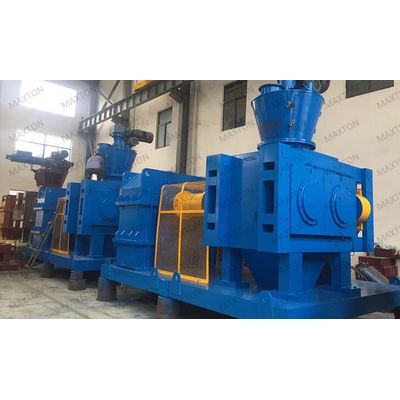
MaxTon - Roller Compactor and Granulator
Roller compactors and granulators are central to processes involving the enlargement of particle size without the use of liquids. The Maxton roller compactor utilizes a dry process whereby materials such as powders and dusts are mechanically compressed into larger, denser forms. The process is facilitated by two counter-rotating rolls, resulting in reduced surface area and enhanced product quality. A higher compaction pressure is applied compared to traditional briquetting, which is ideal for forming specialized solid shapes like sticks or sheets that can be further granulated for usability. The compactor`s hydraulic cylinder pressure is adjustable, allowing for varying the compression force, which is instrumental in soft granulation. Additionally, high-performance screws and adaptable granulators ensure efficient particle sizing. Equipment design, including auxiliary components such as de-aeration and screening systems, is tailored to operating conditions to maximize product quality.
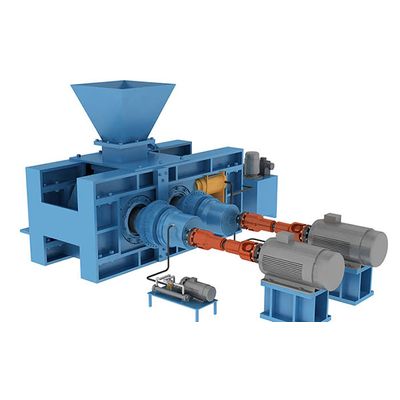
MaxTon - Model HPGR - High Pressure Grinding Rolls (HPGR) System for Industrial Crushing
High Pressure Grinding Rolls (HPGR) are advanced machines used in high pressure grinding processes. HPGR systems apply high pressure between two counter-rotating rollers to compress and crush materials, enhancing the efficiency of size reduction. Initially adopted by the cement industry, HPGR technology is now prevalent in nonferrous, ferrous, and precious metal processing industries. Through static pressure crushing, HPGR promotes material layer crushing, reducing energy consumption significantly compared to traditional impact or shear-type methods. The rollers' adjustable gap controls pressure on materials, achieving fine output sizes of less than 3mm. HPGR's characteristics include a large size reduction ratio and high crushing efficiency, resulting in cost savings during further processing steps such as flotation and leaching. With a roll surface crafted from powder metallurgy alloys, HPGR assures good abrasion resistance, ease of maintenance, and long service life, enhancing its reliability and applicability in mineral processing.