


NLIR products
Mid-Infrared Light Detection
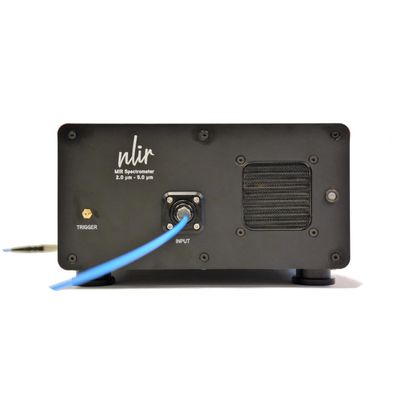
NLIR - Model 2.0 - 5.0 µm - Mid-infrared (MIR) Spectroscopy
Mid-infrared (MIR) spectroscopy is used to analyze MIR light sources and, in both industry and research, for non-invasive characterisation of gasses, liquids and solids as well as characterisation of light sources. The NLIR 2.0 – 5.0 µm Spectrometer (S2050-400/S2050-130k) is based on a novel measurement scheme that upconverts the MIR light to near-visible light. Silicon-based near-visible light detectors are far superior to MIR light detectors in terms of detectivity, speed and noise. The NLIR upconversion technology therefore brings these attractive features, and the advantages that follow, to the MIR regime.

NLIR - Model 7.6 – 12.0 µm - Prototype Spectrometer
The mid-infrared region from 5 µm to 12 µm (2000 cm-1 to 833 cm-1) is very interesting for many industrial and research applications because many molecules have defining absorption lines exactly there. Unfortunately, the detectors (typically HgCdTe) used in FTIR systems for spectroscopy purposes suffer from significant amounts of thermal noise due to its low bandgap. Hence, high levels of input light are needed with long exposure times to achieve a satisfactory signal-to-noise ratio.
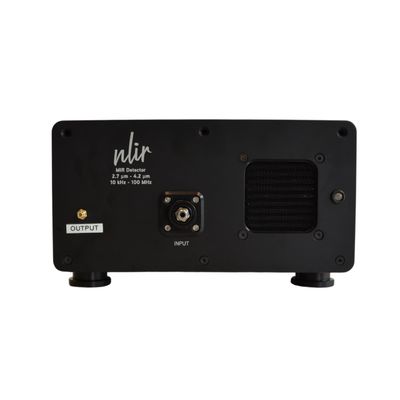
NLIR - Single-Wavelength Infrared Detectors
The greatest challenge for mid-infrared detectors is typically the substantial inherent noise and that they collect large amounts of noise from the surroundings. Our detectors alleviates both limitations by using narrowband and efficient upconversion technology together with low-noise silicon-based detectors. This is all done in our plug-n-play detector modules where the infrared signal is mixed with our high-power pump laser to produce a near-visible signal detectable by a versatile range of high response silicon-based detectors. In case you are not in the need for ultra-low signal detection we also offer broad-band solutions that compromise the efficiency but allow your broad-band sources into the regime of high-speed and low-noise mid-infrared detectors.
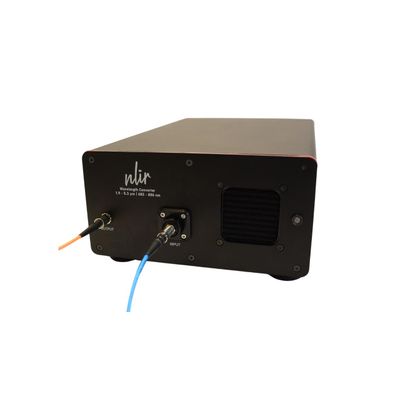
NLIR - Mid-infrared Wavelength Conversion Module
The core of the NLIR technology is upconversion of mid-infrared wavelengths to near-visible wavelengths, which enables use of Si and GaAs detectors. The conversion module does exactly that and no more. Read more about how the conversion works in “Technology”. Accepted wavelengths are in the bandwidth 2.0 – 5.3 µm, and they are upconverted to the bandwidth 695 nm – 886 nm by a 1064 nm high-power laser inside a LiNbO3 crystal. Only the vertical polarization component is upconverted, which may reduce the amount of signal converted but correspondingly it also reduces the converted noise to half. After conversion, efficient spectral filtering below 695 nm and above 886 nm cuts away residual noise.
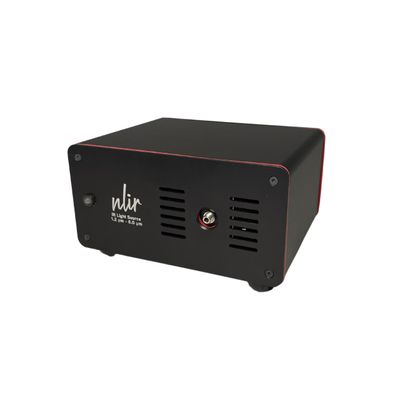
NLIR - High-Temperature Mid-Infrared (MIR) Light Sources
High-temperature mid-infrared (MIR) light sources are relatively cheap and require only simple electronics; they emit light of high power and are stable and robust. However, due to the nature of the warm emitter, the light is incoherent and emitted in all directions, which makes it difficult to guide and focus the light onto a sample with high intensity. NLIR’s fiber-coupled MIR light source makes it easy to bring MIR light to a sample either by positioning the fiber tip close to the sample or by using one of the many commercially available fiber-probes. The light source is plug-and-play, turns on in a few seconds, and is actively cooled so that no parts are too warm to touch.
Technology