Precision Acoustics Ltd
Refine by
Families
4 products found
Precision Acoustics Ltd products
Pressure Measurement - Needle Hydrophones
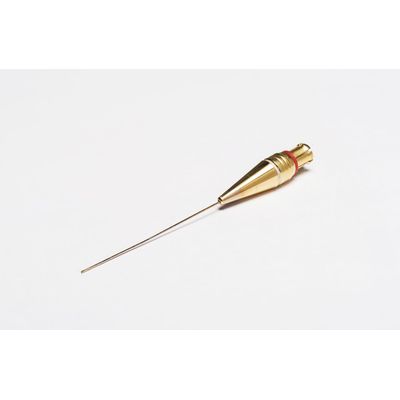
Precision Acoustics - 0.04 mm Needle Hydrophone for High-Pressure Field Measurement
The 0.04 mm needle hydrophone is suited for measuring high-pressure fields at frequencies above 40 MHz. Constructed with precision, each probe is handmade, leading to slight variations between devices. Designed for ultrasonic applications, the hydrophone can operate in liquids such as castor oil and mineral oil. Its PVdF construction, while durable, is susceptible to damage from certain chemicals. Proper usage involves soaking the hydrophone for at least one hour before measurements and promptly removing it from water post-use to avoid prolonged immersion damage. The device should be cleaned with lemon juice if calcium deposits form. For optimal data accuracy, the hydrophone output should be terminated in 50 ohms. While batteries can power the DC coupler, a desktop power supply is recommended for extended use. The hydrophone system supports calibration through peak-to-peak and RMS voltage measurements, ensuring reliable sensitivity data across a frequency range of 0.2 MHz to 50 MHz. For technical assistance or product inquiries, contact Precision Acoustics directly.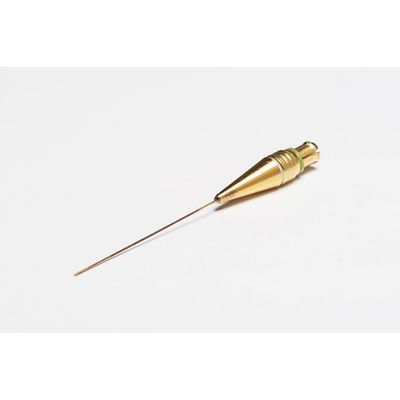
Precision Acoustics - 0.075 mm Needle Hydrophone for High-Frequency, High-Pressure Measurements
The 0.075 mm needle hydrophone is engineered to provide a reliable signal-to-noise ratio, making it suitable for high-frequency, high-pressure fields where minimizing spatial averaging is crucial. Constructed with PVdF material, it can operate in various liquid environments, including water, castor oil, and mineral oil, though caution is advised with some chemicals. Its precision construction allows for accurate ultrasonic intensity measurements, and it stabilizes within an hour of soaking. When used, the hydrophone should be terminated with 50 Ω to ensure proper measurement accuracy. This device includes a preamplifier with an 8 dB gain, powered by a desktop power supply, to remove the DC component from the returned signal. Precision Acoustics manufactures transducers within the 0.2 MHz to 50 MHz frequency range, employing various materials tailored for specific applications. Calibration sensitivity is flexible, enabling conversion between pressure and voltage for peak-to-peak or RMS measurements.Ultrasonic Transducers
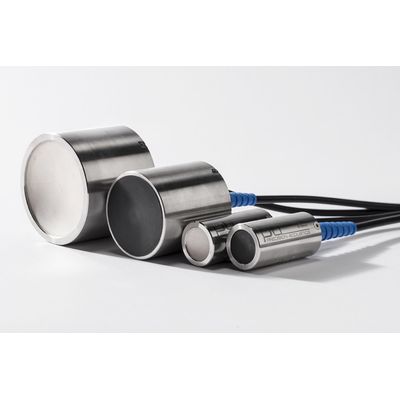
Precision Acoustics - Piezo-ceramic Ultrasonic Transducers for Medical and NDT Applications
Precision Acoustics designs and manufactures ultrasound transducers for a wide range of medical and non-destructive testing (NDT) applications. These transducers utilize materials like PZT and lead metaniobate (PMN), tailored to specific customer requirements, including center frequency, active element diameter, and focusing needs. The company produces transducers over a frequency range from 0.2 MHz to 50MHz, with both resonant and highly damped options available to fit various use cases. Resonant transducers generate a high output close to their resonant frequency but require damping to broaden their frequency range. Piezo-ceramic materials offer efficient electrical to mechanical conversion and are often matched with a quarter wave layer to optimize acoustic impedance. On the other hand, piezo-polymer materials, like PVdF, exhibit high internal damping, making them suitable for short pulse, broadband transducers but necessitate higher voltage levels. These transducers are integral to applications demanding versatility and precision, delivering efficient functionality across a spectrum of technical settings.Acoustic Materials - Low Frequency Anechoic Absorbers