


Solidfog Technologies SPRL products
Dryfog Technology
Solidfog has more than 15 years’ experience in providing H2O2 airborne decontamination systems for the pharmaceutical industry with a successful track record behind. Our nebulisation technology ensures a uniform and reproducible distribution of the H2O2 throughout the whole room. Thanks to the design of the spray nozzle, the precision of the biocide priming pump and control over the air pressure provided by our design, we ensure a robust and consistent aerosol supply.
Methodology
Cycle parameters: In principle, a decontamination process carried out in normal environmental conditions can be rendered without the need of preconditioning phase regarding temperature and humidity. However, these are factors to be considered during cycle development and validation. Studies conducted by an important pharmaceutical company showed that RH conditions between 40-70% and temperatures between 17-27°C can be properly validated to 6-log reduction by adjusting H2O2 initial liquid concentration. The cycle development strategy should consider the worst case situation and try to fix the concentration of H2O2 for simplifying validation.
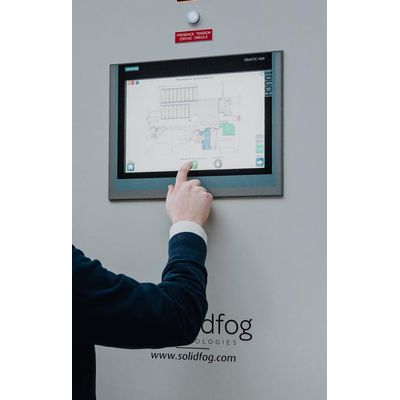
Model DosyMist CS - Centralized DosyMist for Fully Integrated Solution
A centralized system is usally built for customer who needs frequent use of their decontamination system. It requires different components: A main cabinet placed in technical area with all electrical and automation components. If fixed injection points are involved, then weighing system cabinet are needed (they could be placed in technical area or the surrounding area of decontaminated rooms). Fixed injection points placed in the different area to be covered. If mobile units are involved then rj45 connections should be present from room to main cabinets. HMI: to pilot the system.
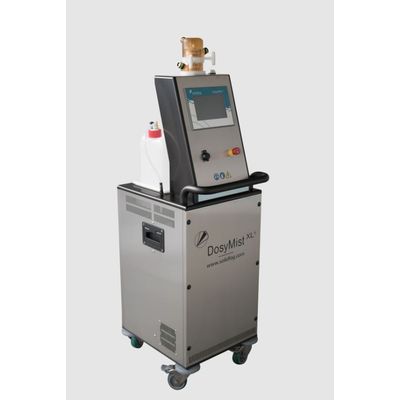
Model DosyMist XL - The Automated Solution for Wide Rooms
The DosyMist XL® is a stand-alone VH2O2 generator designed for the bio-decontamination of large areas. These units can be remotely controlled and synchronised with other equal units via facility management systems. The technical features are specifically designed to meet the requirements of the pharmaceutical industry so it is possible to carry out cycle development and process validation quite easily and in relatively short time. The DosyMist XL® is the natural evolution of the DosyMist® product concept. Launched in 2017, it has two main differences with the other product in the range; the larger capacity with 3 atomisers and with a bigger reservoir, and the introduction of a load cell to control the quantity of biocide injection.
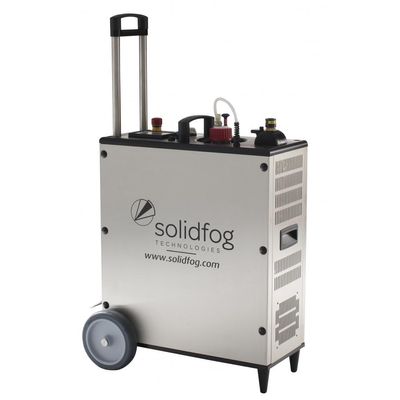
Model DosyMist - The Easy To Handle Mobile Solution
The DosyMist® is the first generation of serial portable VH2O2 generators, which was launched by Solidfog in 2012. Since then, more than 600 units have been sold and successfully implemented for different applications requiring H2O2 airborne disinfection. Most of our customers come from the pharma industry. It is because it has not only been designed to provide an excellent usability and versatility, but also to be a reliable and an easy validation system in life-science laboratories and the GMP production areas. The unit can work as a stand-alone system or connected via Ethernet to a central BMS for remote control.
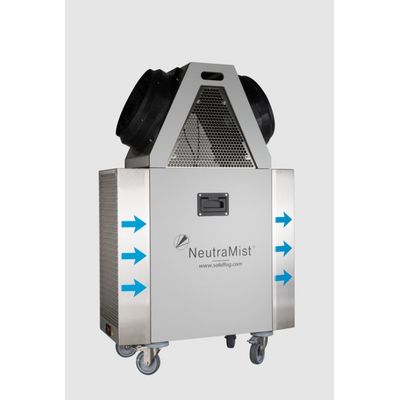
Model NeutraMist - The Catalytic Solution
The aeration phase of a decontamination cycle with VH2O2 is usually the longest one, especially in large rooms or areas. Cycle times will mainly depend on the capacity and design of the HVAC system (either 100% extraction or recirculation). With the Neutramist catalytic system it would be possible to reduce the aeration time consequently. The NeutraMist® is in its mobile design made of HPL panels (high pressure laminate panels) including a ceramic honeycomb structure with active catalytic surface, a centrifugal fan system and air outlet through an HEPA filter panel. The unit can work synchronised with our DosyMist XL® units. Depending on the VH2O2 concentration at the inlet flange, the remaining percentage of VH2O2 may vary from 0,0 to 5,0 ppm after one passage through the catalytic element.