


uFluidix products
Device Materials
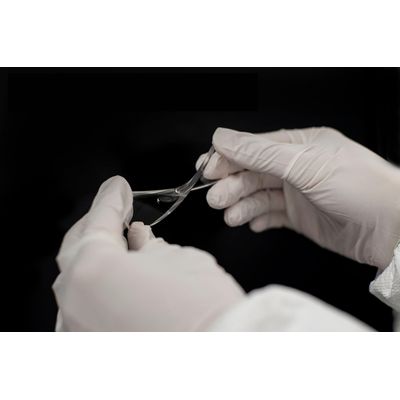
uFluidix - Model PDMS - Silicon-Based Organic Polyme
PDMS is the most widely used silicon-based organic polymer. PDMS is a rubber like elastomer, optically clear, bio compatible, inert, non-toxic, and non-flammable. PDMS chips are the most used platforms in Microfluidics.
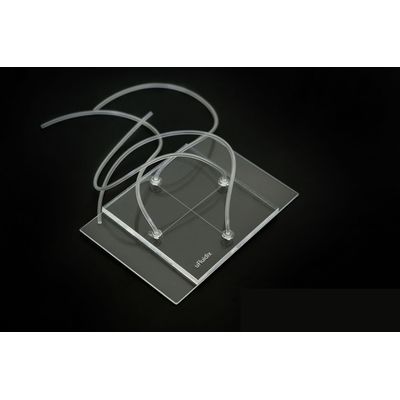
uFluidix - Model PDMS - Glass Polydimethylsiloxane
Since PDMS parts have rubber-like mechanical properties, they are not stiff enough for handling especially when the parts are less than 1 mm (0.04”) thick. Therefore, these PDMS parts are often bonded to glass microscope slide or thin glass cover slips, or custom size glass substrates. Sufficient bonding strength between PDMS and glass is needed for continuous flow microfluidics applications, otherwise the fluid would leak out of the microfluidic channel. uFluidix has special expertise in bonding and sealing PDMS parts to glass and variety of other substrates for the manufacture of microfluidic devices. Glass and PDMs have very different surface properties.
Microfluidic Devices
uFluidix - Straight Channel Microfluidic Device
As the name says is a single straight microchannel with one inlet and one outlet. A single channel is the first choice when the researcher is evaluating material compatibility; such as optical, thermal, chemical, or surface properties. Sometimes a straight channel microfluidic device is used in cell culture studies to optimize reagents, channel dimensions, flow rates, or channel coating for each specific cell type or size. There are many Microfluidics applications for a straight channel.
uFluidix - Y-Channel Microfluidic Device
Y junction microfluidic devices are mainly used for separation applications. Usually, a heterogeneous mixture of particles such as cells enters from one side, separated at the junction, and then delivered via outlet ports. Many physical or flow characteristics could be used in Y-Channel Microfluidic devices to drive the separation such as magnetic, electrical, acoustic, thermal, laser, sheath flow, gravity, etc…. Y Channels are also used as mergers when two different flows enter from one side and a mixture exits.
uFluidix - T-Junction Microfluidic Device
In a typical T-junction Microfluidic device, there is a main straight channel and a perpendicular side channel that connects to the main channel somewhere along the length. T-Junctions are usually used for the generation of droplets, such as water-in-oil or oil-in-water. They are usually simple but useful droplet generators.
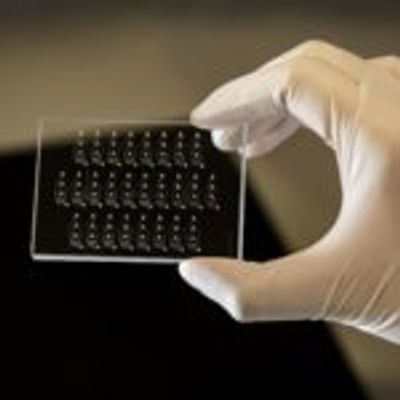
uFluidix - Cross-Junction Microfluidic Device
Cross-Junction Microfluidic devices are made when two perpendicular channels connect to the main channel, mainly in a symmetric way. The junction often acts as a micro-nozzle, therefore creating a flow-focusing phenomenon. Recently many flow-focusing droplet generators such as drop-seq, dronc-seq are introduced for high-throughput sequencing of single cells and other applications.

uFluidix - Spiral Microfluidic Device
Spiral Microfluidic devices are usually a single spiralling channel that branches at the outside end of the channels. Flow normally enters from the center of the spiral and exits from the outside. Spiral channels are mainly used for the separation and sorting of particles based on inertia. Usually, different sizes, weights or shapes of particles can be separated using this strategy. It should be noted that the number of branches at the exist could be anywhere between 2-10, depending on the application.
uFluidix - Micro-Mixing Device
The laminar nature of flow in microfluidic channels means the dominant mixing force is diffusion. This is more pronounced in smaller micro-channels of lets say smaller than 25um. Mixing two different reagents in micro-channels could be very challenging, especially in the case of immiscible liquids such as water and oil, or different viscosity of liquid — syrup and water. If mixing is needed, then one may choose a micro-mixer microfluidic device. Micro-mixers work by creating local turbulent flow, there are many designs and geometries, but the two most famous devices are serpentine mixers and herringbone mixers.
uFluidix - Micro-Reactor Device
Also, know as microfluidic chamber or flowcell, these are microfluidic devices that have a cavity-type feature somewhere along the channel. These microdevices are used when a liquid needs to undergo chemical, physical, or biological reactions. Often heat, UV light or time is needed to activate and do the reaction. Examples are microfluidic devices used in point of care devices where a patient sample such as serum enters the microfluidic chamber, and need to react with reagents such as antibodies, or enzymes. PCR on a chip is the most famous example of such microfluidic devices. There are many types of micro-reactors.
uFluidix - Imaging Microfluidic Device
Often researchers need to image a subject. For instance, Oil and Gas researchers need to model the transport of crude oil or saltwater in porous media, or biologists need to monitor red blood cell deformability in a sepsis study. Others may need to trap an object like C-Elegans and immobilize it for taking a time-lapse video, or follow one single white blood cell and monitor its behaviour in fighting antigens. Microfluidic devices provide a perfect solution for imaging microscopic objects.