


Ultra Instrument Inc.
5 products found
Ultra Instrument Inc. products
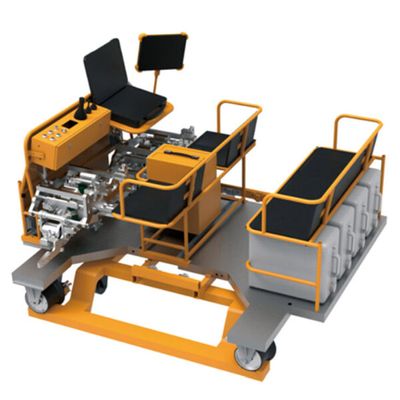
Ultra - Model RS-20 - Integrated Rail State Inspection Vehicle
The RS-20 Integrated Rail State Inspection Vehicle utilizes high-speed HD digital imaging technology to capture full and continuous images of railway tracks. This automated detection system replaces traditional manual inspections by employing image processing algorithms to identify visible track abnormalities. Integrating ultrasonic systems, the vehicle can scan rail images, aiding in flaw detection and automatic recognition of track surface irregularities. The system merges disciplines such as optics, mechanical design, control science, computer science, and information science. Key specifications include dimensions of 1800x1800x900mm, a total weight of 131kg (with modules weighing less than 48kg), and assembly capability within 5 minutes by four people. Its motor runs at 1200W, with an operational range of 60km or 4 hours, a maximum speed of 20km/h, and an endurance on slopes up to a maximum of 35‰. The battery system features protections against overcurrent, overpressure, underpressure, and short circuits. The hardware includes a track image acquisition box, while the software comprises track image collection, control software, and image playback software with automatic identification capabilities. For capturing rail images, it uses a wire-array camera that prevents image deformation, ensuring accurate image processing. The RS-20 encompasses hardware and software designed for rail monitoring and bed patrolling, integrating systems for tunnel detection and data management.Ultrasonic Rail Flaw Detection Vehicle

Ultra - Model UR18-D - Ultrasonic Rail Flaw Detection Vehicle
The UR18-D Ultrasonic Rail Flaw Detection Vehicle employs advanced ultrasonic wheel probe technology, featuring two 9-channel ultrasonic wheel probes. It displays data from a combined 18 channels of the two rails on an LCD screen in a B-scan format. The wheel probe ensures effective ultrasound coupling, enabling detection of rail head flaws, rail bolt hole breaks, and transverse defects at the rail base, even in high-wear or poor surface conditions. The vehicle boasts a detection rate exceeding 90% and includes an alarm system for real-time operator alerts. Constructed from titanium alloy, it has a patented split design, with each part weighing less than 60kg. The vehicle runs on a lithium battery, offering environmental benefits, continuous power, and energy savings with a detection speed of 15 km/h. It operates efficiently in temperatures ranging from -30℃ to 45℃ (-22°F to 113°F). Suitable for various railroads including state-owned railways, private railways, ports, mineral company tracks, and city metros, its modular design allows for easy transport and assembly. The system includes probes, instruments, a probe centering mechanism, a walking platform, and auxiliary devices. Safety features include safety belts, a horn, lights, a stone sweeper, and an anti-overturning device, ensuring secure operations even at night.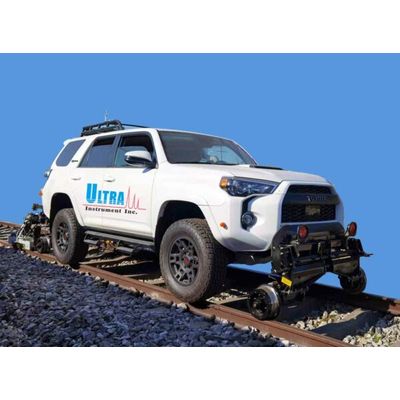
Ultra - Model GT6600 - Hi-Rail Ultrasonic Flaw Detection Vehicle
The GT6600 Hi-Rail Ultrasonic Flaw Detection Vehicle is designed to meet the demands of high-speed rail flaw inspections, providing a comprehensive rail testing platform. The vehicle operates on a hi-rail system, capable of retracting its rail gears to function on regular roads. It can test rails at speeds up to 40 km/h and is equipped with a hydraulic-controlled test carriage which can be operated remotely. This vehicle is tailored for long-distance testing, even under harsh conditions, ensuring high detection rates with user-friendly operation. It features 18 channels with two-wheel probes on each rail, capable of identifying transverse defects in rail heads, bolt hole breaks, and base transverse defects. Testing specifications include compatibility with rail types weighing between 43kg to 75kg per meter, operating temperatures ranging from -30°C to 45°C, and a probe frequency of 2 to 4 MHz. The detection equipment also includes a data storage capacity of up to 300km and displays results in either A or B scan real-time modes. The main vehicle, a 4WD SUV with a 3.0L manual transmission engine, offers endurance of 10 hours for rail testing and 6 hours for road driving at 60km/h.Hand Push Portable Rail Flaw Detector

Ultra - Model RT10-C - Hand Push Portable Rail Flaw Detector for Rail Inspection
The RT10-C is a hand push portable rail flaw detector designed for rail inspection. It utilizes both A-scan and B-scan with B-scan recommended for continuous recording, driven by a shaft encoder. Each pulse occurring every 3 mm ensures reliable rail flaw detection, particularly when used with a properly configured 9-channel wheel probe. The device features a Windows user interface and can display icons on a high-brightness LCD screen, making it suitable for tough environments with temperatures ranging from -30°C to 80°C. This flaw detector operates comparably to a high-speed testing vehicle and is built to function in dusty and wet conditions. Key specifications include a 500MHz main processor, 10 channels (9 for scanning, 1 for manual defect confirmation), a frequency range of 2-4MHz, and a testing speed up to 5 km/h. The alarm system is adjustable, and data can be recorded for up to 400 miles. Its lithium battery offers up to 9 hours of operation with a recharge time of 4 hours. The device includes an 8.4-inch LCD with 800x600 resolution and differential GPS with 1Hz frequency. The chassis and computing components are designed for high reliability, even in harsh field conditions, and the double scanning system enhances detection accuracy.