

- Home
- Companies
- Messe Düsseldorf GmbH
- Events
- Drupa 2024
Drupa 2024
In 2024, the international print industry will once again meet at drupa, the world`s leading trade show for print technologies. drupa stands for inspiration, innovations, top-class knowledge transfer and intensive networking. This is where top international decision-makers in the industry meet and exchange views on the latest technology trends and groundbreaking developments. What influence do the megatrends of sustainability and digitalization have on processes, products, business models and the future of the industry? In 2024, you will find out in Düsseldorf how the print and packaging community is shaping the future. Until then, you can get an overview of our focus topics and megatrends of the upcoming drupa here.

drupa 2024 - The must-attend event for the print industry
Are you interested in participating at drupa 2024 in Düsseldorf? Here you will find all further information about options and possibilities for exhibitors of the coming drupa 2024.
You can register directly as an exhibitor via our online application or calculate the costs for your stand space easily and conveniently before in our stand space cost calculator. You will also find valuable tips for your trade show preparation, as well as information on our trade show focus topics and special forums.
It is one of the main topics of our time: "Sustainability" is more than just a green buzzword, but with regard to the finite nature of fossil resources and the devastating effects of the CO2 emissions of the leading industrial nations, a necessary and central aspect of long-term and future-oriented corporate strategies. The print and packaging industry is considered a pioneer in the field of sustainable innovations. Dependent on the use of raw materials, the print and packaging industry already uses energy- and resource-saving manufacturing methods and thus makes a decisive contribution in terms of environmental and climate protection. drupa 2024 provides information on what is important in the sustainable production of print and packaging solutions and what trends are emerging for the print and packaging industry.
What does sustainability mean in the industry?
Originating in forestry, the term "sustainability" today has many faces. Whether related to resource and energy consumption and the reduction of the ecological footprint, or to economic decisions as well as social justice, sustainability is equally concerned with ecological and economic issues. The print & packaging industry therefore has a responsibility, both as a labor sector and as a consumer of raw materials, to meet its sustainability obligations. Sustainability means actively supporting the preservation of our natural resources, strengthening the economy through modern technologies, and advancing social welfare.
In the print and packaging community, the focus is on the use of sustainable and degradable materials, the use of innovative print and packaging processes, and cutting-edge AI for optimal process control and increased efficiency. Thus, sustainability in the industry inevitably goes hand in hand with the digitalization of print and packaging companies - Industry 4.0 is the key to overall sustainable production in the print and packaging industry. The shift in customers` purchasing behavior and information searches to the World Wide Web, as well as the ever-increasing regulatory environmental requirements, are doing the rest to further increase the demands on the industry - those who want to keep up here should look for sustainable solutions early on.
Sustainable print products and smart printing processes - already present in the printing industry
- Grass
- bamboo
- hemp
- cocoa seeds
- bagasse
By using artificial intelligence, ink consumption can also be greatly reduced without compromising on quality.

The print industry has also made an important contribution in terms of social sustainability since its beginnings: even in the age of digitization, school books, non-fiction books, and workbooks continue to be a basic element in literacy as well as education and training for people of all ages, and thus make an important contribution to social progress in society.
Packaging is the great weakness in environmental protection. Microplastics, heavy metals and other plastics pollute forests and oceans and drive species extinction. Added to this is the often poor ecological footprint due to the raw material extraction and further processing of petroleum, aluminum and other heavy metals. As a result, packaging-free products are currently experiencing unprecedented demand. But does this mean the end of the packaging industry?
Of course not, because modern and efficient packaging keeps perishable and sensitive foods and goods longer and protects them from contamination and damage in transit. They are therefore important in curbing product waste. Sustainable packaging solutions are therefore key in curbing product waste. By developing environmentally friendly, recyclable and reusable packaging, raw materials can also be returned to the recyclable cycle, helping to reduce the volume of waste worldwide. Sustainable packaging can be made of the following materials, for example:
- Wood
- Paper & cardboard
- Grass paper
- Cocoa paper
- Bamboo
- Cornstarch
- Bioplastic
- PLA & CPLA
- rPET
Once again, digitalization is helping to optimize the recycling process: by digitally networking all the players involved in the process chain, it is possible to track in detail which ingredients were used in packaging production and which additional substances came into contact with it during its use. In this way, further reuse options can be accurately identified and the recycling process simplified.
Packaging is the great weakness in environmental protection. Microplastics, heavy metals and other plastics pollute forests and oceans and drive species extinction. Added to this is the often poor ecological footprint due to the raw material extraction and further processing of petroleum, aluminum and other heavy metals. As a result, packaging-free products are currently experiencing unprecedented demand. But does this mean the end of the packaging industry?
Of course not, because modern and efficient packaging keeps perishable and sensitive foods and goods longer and protects them from contamination and damage in transit. They are therefore important in curbing product waste. Sustainable packaging solutions are therefore key in curbing product waste. By developing environmentally friendly, recyclable and reusable packaging, raw materials can also be returned to the recyclable cycle, helping to reduce the volume of waste worldwide. Sustainable packaging can be made of the following materials, for example:
- Wood
- Paper & cardboard
- Grass paper
- Cocoa paper
- Bamboo
- Cornstarch
- Bioplastic
- PLA & CPLA
- rPET
Once again, digitalization is helping to optimize the recycling process: by digitally networking all the players involved in the process chain, it is possible to track in detail which ingredients were used in packaging production and which additional substances came into contact with it during its use. In this way, further reuse options can be accurately identified and the recycling process simplified.

Societies around the world are currently undergoing a transition from linear consumption (products and packaging are manufactured, used and then disposed of in a more or less professional manner) to recycling, which reuses materials as far as possible. This is often accompanied by a loss of quality and use in lower-quality products. Product and packaging designers counter this downcycling with ideas for upcycling - be it the reuse of noble folding boxes or tin cans for storing household and foodstuffs, the re-use of non-toxic plastics from food packaging for toys or toothbrush handles, or a second life as a flower vase that is already built into the design of beverage bottles.
The supreme discipline of this megatrend of reuse, however, are single-variety recycling processes without downcycling effects. For example, when PET bottles are turned back into PET bottles in a closed cycle, when carrier films made of polyester are used again as carrier films after recycling - or when it is possible to reduce the indispensable fresh fiber supply in paper recycling to the limits of what is technically feasible. There is also the possibility of making machines and plants usable for far longer than before by using the highest-quality materials on wear surfaces and through proactive maintenance. This presupposes new business models in which the suppliers of print & packaging technologies sell the machines and systems instead of their use and charge for them in pay-per-use models.
Whether closed material loops or pay-per-use operator models of almost eternally running machines: The necessary keys to implementing the Circular Economy are provided by another megatrend: digitization. Material cycles require transparency throughout the entire product life cycles. Material development, users and recycling providers need precise information on how the specific product or packaging is produced and used, what potentially toxic substances it comes into contact with in the process chain up to disposal, and what processes take place in recycling. The challenge is illustrated by the example of film used for sprayed cut flowers, which is contaminated in the process. If it enters the same material stream as plastic vegetable packaging, it is difficult to understand why the recycled film contains traces of pesticides after recycling. A Circular Economy requires transparency here, just as it does in the case of pay-per-use of virtually trouble-free machines. Fully networked machines with close-meshed, possibly AI-supported condition monitoring are the prerequisite for such business models to actually become practicable and worthwhile for all stakeholders - including the long overlooked environment.
Modern printing technologies finish a wide variety of substrates: paper, cardboard, metal, glass, ceramics, wood-based materials, textiles and a wide range of plastics. Water- and solvent-based printing inks and frequently also transfer films are used for print finishing. Adhesives and release materials are also used. Metals are often involved, especially in the young 3D printing sector. The energy requirements of the devices, machines and systems along the process chain from the pre-press area, through the pressroom and drying, to finishing and binding, as well as packaging and shipping, also play a role.
Today, suppliers of printing and paper technology use all available adjusting screws to minimize raw material and energy requirements across this process chain. This starts with efficient servo drives with power recovery, continues with the use of energy-optimized drying technology, and does not end with the almost complete recovery of solvents or the systematic reduction of the quantities of adhesives and release agents used. Rather, sophisticated technologies make it possible to apply the lever where the resource requirements are highest: with the substrates, inks and films.
Modern packaging machines are processing ever thinner mono-material films containing up to 80 percent recyclate. In many applications, the film thickness can be reduced from the high double-digit to the single-digit micrometer (µm) range thanks to optimized process technology. The same amount of plastic previously used to protect a single product is now sufficient for six to ten. Similar leverage can be achieved where start-up losses in printing and finishing processes are minimized.
The trend towards ever shorter, often individualized runs is leading to more changeovers and restarts. This development should actually increase paper, cardboard and ink waste. However, process optimization and automation are achieving the opposite: startup waste and misprints can be reduced to a considerable extent with the help of state-of-the-art drive technology, automated equipment and close-meshed process control. Since modern printing presses process several thousand tons of paper and several hundred tons of ink every year, these savings effects are not only reflected positively in terms of resource conservation, but also in users` balance sheets. In finishing, too, the waste rate is now tending towards zero, which is economically imperative in the case of short runs alone. The same applies to the energy-saving solutions already available in printing and drying technology. These can not only save hundreds of thousands of tons of greenhouse gases each year, but also relieve print and packaging providers of the burden of soaring energy costs.
Future trends such as the use of artificial intelligence are also promising for resource conservation. This can be used to push savings to the limits of what is feasible, for example by reducing ink consumption precisely to the point where the human eye cannot yet detect any loss of quality.
In order for the step from resource consumption to resource utilization to succeed, overarching systemic approaches are required. Waste must be consistently collected, then sorted by type and finally returned to the respective material cycles. With the Digital Product Passport initiative, which documents all ingredients, spare parts and production-related emissions of each product, the EU is attempting to create the conditions for the longest possible useful life and for consistent recycling.
This is already working in some areas, and the more valuable a material is, the better. In Germany, for example, 90 percent of all aluminum packaging and 98 percent of all aluminum beverage cans are recycled. This not only reduces the direct environmental pollution caused by carelessly discarded waste and the environmentally damaging extraction of bauxite, but it also cuts CO2 emissions by 95 percent compared with the extraction of new aluminum.
According to the German Federal Environment Agency, recycling rates for glass and paper and cardboard are also well above 80 percent. For paper and cardboard, the latest figure was 87.7 percent. On average, paper fibers used in Europe are recycled 3.6 times before they no longer meet the quality criteria required for paper production. The industry is not satisfied with this. To further increase the recycling rate, suppliers of paper systems, print & packaging technologies, recycling solutions and research institutes are focusing on cooperation. In order to keep materials in the loop, important information about these materials and production processes must first make the rounds. Stakeholders in the value chain exchange this information, share their findings and jointly promote design guidelines for recyclable products and packaging as well as networked, digitally controlled process chains for their production in interest groups such as the paper deinking association INGEDE, the CEPI initiative 4evergreen, the folding carton association FFI, the RECYCLASS platform or also in the VDMA.
This cooperation and communication process is now producing solutions at all levels: Optimized control and regulation concepts are enabling increasing recycling shares in paper production. Metallization effects and other finishes are applied in such fine layers that they do not hinder recycling. Recycling concepts are also maturing for carrier films that remain after the transfer of such effects. Research groups are experimenting with fine bio-based coatings to increase the barrier properties of paper packaging to liquid media - and have no effect on recycling. And these are just a few examples of the cross-industry megatrend.
Stakeholders from all parts of the process chain are working together to drive the shift to recyclable materials. The goal is to optimize them from cradle to grave. It starts with the minimal environmental footprint in material production: modern pulp mills, as biorefineries, use 100 percent of the raw materials they use, generate 2.5 times more green energy than they consume, and use water in closed-loop systems. Approaches for decentralized plants that produce paper and green electricity from straw are under development. At the same time, packaging manufacturers and printers are putting their existing material base to the test. Wherever food legislation, barrier requirements and the necessary process speeds, quality aspects and cost structures permit, they are replacing difficult-to-recycle material sandwiches with fully recyclable monomaterial plastics, as well as metal, glass or paper packaging with increasing proportions of recyclates. Because this is accompanied by much more heterogeneous material properties, suppliers of print & packaging technologies and of finishing solutions are in demand. They are adapting their machines to these materials, which are usually much more difficult to process, and creating the necessary flexibility to shape, print and finish changing materials in an appealing way. In doing so, all players along the newly established process chains keep the subsequent recycling firmly in focus. After all, the goal is clear: the path to the circular economy leads via ever better closed material cycles.
Digitization is advancing forward unhindered. Analog processes and information are gradually being transferred to digital systems or replaced by them. Artificial intelligence is already taking over a wide range of tasks and can make decisions in a fraction of the human capacity. The print and packaging industry is not spared from these automation processes either. drupa shows how Industry 4.0 has already made its way into the print and packaging industry and what future trends are emerging.
What will the smart factory of tomorrow look like?
Industry 4.0 means the digital networking of people, machines and processes through the use of information and communication technology. Data-driven production processes, algorithm-controlled logistics and resource-conserving recycling management are bringing about a turnaround in the manufacturing sector. Where previously employee capacity determined the processing time of individual production steps, in the digitally controlled smart factory automated processes can autonomously take over tasks and significantly accelerate the manufacturing process. Employees are thus relieved and can be deployed more efficiently. By means of self-learning AI, impending malfunctions can be accurately predicted and diagnosed - thanks to mobile devices, this information can even be viewed by employees regardless of location, thus reducing unproductive time.
Order processing and accounting also benefit from digital trends: software solutions help to create invoices and send automated payment reminders to the customer, while inventories and personnel planning can be conveniently viewed and processed on the computer.

In order to survive in this competitive market, print companies must also upgrade - AI printing, platform economics and openness to new product solutions away from traditional print products play a key role here. Customers want to be able to place their orders online and track the handling process transparently in real time. A website or online store and tightly meshed networking of those involved in production are therefore basic prerequisites for digitization in the printing industry.
With print-on-demand and mass customization, printing companies also have the opportunity to process individualized print jobs and stand out from the crowd with customer-centric service solutions.
Companies can also counter the decline in print jobs by efficiently reducing costs and minimizing material consumption. The use of artificial intelligence can prevent misprints and significantly reduce material and ink consumption. Personnel costs can be reduced by means of autonomous print technologies.
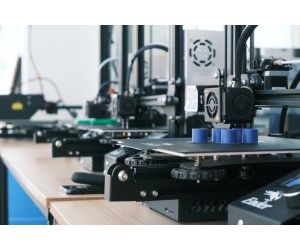
In the packaging industry, too, faulty production and material consumption can be reduced with the help of AI. Learning systems calculate and compensate fully automatically for deviations in the web guidance of cutting machines and printing devices, while sensors and algorithms enable error-free production from the very first copy. Using simulations in seconds, AI can determine the one among various designs that achieves the best possible result with the least amount of material.
Companies will do well using digitization in the packaging industry to their advantage in addressing customers as well. Printing QR codes on packaging is just one of many examples of how consumers can interact virtually with the product. Using augmented reality and QR codes, interactive and entertaining campaigns can be used for customer loyalty or important consumer information can be provided simply and digitally.
- Cost pressure and competition are increasing
- The globalization trend continues
- Customers are becoming more aware of quality and the environment
- Run lengths are falling, large orders are being called off in batches as required
- Demand for individualized/personalized print products is increasing
Thanks to international standardization efforts, machines and systems from different suppliers can now usually communicate smoothly. The Open Platform Communications Unified Architecture (OPC UA) provides the appropriate framework that is being recognized by more and more industries and players. Where a continuous flow of data from prepress to postpress is ensured, process linkage quickly follows suit. Instead of the usual stagnations between individual process steps, the duration of which depended on employee availability, a continuous production process is established. Capacity utilization increases, the need for storage space decreases, and monotonous tasks such as breaking out punched folding boxes no longer have to be done by hand. At the same time, data-based processes increase flexibility. Finishing 4.0 solutions compete with the claim to produce error-free from the very first copy - and thus to reduce to a minimum the expensive rejects of the already printed, cut and finished intermediate products at the end of the 4.0 process chain.
But this only covers part of the novel structures. In the background, sensors along the process chain continuously collect machine and production data. Some of this data is processed decentrally and cost-efficiently with edge computers close to the production line in order to feed the information obtained back to the control and regulation systems in the process without any loss of time. The larger, less time-critical part of the data flows into the cloud for further use and now increasingly AI-supported analysis.Analogous to this vertically integrated data chain, horizontal integration ensures close organizational networking of the players along the value chain. This allows previously separate competencies and know-how to be brought together. Users, suppliers of production hardware and software, developers of a wide variety of substrates and consumables, and research institutes form cooperation networks to jointly further develop print & packaging technologies and process chains and better align their respective products and processes. In addition, data integration and networking create the necessary transparency for efficient recycling and longer machine service lives, for proactive maintenance, refurbishing - and thus for the transition to the Circular Economy. Last but not least, horizontal integration paves the way for simplified digital order processing, accounting, costing, personnel and order planning, benchmarking, inventory management and much more.
A final important aspect concerns the operation and service of Print, Packaging and Finishing Technologies. As the database continues to grow, the effort required to integrate new human-machine interfaces (HMI) and workflow solutions is decreasing. Via smartphone or tablet, operators, service specialists, production planners and managers can access current machine and production data at any time. They carry the control station of the smart process chain with them at all times. Whether it`s troubleshooting, planning maintenance, repairs, an overview of spare parts, consumables and operating material availability, documentation, track & trace functions or forwarding printed rolls and sheets to finishers and postpress - in the process world of Print, Packaging and Finishing 4.0, all that`s needed for manufacturing execution is the mobile device in your pocket. This is also an effective antidote to unproductive downtime in analog, highly segmented production. Meanwhile, the trend is toward HMI solutions that support operators and assemblers in maintenance procedures and repairs via augmented, mixed or virtual reality (AR/MR,VR). Especially where skilled workers are scarce, this use of data and digital networking also opens up potential for a highly productive print & packaging world of the future.
Modern print & packaging technologies are equipped with tightly meshed sensor networks, inline inspection systems and digital measurement, control and regulation technology. Deep Learning and Artificial Intelligence now offer a set of tools to reap the harvest. They extract information from the wealth of production and machine data, which grows by the second, that indicates impending quality problems, looming malfunctions, machine wear, or hidden causes of recurring defects. Such condition monitoring, based on continuous data evaluation, makes it possible to fully exploit the service life of wear parts and operating materials, to proactively plan and synchronize repairs and maintenance, and thus to minimize machine and plant downtime. But the potential of intelligent data evaluation methods is far from exhausted. Artificial intelligence is far better at recognizing complex relationships in large amounts of data than the human brain.
The Print & Packaging Community uses this advantage to compare anonymized data from many millions of production cycles of thousands of users in order to leverage untapped productivity potential through this AI-supported benchmarking. Thanks to deep learning methods, inline inspection systems reliably do their job even when printing systems are running at top speed. In paper production, AI combines findings from continuous process data analyses with documented empirical knowledge from process engineers in order to be able to operate systems trouble-free even in borderline areas. Where precise web guiding is required in winding, slitting and printing processes, learning systems help to overcome the limits of mechanics. For this purpose, they continuously analyze the smallest control deviations and calculate how these can be compensated for in the next cycle - AI-supported precontrol thus ensures that tolerable deviations do not become errors. In printing processes, smart algorithms ensure that the required color saturation is achieved with minimal ink input. This also serves to increase cost and resource efficiency, as does the use of machine learning in packaging design. Based on comparative simulations, the systems run through various designs at lightning speed and determine the one that guarantees the highest output of visually appealing, stable and fully recyclable packaging with the lowest material input.
These are the first steps in a megatrend that will change the print & packaging industry on many levels in the coming decades. Wherever complexity is too high for human thinking, data volumes too large and processes too fast, AI will sooner or later prevail. But this takes time because the systems do not possess intuitive intelligence. Rather, they have to be trained for their respective tasks at great expense before they can independently deepen and refine this learned knowledge in day-to-day practice. But the effort is worth it, because once AI has been learned, it improves process quality without tiring, without being day-to-day, and with steadily increasing performance. The areas of application range from optimized design and layout in prepress, the combination of mass customization and automation, or optimized production control for a large number of different print jobs, to closed control loops throughout the entire process chain or data-based predictive maintenance that minimizes unexpected production downtime.
Whether Amazon or Alibaba, Spotify, Uber, Airbnb, Apple or Facebook: The Platform Economy is transforming business-to-consumer (B2C) markets at a rapid pace. Without even owning a vehicle, an apartment or a song, platform providers have made the initiation of business contacts between providers and demanders their business model. The intermediaries are now worth much more on stock exchanges than global media groups, car manufacturers or hotel chains. Thanks to strong brands, they are the first port of call for Connected Customers all over the world when they are looking for vacation accommodation, want to stream music or movies, or just want to do their shopping. The most successful providers are characterized by digitally optimized order processing, simple and transparent payment processes, and intelligent data analyses, on the basis of which they can align their services and offers ever more precisely to customer needs and satisfy them optimally. In an increasingly digital society, Platform Economy players are conquering one B2C industry after another. Even if there are critical tones, the openness of end consumers to the use of digital platforms is increasing. As centers of agglomeration on the World Wide Web, they are attracting not only customers but also more and more providers - further fueling the rapid growth of platforms.
Comparable trends can be observed in the print community. For example, the first major online print stores are supplementing their platforms by bringing their customers together with external providers of graphics, design, text and other creative services. To do this, they sometimes cooperate with crowdsourcing or crowdworking platforms. Establishing platforms to provide their own customers with convenient access to external expertise is also a trend among technology providers. Ideally, ecosystems are created that network established companies and creative startups, in which innovation partners can be found for the development of new digital business models, and on which external partners offer apps that support users in the evaluation and intelligent use of collected machine and process data.
Ultimately, the aim is to stimulate the exchange of complementary expertise on such platforms. Where partners learn from and with each other and exchange their respective perspectives on the opportunities and risks of digitization projects, they increase their digital readiness. This includes questioning methods that have been practiced for many years and opening up to digital workflows that are often agile. Because it is evident across many industries that competition is increasingly being fought over how effectively providers refine data into information that brings them and their customers the greatest benefit. If you don`t get to grips with this, you won`t be able to shape the innovation process, which is now so often taking place in fast motion, but rather will be overtaken by it in the long term. As a cross-industry megatrend, the path to the Platform Economy harbors many imponderables. However, it is already clear today that there is no way around the rapid development of digital competencies for companies.
The Internet speeds up our communication and makes information available more quickly and easier to compare. The service providers and technology suppliers in the Print & Packaging Community are using this connectivity to benefit their customers. Digital prepress, computer-to-plate processes, web-to-print offerings and the increasing interaction of brand owners with their digitally networked end customers in the design of products, packaging and campaigns are evidence of how open the community is to the new digitally networked process worlds.
Connectivity is also changing the relationship between print service providers and their customers. The latter are constantly online, used to convenient online ordering processes, impatient and demanding. If they don`t find what they are looking for immediately, they switch to another provider`s platform. They compare prices and offers, want to implement creative ideas spontaneously and without waiting times if possible, but at the same time demand high sustainability standards.
To cater for all this, print service providers are establishing efficient web-to-print platforms or at least interactive web stores. In order to compete successfully in an increasingly online environment, they need a production base that is as flexible as possible. For Connected Customers, the nearest print shop with a broad machine base and every conceivable substrate and finishing option is just a mouse click away. If they don`t find what they`re looking for straight away - or are dissatisfied with pricing and delivery times - they`ll look elsewhere. To meet these demands, print service providers also need to network, build partnerships and coordinate investments in their network so that their offerings of modern print & packaging solutions complement each other perfectly. This order processing, which is distributed among several partners, requires them to be digitally networked at all times in terms of efficient order development, including logistics and billing for the services provided in each case. Since many customers divide larger jobs into several batches which they call up as required, it is all the more helpful for such partner networks that modern print and paper processing technology reads in stored parameters of such recurring jobs at the touch of a button and increasingly automates press settings during job changes. In this way, digitally networked Print & Packaging Technologies ensure reproducible quality at all times.
Connectivity has another important level for the Print & Packaging Community: Since Connected Customers are also online on the move via smartphone or tablet, it is important to create convergence between the digital cosmos and reality. This is feasible in the form of printed QR codes or printed electronics. The transitions between the Internet and reality are blurring. The packaging alone no longer has to convey all the product information, but can link to additional multimedia information stored virtually. This opens up space for new interactive campaigns and design approaches. For customers who are always on, the Internet of Things (IoT) is changing consumer habits. Print works at the interfaces and can pick up on this trend just as proactively as the packaging community. However, this presupposes that it understands the Connected Customer for what it is: a great opportunity.
tpp - touchpoint packaging
touchpoint packaging is an open platform for all packaging experts involved in the development of forward-looking packaging solutions. The trade audience has the opportunity to learn about the latest developments in packaging design and production and to gain insights and inspiration in accompanying presentations.
dna - drupa next age
As part of drupa next age, you are at the center of disruptive developments. Where there are few points of contact between industry newcomers and established companies in day-to-day business, the drupa special show creates a networking space in which encounters at eye level take place. These collaborations have the potential to significantly shape the further development of the industry.

touchpoint sustainability
touchpoint sustainability offers selected exhibitors at drupa, who contribute to greater sustainability with innovative solutions, a central platform and stage to transfer top-class expertise, present their concepts, solutions and best practice as well as for professional discussion.

At touchpoint textile, you will experience applications in different areas such as textile direct printing, screen printing, transfer printing or digital printing. Experience a fully networked, integrated production chain - from design to the finished product.

drupa cube
At drupa cube, top international speakers will provide you with practical insights for implementation in your own company. From business trends and best practices to the future of printing.

Welcome to drupa 2024!
Discover the future of print technologies and graphic communication
drupa is the leading trade fair for the printing and graphics industry. It takes place every four years in Düsseldorf and is a must-attend event for everyone involved in the printing, packaging and graphics industry. Here you can find out why you should visit drupa.
Connect with industry leaders
drupa is the perfect opportunity to meet experts and leaders in the printing and graphics industry. You will have the opportunity to meet professionals from all over the world and learn about the latest trends, techniques and technologies.

drupa showcases the latest and most innovative printing technologies and equipment. You will have the opportunity to see and experience the latest developments in printing and graphics.
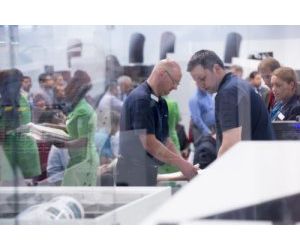
In addition to the extensive program, drupa also offers several special forums where specific topics of the printing and graphics industry are focused and discussed in depth. Whether you want to expand your knowledge, discover new solutions or make valuable contacts, the special forums at drupa offer you a unique and valuable opportunity to do so.

drupa is the ideal platform to discover new products and services in the printing and graphics industry. You have the opportunity to learn about new materials, equipment, software and much more that can help you take your business to the next level.

drupa attracts visitors from all over the world, including many potential customers and partners. You have the opportunity to showcase your products and services, meet new customers and forge new partnerships that can help grow your business.
In summary, drupa is a must-attend event for anyone involved in the print and graphics industry. With its impressive range of exhibitors and programs, drupa offers an unrivalled opportunity to learn, network and grow your business.

What you can expect at drupa
drupa is the largest trade fair for the printing and graphics industry worldwide and offers its visitors a wealth of opportunities. At the show, visitors can find out about the latest technologies and trends, discover innovative products and solutions and make valuable contacts. drupa is a must-attend event for everyone involved in the printing and graphics industry.

drupa is the best place for graphic artists, designers, brand owners as well as project managers to network. The exhibitors at drupa present their latest products and solutions on brand management, process management, production planning but also project management, graphic design and many other topics. The show is a great opportunity to learn about the latest developments in the industry and discover innovative products and services that can help you grow your business and increase your efficiency.
In addition, drupa is also an excellent opportunity to network and build relationships with potential customers and partners. With visitors from all over the world, the show is a place where you can make valuable business contacts that can help you grow your business on a global scale.
Take a look at our list of exhibitors for an overview of all the companies that will be presented at drupa 2024. This way you can search in advance for exhibitors relevant to your interests and prepare for your visit from May 28 - June 7, 2024 in Düsseldorf. Make the most of your valuable time at drupa 2024 and find out in advance about the companies and service providers in the global print, media and packaging industries.