- Home
- Companies
- Cambridge Environmental Research ...
- News
- ADMS 6 & ADMS-Screen 6 released
ADMS 6 & ADMS-Screen 6 released
CERC are delighted to announce that version 6 of ADMS and ADMS-Screen is now available for download from the user area. Existing licence holders will be receiving an email with their new licence shortly.
ADMS is an advanced dispersion model used to model the air quality impact of existing and proposed industrial installations. Its many features include allowance for the impacts of buildings, complex terrain, coastlines and variations in surface roughness; dry and wet deposition; NOx chemistry schemes; short term releases (puffs); calculation of fluctuations of concentration on short timescales, odours; condensed plume visibility; and allowance for radioactive decay including ?-ray dose.
Some of the new features in version 6 of ADMS include
- Buildings: enhancements to the modelling of buildings, including the ability to automatically determine a main building. Easier plotting of the effective building and changes to the way the effect of buildings are modelled, particularly for upwind sources.
- Source apportionment: the new `output per source` option will write the output contribution from each source to each receptor in a new set of output files. The data in these files can be visualised in the Mapper by colour-coding the sources by what degree each source contributes to the concentration at the selected receptor for a selected met. line.
- Time-varying emissions: the ability to specify profiles on a per source per pollutant basis, along with improvements to the entering of time varying emissions factors on screen.
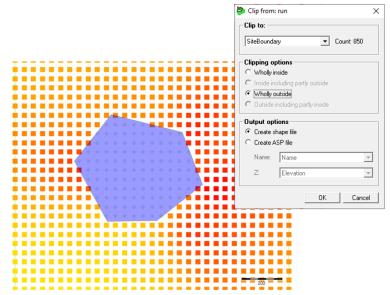
- New tools: `Layer statistics` to find and display the minimum, maximum and X, Y location for each numerical field in a layer. ‘Clip layer to polygons’ allows individual features from one layer to be ‘clipped’ to polygon(s) or polyline(s) from a separate layer. Easily create receptor point (.asp) files containing several different sets of 3D gridded output points, in polar, Cartesian or rotated Cartesian form. Open ADMS-Urban and ADMS-Roads model files (.upl files) directly in ADMS.
- Much more: Please view all the updates in detail in the What`s New? guide.
For further information on this release or any CERC products please email us.