Air Quality Modelling Software - Recent CERC research publications
Alongside core activities of developing air quality modelling software and providing environmental consultancy services, CERC take an active role in UK and international scientific research activities. 2022 was a busy year for CERC`s research team, with ten published co-author journal articles.
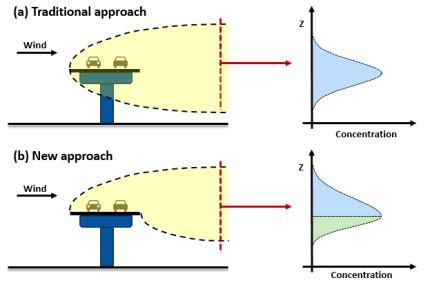
New software development and evaluation was covered in two papers. The improved elevated roads modelling implemented in ADMS-Urban and ADMS-Roads, commissioned by Highways England (now National Highways), was discussed and evaluated by O`Neill et al., upper image. Seaton et al. described the simplified near-road dispersion model based on ADMS-Urban developed within the SPF Clean Air Programme Multi-Model Air Quality System for Health Research (MAQS-Health) project, managed by the UK Met Office.
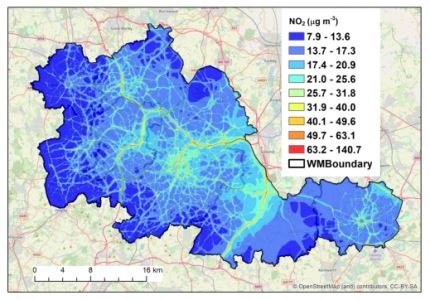
CERC were co-authors in two publications related to the NERC-funded West Midlands Air Quality Improvement Programme (WM-Air) project, led by the University of Birmingham. Regional modelling of fine particulates including regional and national emissions scenarios was described in Mazzeo et al. Coupled regional-to-local modelling using the ADMS-Urban Regional Model Link system to generate street-scale concentrations was covered in Zhong et al., with annual average NO2 concentrations shown in the lower image.
CERC`s work in developing a system to predict adverse meteorological conditions at Hong Kong International Airport was reported in two papers in the Atmosphere journal. These latest results, from a productive collaboration with Hong Kong Observatory that began in 2010, describe the development and evaluation of a wind shear forecasting system.
CERC also contributed to a study of emissions in Beijing, using modelling of perturbed ensembles (Yuan et al.), in collaboration with researchers from the University of Cambridge and Tsinghua University Beijing. Work with the Hong Kong University of Science and Technology (HKUST) studied the consequences of reducing emissions of nitrogen oxides (NOx) and/or volatile organic compounds (VOC) in Guangzhou (China) and surrounding areas using regional-to-local modelling, reported in Zhang et al. Other activities included evaluation of uncertainty in urban air quality sensor measurements (Peters et al.) and consideration of standardised source terms for dispersion and transmission modelling of the SARS-CoV-2 virus (Stettler et al.).
Further information about CERC research is available from our earlier co-author publications and presentations. Publications from other groups using our modelling software are also available.