


- Home
- Companies
- ION Science Ltd.
- News
- Benzene Ring Explained Delving into the ...
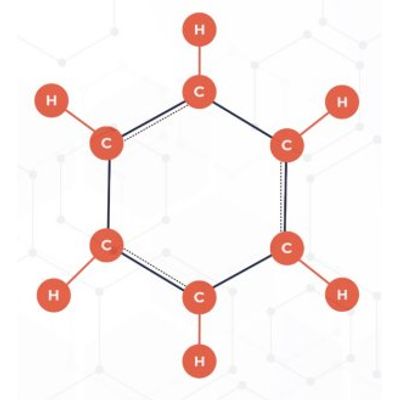
Benzene Ring Explained Delving into the Unique Structure of Benzene
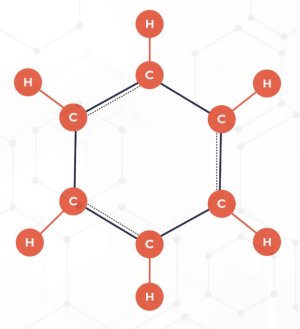
Fundamentally, the benzene ring embodies a hexagonal configuration featuring six carbon atoms, with each carbon atom forming a single bond with a hydrogen atom. What distinguishes it from typical hydrocarbons is the alternating sequence of single and double bonds connecting these carbon atoms. This alternating bonding arrangement constitutes the fundamental aromaticity and stability intrinsic to the benzene ring.
The discovery of the benzene ring is a tale that revolves around the brilliant mind of Friedrich August Kekulé, a German chemist who lived in the 19th century. During the mid-1800s, the structure of benzene, a compound extracted from coal tar, confounded chemists. While they understood its composition-comprising six carbon and six hydrogen atoms-the arrangement remained an enigma.
According to legend, in 1865, Kekulé experienced a pivotal moment while sleeping by a fireplace. Within his dream, he witnessed atoms in a graceful dance, forming a serpentine structure. Remarkably, this serpent had its tail enclosed in its mouth, resulting in a closed ring shape. Upon awakening, Kekulé had a profound revelation: the structure of benzene resembled a hexagonal ring. This visionary dream marked a ground-breaking moment in understanding the essence of the benzene molecule.
Kekulé’s proposition illuminated the stability of benzene. Instead of featuring the anticipated arrangement of three single and three double bonds, benzene’s electrons exhibit a distinctive quality – they are delocalised. In essence, this signifies that the six pi electrons, typically linked with the double bonds, are not restricted to specific carbon-carbon pairs; rather, they are evenly dispersed throughout the entire ring. This phenomenon of electron delocalisation bestows an exceptional stability upon the molecule, ultimately giving birth to its aromatic nature.
Kekulé’s finding brought about a paradigm shift in the realm of organic chemistry. The introduction of the benzene ring fundamentally altered the landscape, establishing itself as the cornerstone for the examination of aromatic compounds and their reactivity. Furthermore, it yielded substantial real-world utility in the industrial sector, where benzene derivatives assumed pivotal roles in the manufacture of plastics, synthetic rubber, dyes, pharmaceuticals, and a multitude of other products.
The benzene ring, characterised by its graceful hexagonal configuration and distinctive aromatic attributes, stands as a defining juncture in the annals of chemistry. Friedrich August Kekulé’s revelation regarding it heralded an era of boundless opportunities, fundamentally altering our comprehension and manipulation of molecules. Emerging from the realm of dreams to ground-breaking revelations, the benzene ring perseveres as an enduring emblem of scientific exploration and ingenuity.
The basics of detecting benzene guide which can be downloaded below provides the reader with an in-depth balance of knowledge covering the main properties, exposure and detection of benzene.