
Customer Story: DKMS Life Science Lab
DKMS LIFE SCIENCE LAB relies on a unique CMV analysis method and flexible automation solutions to match leukemia patients with the best possible stem cell donors.
Every 35 seconds great misfortune strikes, because every 35 seconds a patient is diagnosed as having leukemia. A long and difficult wait for a stem cell donor begins for those who are affected. Hundreds of thousands of patients are searching worldwide. The process of matching patients with donors is difficult. Simply having an identical blood type is not enough. Many other genetic parameters must match in order for a stem cell transplant to succeed.
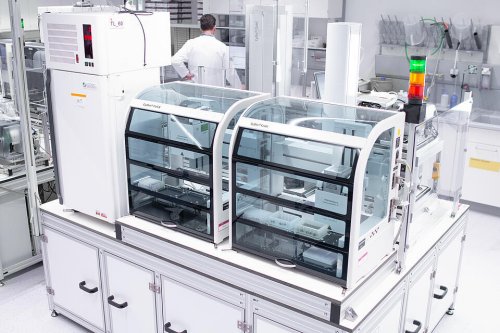
Consequently, things are running at full steam in DKMS LIFE SCIENCE LAB in Dresden; thousands of samples of potential stem cell donors are analysed here every day. Highly-detailed donor profiles are generated from the data obtained from the laboratory analyses. The information is fed into the DKMS stem cell donor database; with over 9 million donor profiles, it is the largest global database of its kind. DKMS gGmbH brings donors and patients together all over the world. Thanks to the detailed profiles provided by the laboratory, the probability of successful stem cell transplantation increases enormously. In addition to the 12 HLA profile characteristics (HLA – human leukocytes antigens), many other markers are being analysed. One of them is the CMV status (CMV – cytomegalovirus) of potential donors. Selecting a donor who has CMV status compatible with the patient reduces the risk of additional complications.
The task: CMV identification with high-throughput
CMV is a kind of herpes virus. Infection with the virus can be life-threatening to leukemia patients with a weakened immune system. Up to now, identification of the CMV status of potential stem cell donors was only possible based on blood samples. However, approximately 90 percent of the samples received by DKMS LIFE SCIENCE LAB are cheek swab samples, in the form of buccal swabs with saliva and cells of the oral mucosa. This was sufficient for identification of HLA markers and other genetic parameters, but not for the CMV status. This meant that, for the majority of potential donors, the CMV status could not be identified at the time of registration. In every case, the CMV status will be checked again immediately before a transplantation via antibody detection. If all information is already available while choosing a potential donor, the selection can be made much faster and more targeted. DKMS LIFE SCIENCE LAB has therefore developed a new method in order to begin the CMV analysis process at the time of registration. The identification of the CMV status determined from buccal swab samples sets new standards for CMV analysis.
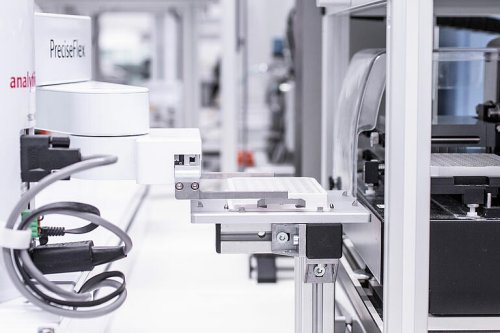
Therefore, the number of CMV analyses rose immensely. Accordingly, the original laboratory facility had to be adapted to meet the new conditions. It was necessary to adapt the existing automation systems in order to scale up from the previous 15,000 samples per month to 100,000 per month and at the same time to ensure the highest-level quality of the analyses ‒ an enormous challenge.The automation of such a process is, of course, no easy task. Many factors need to be taken into account and many parameters have to be brought in line with each another. Boosting the sample throughput was imperative, however. Higher throughput, in this case, simply means saving more lives.