


- Home
- Companies
- Shanghai Metash Instruments Co., Ltd.
- News
- Double Beam UV-Visible ...
Double Beam UV-Visible Spectrophotometer in Food and Beverage Analysis
Food and beverage laboratories operate under a unique mix of analytical pressure: high sample throughput, diverse matrices, strict regulatory tolerances, and the need for long-term data consistency. In this context, a double beam UV-visible spectrophotometer is not chosen for novelty, but for its ability to maintain signal integrity across variable conditions. Modern testing increasingly focuses on trace-level components, narrow absorption features, and long-duration stability—requirements that directly influence instrument architecture and detector configuration.
Rather than relying on theoretical performance metrics, experienced laboratories prioritize how an instrument behaves under routine operation: warm-up stability, calibration repeatability, sensitivity to weak absorbance signals, and maintenance workload. These factors collectively determine whether analytical data can support confident quality decisions. In this blog post, METASH, as one of the high performance precision UV spectrophotometer manufacturers, will share information about double beam uv-visible spectrophotometers in food and beverage analysis.
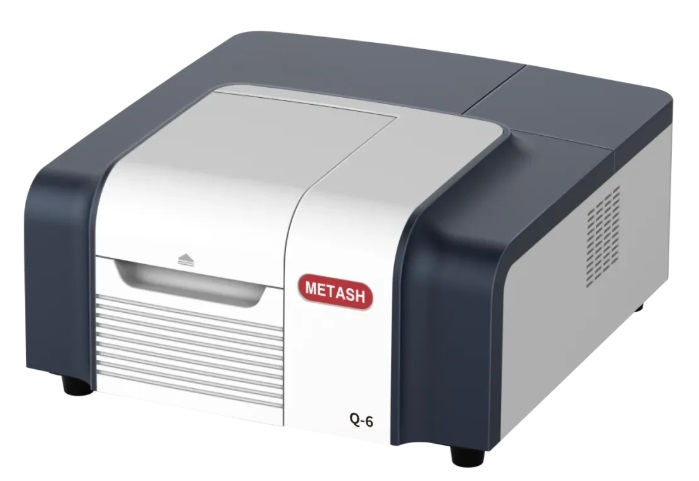
Sensitive detection remains a critical requirement when dealing with weak radiation energy or low-concentration analytes. The use of a photomultiplier tube (PMT) detector significantly enhances signal responsiveness compared to standard photodiode systems. In food and beverage analysis, this higher sensitivity directly improves measurement confidence for trace additives, micronutrients, and compounds with inherently low absorbance intensity.
Fast detector response also benefits kinetic measurements and rapid multi-wavelength scans, where signal lag can distort results. By maintaining a high signal-to-noise ratio even at low energy levels, PMT-based detection allows laboratories to reduce repeated measurements and minimize uncertainty introduced by background fluctuations.
Not all food-related analytes exhibit broad, forgiving absorption peaks. Certain compounds, including specific pharmaceutical-grade additives and functional ingredients, present sharp spectral features that require precise bandwidth control. A continuously adjustable spectral bandwidth from 0.1 to 5.0 nm, with fine resolution steps, provides analytical flexibility across a wide range of applications.
For samples with narrow absorption peaks, smaller bandwidth settings improve peak definition and quantitative accuracy. Conversely, broader bandwidths can be selected for routine screening where speed and robustness are prioritized. This adaptability allows a single double beam UV-visible spectrophotometer to support both precision-focused analysis and high-throughput quality control without methodological compromise.
Stability is the foundation of meaningful analytical data. In food and beverage analysis, where comparative testing across batches and time periods is common, even minor wavelength drift or baseline instability can obscure real trends. Instrument designs incorporating dual light sources, such as deuterium and tungsten lamps, address this challenge by optimizing performance across UV and visible regions while extending service life.
The addition of an auxiliary mercury lamp for wavelength verification further strengthens wavelength accuracy. One-key calibration routines simplify routine validation, ensuring that wavelength precision is maintained without introducing operator-dependent variability. Combined with premium optical components and high-quality lens coatings, these features improve repeatability and reduce recalibration frequency.
Dark current drift is a subtle but persistent source of error in spectrophotometric measurements, especially during long scanning sessions. Real-time automatic calibration of dark current compensates for detector noise fluctuations, preserving baseline consistency. In practical terms, this allows laboratories to run extended analytical sequences without interrupting workflows for manual corrections.
For food and beverage laboratories managing continuous testing schedules, automated dark current compensation supports uninterrupted operation while maintaining data reliability. This capability becomes increasingly important as regulatory scrutiny emphasizes traceability and consistency in analytical records.
Food and beverage testing rarely relies on a single sample format. Liquids, suspensions, and extracts may all require analysis within the same laboratory. A larger sample chamber with support for multiple optional accessories expands the functional scope of a double beam UV-visible spectrophotometer without adding complexity to the instrument footprint.
Optional configurations such as multi-position cell holders, autosamplers, thermostatic cell holders, integrating spheres, and reflection accessories enable laboratories to adapt the instrument to evolving testing needs. This modular approach reduces the need for multiple dedicated instruments, streamlining validation and maintenance processes while preserving analytical flexibility.
While stand-alone functionality is valuable in certain environments, PC software control remains essential for method development, data management, and regulatory documentation. User-oriented software interfaces simplify method setup, spectral analysis, and report generation, reducing training time and operational error.
From an experience-driven perspective, software clarity directly affects laboratory efficiency. Intuitive layouts and transparent parameter control allow analysts to focus on data interpretation rather than system navigation. When integrated into laboratory information workflows, PC-controlled spectrophotometers support consistent method execution across teams and locations.
Maintenance considerations often influence purchasing decisions as strongly as performance specifications. Instruments designed with independent modular architecture simplify servicing and reduce downtime. Socket-type lamp designs allow quick replacement without optical realignment, minimizing disruption to validated methods.
For food and beverage laboratories operating under cost-conscious environments, reduced maintenance complexity translates into lower long-term operational burden. Predictable service intervals and straightforward component replacement help laboratories maintain analytical capacity without over-reliance on external technical support.
The true value of a double beam UV-visible spectrophotometer in food and beverage analysis lies in its ability to generate data that withstands scrutiny. Stable optics, sensitive detection, precise bandwidth control, and automated calibration together create an analytical environment where results can be trusted over time.
This reliability supports not only compliance requirements but also internal process optimization. When analytical variability is minimized, deviations in product quality are more likely to reflect real process changes rather than measurement artifacts. Over time, this distinction enables more informed decision-making across formulation, sourcing, and production control.
Food and beverage analysis continues to evolve toward higher sensitivity, tighter tolerances, and greater documentation transparency. Instruments must therefore balance technical capability with practical usability. A well-configured double beam UV-visible spectrophotometer meets this balance by delivering stable performance without imposing unnecessary operational complexity.
By integrating high-sensitivity PMT detection, adjustable spectral bandwidth, robust calibration systems, flexible sample handling, and efficient maintenance design, such instruments support both current analytical demands and future expansion. Their role extends beyond routine measurement, forming a stable analytical backbone for modern food and beverage quality systems.