


- Home
- Companies
- Cambridge Environmental Research ...
- News
- Estimating emissions from concentration ...
Estimating emissions from concentration measurements: inverse dispersion modelling report published
The Environment Agency recently commissioned CERC and AQC to investigate inverse dispersion modelling methods which could be applied to fugitive (uncontrolled) sources of methane. Inverse dispersion modelling methods allow the estimation of unknown emission rates from concentration measurements. Improving estimates of methane emissions from sources such as landfill sites is important for quantifying greenhouse gas impacts.
The report from this project has now been published online. It includes: a literature review of different inverse dispersion modelling methods; an assessment of the applicability of inverse dispersion modelling methods to different EA-regulated facilities; a study testing four inverse dispersion modelling methods with measurements from three landfill sites; and recommendations for future use of inverse dispersion modelling.
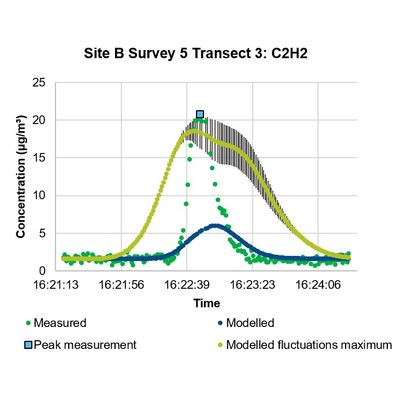
CERC have previously developed and implemented an inverse dispersion modelling approach for improving estimates of urban emissions. For this project we developed a new `modified Bayesian` inverse modelling technique, due to the short timescale of the plume transect measurements. Measurements at 1 second intervals capture the instantaneous rather than ensemble plume. The concentration fluctuations module in ADMS was used to represent the short-term distribution of concentrations, with inverse modelling applied to the peak modelled and measured concentrations only.
The image shows an example of transect measurements of acetylene (C2H2) tracer gas. The 1 second measured data displays a narrow peak, while standard modelling (`modelled`) predicts a wider plume with a lower peak concentration. The maximum model prediction of 1 second concentrations from the fluctuations module (`modelled fluctuations maximum`, also showing standard deviation error bars) gives good agreement with the peak measurement. Methane measurements from the same transect were used in the inverse modelling study.
