


Exploring air quality model evaluation techniques
Comparisons of modelled and measured data are a key part of evaluating model performance. CERC`s latest project for the Atmospheric Dispersion Modelling Liaison Committee (ADMLC) is investigating approaches to air quality model evaluation. A literature review is identifying established and emerging model evaluation techniques and performance metrics for a variety of model types and applications. Case studies will then be used to test the different performance metrics individually and in combination. The project aims to develop best practice recommendations for evaluating a broad range of model applications, reporting late in 2024.
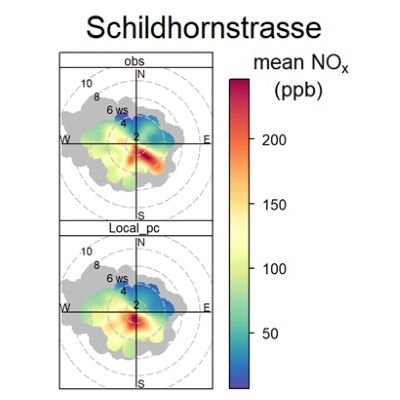
CERC have extensive experience of model evaluation through assessments of the ADMS family of models and inter-comparisons with other models. Jenny Stocker, CERC`s Associate Director (Research) has been a long-standing participant in the Forum for Air Quality Modelling (FAIRMODE) initiative which has developed model quality and model performance indicators. CERC have developed and made public the `Model Evaluation Toolkit` which allows user-friendly access to a broad selection of graphical and statistical model evaluation analyses. The Model Evaluation Toolkit was originally developed under the FP7 PASODOBLE project and recently extended under the SPF Clean Air Programme MAQS-Health project. It makes use of Openair functions and can additionally generate the statistics and graphics recommended by FAIRMODE. The image shows polar plots of the measured and modelled variation of hourly average NOx concentrations (units ppb) with wind speed and direction at the Schildhornstrasse site in Berlin produced using the Model Evaluation Toolkit, as published in Seaton et al. (2022).