


UK Environment Agency TAPRI project reports published
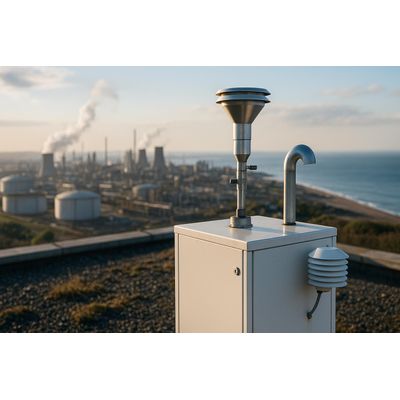
The UK Environment Agency has published a six-report suite from the Thermal Transport of Air Pollution from Regulated Industries (TAPRI) project, investigating how thermal air flows influence dispersion of pollutants from industrial and waste sites. Thermal flows include sea breezes, warm urban air, and downslope drainage; the work combines real-world data, analysis, and modelling to quantify the frequency of such conditions, their impact on air quality, and potential shifts under future climates.
CERC contributed a dedicated report titled Case studies on thermal flow conditions, which presents analyses of meteorological, land-use and topographical data for selected pilot areas and outlines modelling approaches to estimate air-quality impacts using the ADMS and KLAM-21 frameworks, aided by Numerical Weather Prediction data. The project was delivered in collaboration with Air Quality Consultants and John Moncrieff from the University of Edinburgh`s School of Geosciences, under Defra`s Research Development & Evidence Framework Agreement.
The TAPRI suite comprises six reports, including a summary, stakeholder consultation outputs, and an exploration of project outcomes.
Case study insights and modelling approach
The CERC case studies demonstrate how integrated meteorology, land use and topography data can inform thermal-flow–driven dispersion assessments and illustrate practical approaches to modelling air-quality impacts in pilot areas, using established tools and local-scale data.
Related outputs and policy-relevant findings
- Oxfordshire health and financial impacts study: The county`s Air Quality Strategy includes a report describing data generation to assess health impacts and healthcare costs. The assessment uses ADMS-Urban and input from a university tool to quantify PM2.5 and NO2 health effects under policy scenarios, including Net-Zero and local measures such as electrified public transport. The results indicate that reductions in industrial emissions, tighter domestic wood-burning controls, and shifts in road freight yield substantial health and economic benefits; multi-sector policy pathways yield the largest gains. Inputs were prepared for the AQ-LAT tool to quantify health outcomes and costs, supporting policy appraisal.
- MAQS 1.4 release: MAQS is CERC`s automated system for coupling high-resolution urban air-quality modelling (ADMS-Urban) with a regional model. MAQS 1.4 adds compatibility with the latest ADMS-Urban and ADMS-Airport versions, automatic updates of existing input configuration files, support for a site properties data file for spatially varying grid-cell parameters, and the extraction of surface roughness length from regional meteorological data for use by ADMS-Urban.
- West Midlands forecasting and alert system: The West Midlands Combined Authority launched a high-resolution air quality forecasting system delivering 3-day forecasts and alerts for NO2, O3, PM2.5 and PM10 at 5 m resolution. Alerts are issued when levels reach moderate or higher on the DAQI scale and delivered via multiple channels. The system is integrated into WMCA`s air-quality data platform, linking current sensor data with forecasts to inform regional policy and public health decisions. The project builds on CERC`s experience in operational forecasting and collaboration with WM-Air, WM-NZ and WM-Adapt.
- ADMS User Group: Following this year`s ADMS User Group Meetings, PDF presentations are available to registered users from the CERC User Area. Access requires a valid support contract; registration and password assistance are available through the CERC portal.
Original: http://www.cerc.co.uk/about-us/news.php?newsitem=448#news448