


Intelligent Imaging Innovations, Inc.
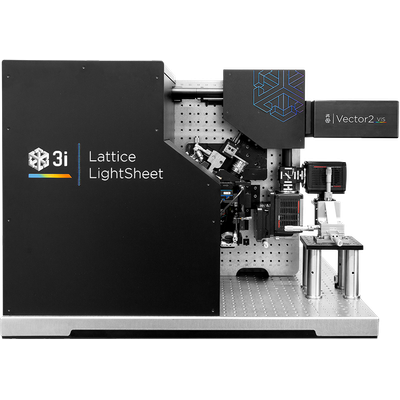
3i - Model Lattice LightSheet - Microscope for 3D Live Cell Imaging
The Lattice LightSheet microscope by Intelligent Imaging Innovations is a sophisticated imaging device designed for high-resolution, dynamic 3D live cell imaging. This system leverages an optical lattice to form exceptionally thin light sheets, enabling prolonged observation of biological specimens with exceptional detail. The microscope excels in 4D live cell imaging, facilitating studies that extend for hours or days, far surpassing the temporal limitations of traditional imaging platforms. Its advanced optics incorporate specialized cylindrical lenses to create and modulate the light sheet using a spatial light modulator, enabling users to achieve high spatiotemporal resolution and sensitivity. Supporting photomanipulation and single-molecule localization microscopy, the Lattice LightSheet provides environmental control, advanced beam structuring, and modular light sheet configuration to accommodate diverse experimental needs. This system is particularly beneficial for research in fields such as cell biology, immunology, and neuroscience, offering powerful tools for exploring cellular and subcellular dynamics.
Most popular related searches
live cell imaging
microscopy
quantitative imaging
cell biology
microscopy system
membrane diffuser
cell imaging system
inline sampling
The lightsheet is rapidly dithered along the X axis and one image is captured per Z plane.
Deconvolution
Quantitative image restoration (after standard sheet scan) via constrained iterative deconvolution in SlideBook.
Structured Illumination Microscopy (SIM):
The light sheet is moved in five discrete phase steps along the X axis. Five raw images are collected that are reconstructed to produce an image that is beyond the diffraction limit of the detection objective by a factor of ~1.4x.
Photomanipulation
Photomanipulation is a powerful tool for studying membrane dynamics, receptor and vesicle movement and photo conversion of specific molecules. Addition of the Vector2 X,Y galvo scanner makes complicated bleaching, FRAP, uncaging and photoconversion experiments easy. Compared to a spinning disk or point scanning confocal, photomanipulation experiments on a lattice can be done more rapidly and with less inherent bleaching. Vector2 can be added to new or existing Lattice LightSheet systems.
- photomanipulation : Bleaching of a cell membrane via Vector2. Targeting of specific regions of interest is highlighted by the flashes of excitation light in a line across the sample, repeated over a few time points to gently bleach out the target portion of the sample. Bleaching is possible with any laser present on the system.
- frap : Fluorescence Recovery After Photobleaching (FRAP) can be used to study kinetics of membrane diffusion after a targeted region has been bleached of fluorescent signal. Over time the fluorescence in the targeted area recovers based on the rate of diffusion.
Single Molecule Localization Microscopy
Cell biologists and biophysicists are increasingly interested in tracking single molecules of interest instead of looking at groups of proteins as a unit. Single molecule localization microscopy (SMLM) offers researchers the ability to observe individual fluorophores on a single molecule of interest and observe how each behaves. Typically, techniques like TIRF have been required for SMLM but Lattice LightSheet offers the following capabilities to increase overall signal-to-noise and facilitate SMLM imaging in 3D:
- High-powered lasers (up to 2W)
- The most sensitive sCMOS cameras with low read noise and 95% QE
- 100+ fps acquisition for rapid single plane imaging or acquiring volumes per second
- Photoswitching and photoconversion through Vector2
Intracellular to Extracellular to Multicellular Imaging
Motorized Light Sheet Selection
With 17 different light sheet lengths and thicknesses to pick from, it is easy to find the ideal Lattice for your sample.
- 15-20 µm sheets for intracellular events
- 30-40µm sheets for small organoids and cell-cell interactions
- 50-75µm sheets for large organoids and portions of embryos or larger organisms
Using the “Mask” mode allows for changing of the light sheet while the sample remains in focus, allowing users to evaluate different light sheet parameters in real time. SIM is possible with any of the sheets, opening the door for fast super-resolution imaging of an assortment of sample types.