


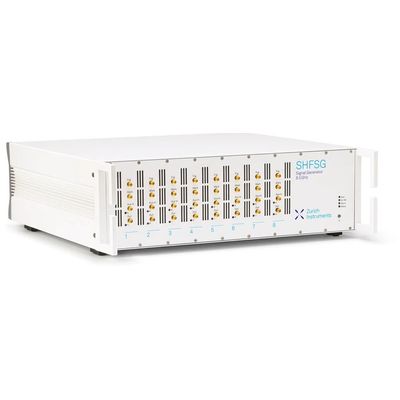
Zurich Instruments - Model SHFSG -8.5 GHz Signal Generator
The Zurich Instruments SHFSG Signal Generator produces qubit control signals in the frequency range from DC to 8.5 GHz with a spurious-free modulation bandwidth of 1 GHz. The SHFSG uses a double superheterodyne technique for frequency up-conversion, which eliminates the need for mixer calibration and saves time on system tune-up. Each SHFSG comes with 4 or 8 analog output channels with 14-bit vertical resolution. Controlled by LabOne, its APIs or the LabOne QCCS Software, the SHFSG supports quantum computing projects with sizes ranging from a few to several hundred qubits.
When synchronized by a PQSC, multiple SHFSGs can be combined within a Zurich Instruments QCCS to enable control of many-qubit systems. Multi-qubit gate operations with minimal latency and high fidelity can be realized thanks to an advanced sequencer, a low-latency signal processing chain and low-phase-noise synthesizers. Combined with the SHFQA Quantum Analyzer for real-time qubit readout, the SHFSG represents the second generation of instruments integrating microwave generation and analysis.
- 4 or 8 output channels, control of up to 8 qubits
- Operation from DC to 8.5 GHz with 1 GHz bandwidth and free from mixer calibration
- Low phase noise and low spurious tones for high-fidelity gates
- High output power for short gate pulses without external amplification
- 14-bit output at 6 GSa/s
- Controlled through the LabOne® QCCS Software, LabOne, or LabOne`s APIs for Python, C, MATLAB®, LabVIEW™ and .NET
- Coherent manipulation of qubits with single- and multi-qubit gate operations
- Qubit spectroscopy and characterization
- Real-time, low-latency and global feedback for error correction
- Superconducting qubits
- Spin qubit/superconducting resonator hybrids
- NV centers
- Qubits, qutrits and ququads
High-fidelity qubit operation
The frequency range from DC to 8.5 GHz enables a single SHFSG to generate a variety of single- and multi-qubit gates. The SHFSG`s super-heterodyne frequency conversion scheme operates over a wider frequency band and with better linearity and fewer spurious signals than standard IQ-mixer-based methods. This means that the SHFSG generates spurious-free, stable signals without requiring its users to spend time on mixer calibration or system maintenance. Building on the performance of synthesizers specifically designed for qubit control, the SHFSG offers low phase noise and low timing jitter across the output frequency range, ensuring that qubit gate operations realize the full potential of the quantum processor in terms of fidelity. Each SHFSG contains 4 low-phase-noise synthesizers, corresponding to 1 synthesizer per channel in the SHFSG-4 variant and to 1 synthesizer per channel pair in the SHFSG-8 variant.
Advanced sequencer for efficient workflows
The SHFSG supports minimal use of waveform data even when complex signals are required. Users provide the desired signal in the form of a pulse description to the LabOne QCCS Software, which then automatically programs the SHFSG in the most memory-efficient manner. Even for many-qubit systems that rely on multiple SHFSGs, this approach ensures that complex tune-up and calibration routines are completed with a minimum of instrument communication time. Support of loops and conditional branching points further enables the implementation of quantum error correction and active reset, while real-time phase updates make it possible to implement virtual Z gates. With up to 98 kSa waveform memory per channel, the ability to handle up to 16k sequence instructions, and a sampling rate of 2 GSa/s, the SHFSG offers customizable multi-channel AWG signals for qubit control.
Scalable system approach
Each channel of the SHFSG has its own AWG core for creating phase- and timing-programmable waveforms, so that a single SHFSG-8 instrument can control 8 individual qubits. To carry out advanced protocols such as global error correction, several SHFSGs (for qubit control) can be combined with multiple SHFQAs (for qubit readout). The Zurich Instruments ZSync interface links the SHFSGs and SHFQAs to each other via the central PQSC Programmable Quantum System Controller; the LabOne QCCS Software optimizes communication across instruments, thus simplifying protocol execution. Up to 18 SHFSGs can be synchronized through a PQSC, leading to coordinated control of up to 144 qubits. SHFSGs that are synchronized through a PQSC can be programmed with the LabOne QCCS Software, with LabOne, or with its APIs for Python, C, MATLAB®, LabVIEW™ and .NET – so that users decide how they wish to incorporate the SHFSG into a new or existing setup.
Signal Outputs
Number of RF outputs: 4 (SHFSG-4 model)
8 (SHFSG-8 model)
Frequency range: DC - 8.5 GHz
Signal bandwidth: 1.0 GHz
Output ranges (dBm): -30 dBm to +10 dBm
Output impedance: 50 Ohm
Number of synthesizers: 4 (both models)
D/A conversion: 14 bit, 6 GSa/s (after internal 3x interpolation)
Output voltage noise density: -135 dBm/Hz (1 GHz, 10 dBm, offset > 200 kHz)
-140 dBm/Hz (4 GHz, 10 dBm, offset > 200 kHz)
-144 dBm/Hz (6 GHz, 10 dBm, offset > 200 kHz)
-144 dBm/Hz (8 GHz, 10 dBm, offset > 200 kHz)
Output phase noise: -90 dBc/Hz (6 GHz, carrier offset 1 kHz)
-98 dBc/Hz (6 GHz, carrier offset 10 kHz)
-100 dBc/Hz (6 GHz, carrier offset 100 kHz)
Output level accuracy: ±(1 dBm of setting)
Spurious-free dynamic range (excl. harmonics): 74 dBc (1 GHz, 0 dBm)
66 dBc (4 GHz, 0 dBm)
60 dBc (6 GHz, 0 dBm)
65 dBc (8 GHz, 0 dBm)
Output worst harmonic component: -40 dBc (1 GHz, 10 dBm)
-40 dBc (4 GHz, 10 dBm)
-38 dBc (6 GHz, 10 dBm)
-36 dBc (8 GHz, 10 dBm)
Markers and Triggers
Marker outputs: 1 per channel, SMA output on front panel
Marker output voltages: 0 V (low), 3.3 V (high)
Marker output impedance: 50 Ohm
Marker output rise time: 300 ps (20% to 80%)
Trigger inputs: 1 per channel, SMA on front panel
Trigger input impedance: 50 Ohm / 1 kOhm
Waveform Generation
AWG cores: 1 per channel
Waveform vertical resolution: 14-bit analog + 2-bit marker
Waveform memory: 98 kSa per channel
Sequence length: 32k instructions per AWG core
AWG sampling rate: 2 GSa/s
Minimum waveform length: 32 Sa
General
Dimensions: 449 x 460 x 145 mm (19" rack)
17.6 x 18.1 x 5.7 inch
Weight: 15 kg (33 lb)
Power supply: AC: 100-240 V, 50/60 Hz
Supported clock frequencies (external or internal): 10 MHz or 100 MHz
Connectors:
SMA on front and back panel for trigger, signals and external clock
32 bit DIO
1 ZSync
1 GbE
USB 3.0
Maintenance USB