


- Home
- Companies
- Dispersion Technology, Inc. (DTI)
- Products
- DTI - Model DT-1210 - Acoustic and ...
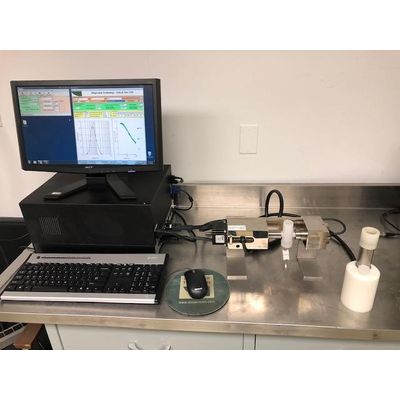
DTI - Model DT-1210 -Acoustic and Electro-Acoustic Spectrometer
Acoustic and electro-acoustic spectrometer. Particle size distribution and zeta potential with minimizing sample volume.
Acoustic and electro-acoustic techniques have significant advantages for characterizing particle size distribution and zeta potential when used in conjunction. As such, an optimum technique based on ultrasound should combine both acoustic and electro-acoustic spectroscopy together in one instrument. The Acoustic & Electro-acoustic Spectrometer DT-1210 is such an instrument. It is similar to DT1202 in function, but sample handling is completely different.
Sample handling setup
The DT-1210 has a very flexible sample handling system that we have developed while dealing with complex concentrated systems for over 15 years. Instead of combining both ultrasound based sensors (Acoustic for sizing and Electroacoustic for zeta) like in 1202, these sensors are completely separate. In addition, Acoustic sensor has disposable sample cell with sample volume under 5 ml. Zeta potential probe has a cup accessory that reduces sample volume down to 0.2 ml.
Options
Available set of Options for DT1210 is similar to the DT-1202. For instance, it can be supplied with 2 burettes for titration. This allows measuring zeta potential and particle size at different pH, surfactant concentration, and ionic strength. Aqueous and non-aqueous conductivity measurements are also optional. Non-aqueous conductivity is especially important for characterizing zeta potential in non-polar liquids. The Rheological option is suitable for characterizing longitudinal rheological properties, such as compressibility and bulk viscosity. Porous materials Option extends zeta potential capability for these types of samples. This option includes also measurement of porosity with high frequency aqueous conductivity probe. However, implementation of some of these Options requires different sample flow arrangements.