- Home
- Companies
- Dynaflow, Inc.
- Products
- Acoustic Bubble Spectrometer(ABS )
Acoustic Bubble Spectrometer(ABS )
The Acoustic, Bubble Spectrometer is a commercially available acoustics based device that measures bubble size distributions and void fraction of bubbles in liquids. The initial efforts to develop the technology were funded by Small Business Innovation Research (SBIR) awards from the National Science Foundation. Continued developments were funded by institutions and companies in both public and private sectors, including Department of Energy, Oak Ridge National Laboratories, and many other private companies. The ABS Acoustic Bubble Spectrometer®© is under constant development, driven by new commercial applications and by the request of customers using the instrument to address their specific applications.
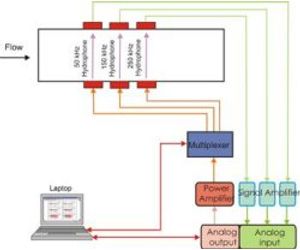
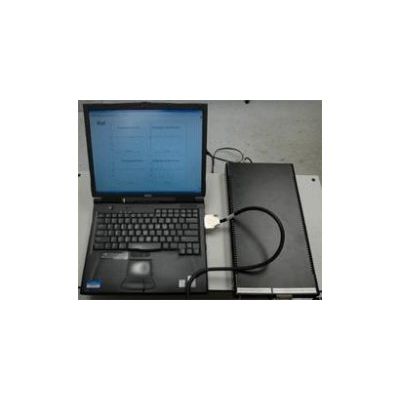
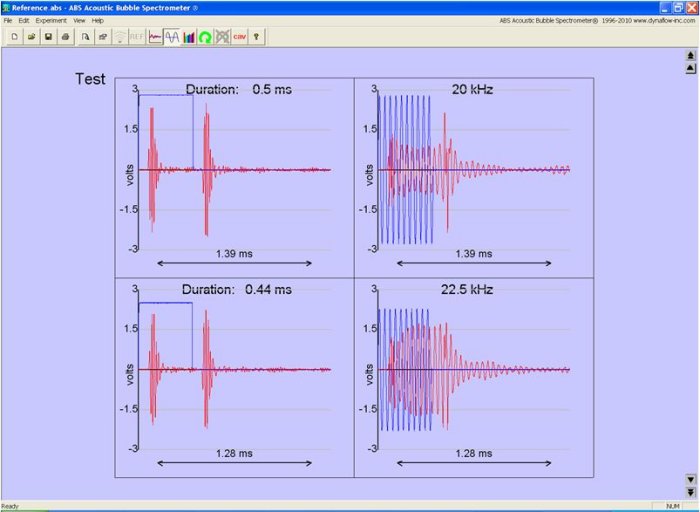
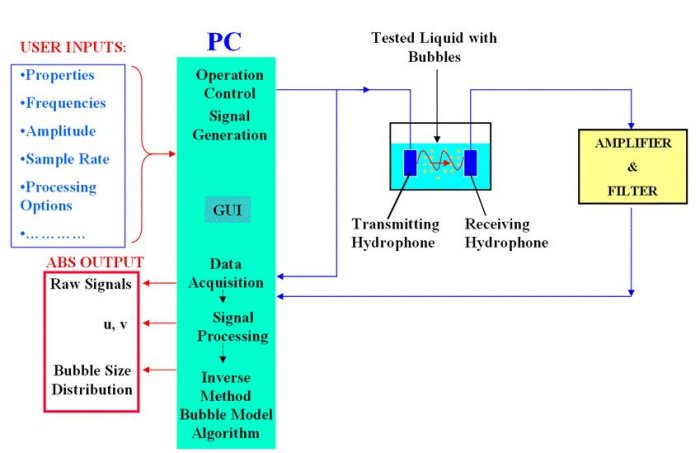
The device extracts the bubble population from acoustical measurements made at several frequencies. It consists of a set of two transducers/hydrophones connected to a computer. A data acquisition board controls the hydrophones` signal generation and acquisition. The PC is also used for analysis of the data and provides, using Dynaflows`s software, the sound speed and attenuation as a function of frequency.
The bubble population can be obtained from these measurements by a solution of two Fredholm Integral Equations of the first kind. These equations are ill-posed and are a challenge to solve - especially when the data has noise. In our research, we developed novel algorithms that are able to accurately solve these equations using a constrained optimization technique.
The instrument can provide the data in near real time, thus making it suitable for process applications. The bubble distributions from the ABS Acoustic Bubble Spectrometer have been validated by comparison with micro-photography.
Compared to optics based devices, the ABS Acoustic Bubble Spectrometer is inexpensive and easy to use. In addition, the acoustic technique is very sensitive to bubbles and is not fooled by the presence of particulate matter which are optically not readily distinguishable.
- Very sensitive to bubbles
- Optically transparent liquid or containers are not required
- Distinguishes bubbles from particles
- Built on a PC Windows platform with a user-friendly graphical interface
- Measurements are easily and rapidly conducted
- Validated by comparison with microphotography
- Near real-time measurement
- Cost effective
- User-friendly system
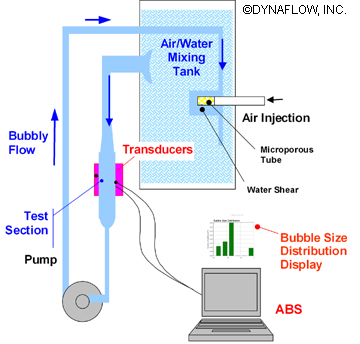
The device can be used in a wide variety of two-phase flow applications where knowledge of the bubble size distribution and the volume fraction and/or area of contact between the gas and the liquid is important. Major areas of application are in oceanography, controlled laboratory testing, and industrial flows. Possibilities for further application are in the field of bio-medical instrumentation.
Aeration: Bubble counting has potential uses in monitoring aeration in areas such as sewage treatment. Another potential use is in the area of fish farming, where fish species can be categorized by the size of their swim bladders. Use of the present acoustic techniques would permit measurement of the numbers and size of fish in a given volume.
Oceanography: Gas bubbles are generated in large numbers in the upper ocean layers, and have a significant effect on ocean acoustic properties. Bubbles strongly modify the sound speed and make the ocean acoustically dispersive. The modeling of the ambient sound-spectrum in the ocean require the bubble size distribution as input. Knowledge of the amount and location of gas exchange is also required in ocean-atmospheric studies including the carbon-cycle, study of the balance of greenhouse-gases, the oxygenation of oceans and its role in the food-chain, etc.
Cavitation and Multiphase Flow: Micro-bubbles act as nuclei for cavitation inception. Cavitation is a process in which cavities grow and implode violently in a liquid, occur in flows following a pressure drop, or in the presence of an acoustic field. Cavitation has a strong erosive effect on nearby boundaries such as valves, gates, pumps, propellers and fluid-machinery, and is a significant noise source. Knowledge of the sizes of bubbles in a medium along with knowledge of the flow/sound-field can be used to predict the likelihood of cavitation and provide important information for improving design. Naval architects now require information on bubble population under field conditions for the design of propellers so that conditions in the field can be related properly to conditions in the laboratory. Cavitation tunnels as well as turbine and power plant equipment users, which perform measurement of void-fraction/bubble population to determine optimal and safe operating conditions, should thus find use for the device.
- Maritime – hydrodynamics, propulsor performance, cavitation, power plants, turbomachinery, pumps
- Biomedical – blood transfusions, artificial heart valve, bubbles in tissue and blood, decompression sickness
- Space – effects of microgravity on multiphase fluids, reduced pressure effects
- Oceanography – atmosphere / ocean interface studies, air entrainment, oxygenation, sound transmission, background noise
- Multiphase Flow – valves, pumps, propellers, fluid machinery, industrial & chemical processes, specialty fluids, measurement of aeration bubbles, boiling
- Education / Research – fluid dynamic & cavitation studies, bubble nuclei in water tunnels
- Environmental – categorizing fish by size, monitoring sewage treatment, mixing
Generation 2 Base System
Includes the following:
- Desktop Pentium IV (CPU Only), Windows XP
- 10 MHz Data Acquisition Card
- 1/2 inch Transducers (2)
Upgrade
- Notebook PC w/Extension unit for PCI
- 64 Bit Dual Core Processor
- No-Hardware ABS Software
- License Renewal (annual)
- Transducer Amplifier (Recommended for smaller hydrophones and noisy experiments
- Multi-Hydrone Sets
- Cavitation Susceptibility
USB Asynchro-DAQ System
Includes the following:
- 1.25 Mhz Asynchronous Data Acquisition Card
- Integrated USB box
- One Year Software Support and Upgrades
- USB Synchro-DAQ System
Includes the following:
- 2.0 Mhz Synchronous Data Acquisition Card
- Integrated USB box
- One Year Software Support and Upgrades
Transducers Center Frequency
- 50 KHz
- 150 KHz
- 250 KHz
- 500 KHz
Emitter & Receiver Transducers / Hydrophones Square (2 ABS Transducers Active Area)
- 0.5x0.5 in 2
- 1x1 in 2
- 2x2 in 2
- 3x3 in 2
- 4x4 in 2
Circle (2 ABS Transducers Active Area)
- 0.5 in Diameter
- 1 in Diameter
- 2 in Diameter
- 3 in Diameter
- 4 in Diameter
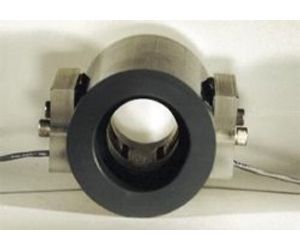
Instrumented Bypass Setups
- 2 ABS Transducers Active Area
- 0.5x0.5 in 2 (Embedded in 1.5 in Inside Diameter * PVC Pipe)
- 1x1 in 2 (Embedded in 1.5 in Inside Diameter * PVC Pipe)
- 1x1 in 2 (Embedded in 3 in Inside Diameter * PVC Pipe)
- 2x2 in 2 (Embedded in 3 in Inside Diameter * PVC Pipe)
Multi-Hydrophone Sets
- 2 Sets
- 3 Sets