


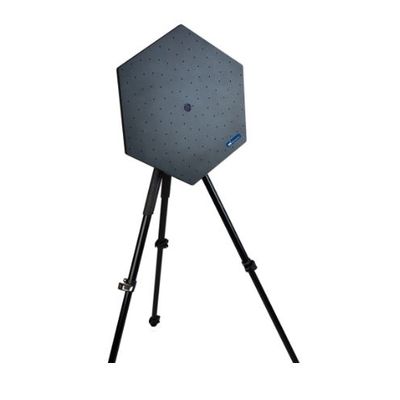
Norsonic - Model Nor848B -Acoustic camera
The Norsonic Nor848B acoustic camera is a module based approach to acoustic camera that gives the user both portability and great resolution for a wide range of measurement situations.
- Hextile – Lightweight and portable
- Multitile – Great resolution
- Multitile (LF mode) – Low frequency measurements
Acoustic beamforming arrays, commonly known as acoustic cameras, enable the user to visualise different sound sources at different frequencies and source strengths. The resolution and ability to resolve sound sources spaced closely apart, and at lower frequencies, is mainly decided by overall size and number of microphones of the equipment being used. Although image manipulation and deconvolution techniques on the beamformed results might give added resolution, in practise the properties of the array still influence the results. This size versus resolution criteria is the crux of the acoustic camera market. Users want something that is small, light weight, and portable, while at the same time having excellent resolution, and the ability to go low in frequency. This has been an impossible demand for a single system – until now.
The Norsonic Hextile is a module based approach to acoustic camera that gives the user both portability and great resolution for a wide range of measurement situations. The array dish is based on a hexagon shape, given it both its name, and the ability to combine several tiles into larger systems.
Hextile – lightweight and portable
With a single Hextile, the user has a small, portable and lightweight acoustic camera that can be used for a wide range of measurement situations. The Hextile is a USB based acoustic camera, with a single USB cable for both power and data transfer – no extra battery cable needed. The array is made from robust and lightweight aluminium, has 128 MEMS microphones, and is less than 3 kg in weight while having a maximum diameter of 46 cm. The low frequency limit for the Hextile is 410 Hz.
Multitile – great resolution
For users that require better resolution both in lower frequencies and overall, three single Hextiles can be combined to a larger Multitile system, consisting of 384 microphones with a maximum diameter of 96 cm. The low frequency limit for the Multitile is 220 Hz.
Multitile (LF mode) – Low frequency measurements
For special low frequency applications below 1 kHz, it is also possible to utilise the Multitile in the low frequency configuration as the Multitile (LF mode). By placing the individual Hextiles further away, the maximum diameter of the complete array system is increased to 1.46 m, making it ideal for low frequency measurements. The Multitile (LF mode) is for low frequency measurements below 1 kHz, with a lowest frequency limit of 120 Hz.
The software design strategy has always had user friendliness and ease of use in mind. We want the user to be able to get results quickly, and start analysing recordings easily, thus spending time on the analysis, rather than the measurement set up or configuration of parameters. Live view of measurements combined with an intuitive software interface enables users without prior experience to make measurements within the first five minutes after powering the device.
Order analysis
Especially in automotive applications RPM measurements may give vital information. The acoustic camera software has the possibility to display frequency content as a function of RPM by using the order analysis function.
In the spectrogram window, frequency as a function of RPM is plotted. It is further possible to select a square in the spectrogram window to isolate interesting events. By pressing the “apply” button on the selection, the RPM and frequency limits in the main view window automatically change to the limits set by the selection in the spectrogram. The user may then find and interesting sound event in the spectrogram, and automatically get the corresponding colour plotting of the event chosen.