


- Home
- Companies
- Sea Sciences, Inc.
- Products
- Acrobat - Tow Body System
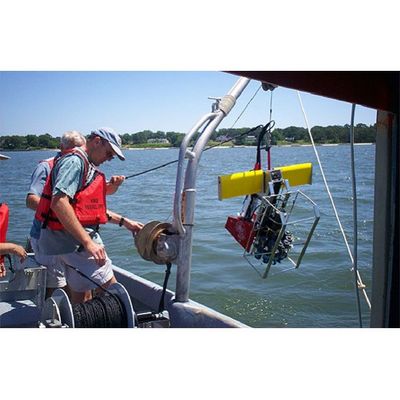
Acrobat - Tow Body System
In today’s marketplace, there are many platforms available to support sensors in fresh and saltwater environments.
Consider the following Acrobat tow body system advantages in making a decision:
- Data in real time using Ethernet connectivity
- Power, of unlimited duration with 200 watts available for Acrobat and payload
- Payload, almost any sensor suit and without design change requirements
- Survey Speed, from 2 to 12 kts
- Lightweight, 14 Kg (30 lbs) tare in air without payload
- Size, basic dimension of 1.36 x 0.4 x0.8 meters (4.5×1.3×2.6 ft) without add-on expansion modules
- Portable, capable of being easily shipped worldwide, setup on any boat and used in any environment
- Software, written in Java for operating system independence including Linux
- Underwater Path Control, remote manual or automatic via computer
- In-the-field Support, most user problems can be resolved via 24/7 cell phone or e-mail communications
- Warranty, Our products carry a 2-year warranty
The flexibility of the Acrobat system to carry and provide real-time data from a wide variety of off-the-shelf instrumentation is without equal in today’s marketplace.
The Acrobat body uses an open frame design for placement of control modules and payload sensors. This means that there is little if any restrictions on the makeup and size of sensors, etc.
The basic Acrobat frame supports a molded active wing set, motor module, optional Ethernet and Power module, tail fins, adjustable horizontal stabilizer, and an adjustable tow bar.
The payload sensors are fitted to quick-release extension frames attached below the basic Acrobat frame.
The optional Ethernet module supplies power for the entire Acrobat system including all payload sensors. The serial data from the sensors is Ethernet multiplexed and sent topside for computer processing.
Acrobat
- Size/Weight: LTV-50X body
- Length (Excluding tow bar): 0.80m
- Maximum Height (tail): 0.40m
- Maximum Width (with long wings): 1.36m
- Weight with small wings (excluding instrumentation): In Air = 15kg , In Water = 9kg
Operating Profile
- Control: Manual and/or computer control with real-time communications
- Depth Range: 100m or less and is function of tow speed, cable, weight, and wing size
- Control Modes: Constant depth, height above bottom, constant undulation, varying undulation, and maximum number of undulations
- Towing Speed: 2 to 12 knots typical
- Dive / Climb Speed: Independently adjustable
Engineering Details
- Flight control: Hand Control Module for limited manual operation plus user owned PC and LTV software or (OPTION) Control Command Module with active screen system in a protective case and the LTV software installed
- Data used for control: Wing angle, vehicle depth, GPS, and echo sounder depth Power: LTV power module 120/220 AC in, 30VDC out, max.1A
- Materials: Welded stainless steel frame, towing yoke; composite wings, PVC tail
Support Systems
- Winch with slip ring assembly: For ease of cable deployment/recovery. Not required for short cable lengths and safety clutch system
- Cable: Faired, 9 mm diameter Vectran with 9 conductors. Standard suggested minimum length is 150 m for operations to 50 m
- Safety Tow System: Reduces sudden increase in towing loads and provides a means of safely anchoring the towing line to the boat while towing
- Computer: Suggested minimum configuration is a PC Notebook with Pentium or better processor, active matrix display, 2 standard serial and/or USB ports, 800M hard drive, and a CD-ROM drive
- Navigation: GPS / Depth sounder combination. Multiplexed NMEA 0183 data is used by the Acrobat Control PC for horizontal tow body position and altitude off the bottom display
he choice of which Acrobat system to purchase initially depends on the instrumentation payload size and makeup, that the system is expected to carry and the funding available.
The Acrobat systems are modular and with some limitations, can be expanded at any time to carry larger and more complex payload suites. To that end the systems can be divided into 3 major groups with all groups customizable as needed.
The groups are: Basic, Intermediate, and Professional with increasing cost and capability from one to the next.
Intermediate includes a selection of quick-release payload frames, Ethernet communications, and power supplied to the entire system including payload.Intermediate sustems usually include an electric winch, and at least 200 meters of tow cable.
Customization can include special payload frames with Rosette samplers or other samplers, HiDef color video cameras, one or two optical fibers in the tow cable, and other needs. We suggest you contact us and we will work with you to provide a successful system. We can provide quotes with sufficient component detail to allow deletions or additions based on requirements and funding.
The length of tow cable needed is generally a ratio of cable length to tow depth. With the Acrobat systems, this is usually between 2:1 up to 6:1.
The decision over what to use is generally based on desired tow speed, desired depth of dive, sea-state, weight and size of Acrobat system.
For instance, for speeds up to 6 kts and a depth of 0 to 40 meters, we might suggest 150 meters of cable as a start. Usually a discussion with the end user concerning the field program results in a good estimate of the cable length needed.
The cable construction is designed with a copper conductor bundle center section, covered by a Vectran weave which in turn is covered by a poly weave having a one-sided fairing to reduce strumming while towing. This combination is almost weightless in sea water allowing the Acrobat to return to/or very near the surface.