

World-Water - Model BIOCOS -Activated Sludge System for Municipal Wastewater Treatment
Our biological combined system (BIOCOS®) is an activated sludge process maintaining a consistent water level during operation. This technology shares features of both continuous-flow and sequencing batch reactor (SBR) systems. The benefit of cycles allows for more operational flexibility under variable load and flow situations typical of municipal wastewater treatment.
To recycle the thickened bottom layer of the settled sludge blanket, we implement an air-lift to move the sludge from the the ALT tank to the selector zone of the AIR tank. Transferring the compressed sludge layer provides a 50% more mixed liquor suspended solids (MLSS) within the AIR tanks compared to the ALT tanks.
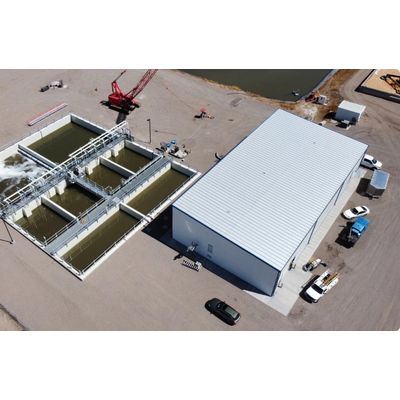
Mixing (MIX) PhaseBIOCOS is a cyclic activated sludge system with two aeration tanks (AIR tanks) hydraulically connected to an alternating pair of sludge recycling and settling tanks (ALT tanks). When one ALT tank has an open decanter and settling is complete, water flows to the aeration tank and pushes the clear supernatant water out of that corresponding ALT tank.
This system reduces operation and maintenance efforts because all operational phases are exclusively driven by pressurized air from the same blower system. This allows for the removal of conventional return activated sludge (RAS) pump stations and electro-mechanical equipment used for mixing and settling purposes.
- Optimized biological phosphorous activity with inDENSE®: Increased biomass minimizes the demand for chemical phosphorous precipitation.
- Small tanks reduce overall system volume and densified biomass helps improve settleability.
- Denitrification capability: Up to 50% of the nitrogen removal typically occurs in the sludge blanket of the ALT tanks. This denitrification approach is highly suitable for low biochemical oxygen demand (BOD) and total nitrogen (TN) ratios in the feed through endogenous decay.
- Low fine particles: Sequenced settling of the sludge blanket forms a floc-filter which reliably removes fine particles. This produces an effluent that is low in suspended solids and suitable for water reuse.
- Simple O&M — There is no mechanical equipment within the aeration and settler tanks and blower air is utilized for the RAS-recycle and mixing phases, resulting in low maintenance requirements.
- Low space demand: Common-wall construction allows for a compact footprint with the reduced need for external piping that are required for a recycle and pump station.
- Less energy demand — Substantial savings due to the minimization of mechanical devices. By adding AvN®-control this further reduces the aeration demand for nutrient removal.
- Capital investment savings: Investment costs are low due to a lack of mechanical equipment (blowers and in-tank piping compared to scrapers, mixers and recycle pumps) and common wall construction between the AIR and ALT tank.
- Innovative but proven technology: More than 200 reference plants are already operational.