


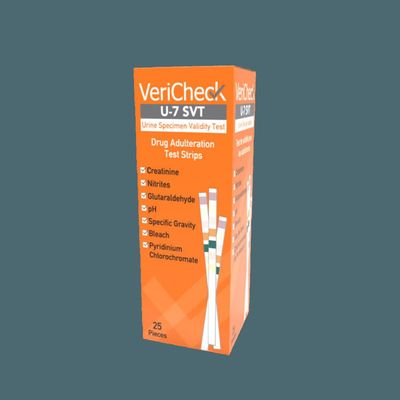
Adulteration Tests
Specimen Validity Test 7-parameter Adulteration Test Strip. VeriCheck® U-7 SVT test strip provides a 7-parameter screen to confirm the validity of urine for the purpose of screening for drugs of abuse. This test tests: Creatinine, Nitrite, pH, Specific Gravity, Glutaraldehyde, Bleach and Pyridinium Chlorochromate. ATION The validity of screening urine depends on the integrity of the urine sample. Contaminated or adulterated samples may cause erroneous results leading to significant consequences. Hence, it is important to ensure that the samples are consistent with normal urine. The VeriCheck® U-7 SVT will determine: Whether the sample is diluted or substituted with water or other liquids. Whether the sample contains commercially available adulterants including; Stealth, Urine Luck 6.3 and 6.4, Whizzes, Klear, Clear Choice, Instant additive Lucky Lab, LL418, Purafyzit, Clean or detoxifying cleansers
WARNING AND PRECAUTIONS
For in vitro use only.
For informational or forensic use only.
Each test strip is single use only.
The desiccant in the strip container is a non-toxic substance silica gel. If the desiccant is inadvertently ingested, drink water immediately and contact your local poison control center for more information.
Used test strips can be disposed of into the general waste/garbage.
Creatinine: Creatinine reacts with a creatinine indicator in an alkaline medium to form a purple brown color complex. The color intensity of the test pad is directly proportional to the concentration of creatinine in the sample.
Nitrites: The test is based on the diazotization reaction of nitrite with an aromatic amine to produce a diazonium salt. It is followed by an .o-coupling reaction of this diazonium salt with an aromatic compound on the reaction pad. The azo dye produced causes a color change from white to pink.
Glutaraldehyde: This analysis is based on the reaction of the aldehyde group on the glutaraldehyde with an indicator to generate a brown color complex.
pH: Double indicator system. The indicator`s methyl red and bromothymol blue are used to give distinct color changes from orange to green to blue.
Specific Gravity (SG): Ionic solutes present in the urine cause protons to be released from a polyelectrolyte. When the protons are released it produces a color change of bromothymol blue from blue-green to yellow-green.
Bleach: If Bleach is detected, a color indicator reacts with it to form a blue complex.
Pyridinium Chlorochromate: A color indicator reacts with pyridinium chlorochromate to form red-violet color.
Do not open the container until ready to use.
Close the bottle cap immediately after opening. Keep the bottle tightly closed between tests.
Do not remove desiccant from bottle.
Do not touch reagent pad(s) on the strips.
Keep out of reach of children.
SPECIMEN COLLECTION AND HANDLING
Use a clean dry container to collect the urine specimen and test it as soon as possible. If testing cannot be done within an hour after voiding, refrigerate the specimen immediately and let it retum to room temperature before testing. Improperly stored urine specimens (e.g. urine stored for over 4 hours at room temperature) may produce inaccurate results.
Aliquot the small portion of urine sample into another container in order to avoid contamination of the whole urine sample. Do not dip the test strip directly into the primary collection container.
VISUAL TEST PROCEDURE
The procedure must be followed exactly to achieve reliable results.
Dip the strip into the urine no that all tests areas are immersed for no longer than two seconds.
Draw the edge of the strip along the brim of the container or to remove excess urine.
a. Do not let the test areas touch the container.
Tum the strip on its side and tap it once on a piece of absorbent material to remove any remaining urine.
a. Excessive urine on the strip may cause an interaction of
chemicals between adjacent reagent pads which may cause an incorrect result to be interpreted.
After 60 seconds, compare the test results carefully with the color chart on the vial label under good light. While comparing, keep the strip horizontally to prevent possible mixing of chemicals between adjacent reagent pads