


- Home
- Companies
- Sequoia Scientific, Inc.
- Products
- Sequoia Scientific - Model LISST-25X ...
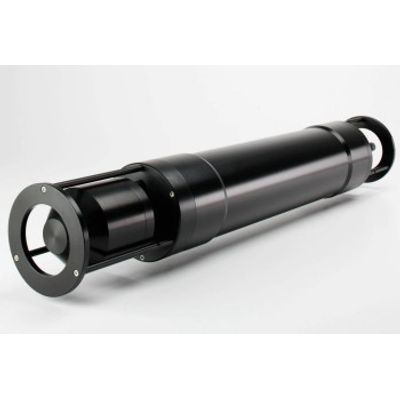
Sequoia Scientific - Model LISST-25X Series -Advanced Turbidity Sensor
The LISST-25X has been discontinued. No support of any kind is available for the LISST-25X.
- Stop sediment sampling, measure!
- 100% calibration-free
- Measure total concentration and mean particle size at 1Hz
Essentially, the LISST-25X offers capabilities between those of an OBS, which suffers calibration changes due to changes in grain size or color and the LISST-100X, which provides the detailed size distribution. In short: The LISST-25X overcomes the OBS’s shortcomings, but does not provide the full size distribution of the LISST-100X.
An anti-fouling accessory BioBlock is available for this instrument. The picture on the left shows the LISST25X with the BioBlock installed.
BioBlock is very strongly recommended for deployments in biologically productive waters.
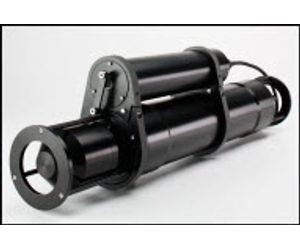
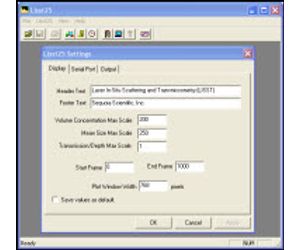
The instrument is self-contained, with memory and batteries. It is fully programmable to set sample rate. Data can be internally stored or captured in real time. A depth sensor is included as standard. Windows software for data offload and display is provided.
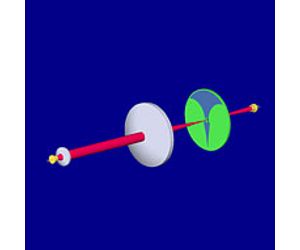
The idea behind the LISST-25X is to use shaped focal plane detectors. These detectors (see figure) derive their shape from the physics of light scattering. The shape is found such that for any size of particle in the 2.5 to 500 micron range, the instrument reports the correct volume concentration. A different shape is found to yield area concentration.The ratio of volume to area is called the Sauter Mean Diameter. The instrument employs 2 pairs of shaped detectors. One pair measures particles in the 2.5 to 63 micron range, the other in the 63-500 micron range.
The idea behind the LISST-25X is to use shaped focal plane detectors. These detectors (see figure) derive their shape from the physics of light scattering. The shape is found such that for any size of particle in the 2.5 to 500 micron range, the instrument reports the correct volume concentration. A different shape is found to yield area concentration.The ratio of volume to area is called the Sauter Mean Diameter. The instrument employs 2 pairs of shaped detectors. One pair measures particles in the 2.5 to 63 micron range, the other in the 63-500 micron range.
- Small angle forward-scattering laser diffraction technology (also called laser diffraction)
- Self-contained with internal batteries and built-in programmable datalogger, holds up to 27,000 samples
- Solid state red diode laser @ 670 nm
- RS232C serial data interface
- Programmable data collection
- Integrated BioBlock connection
- Internal battery (4 x 9V, alkaline or lithium)
- External power option 6-12VDC @ max 250mA
Specifications (subject to change without notice)
Parameters Measured
- Sauter mean diameter [µm] (what is the Sauter mean diameter?)
- Total volume concentration [µl l-1]
- Sauter mean diameter in 63-500 µm sub-range [µm]
- Total volume concentration in 63-500 µm sub-range [µl l-1]
- Optical transmission [%]
- Depth [m]
- Date and Time
Size ranges
- 2.5-500 µm for the full range
- 63-500 µm for the sub-range
Concentration ranges
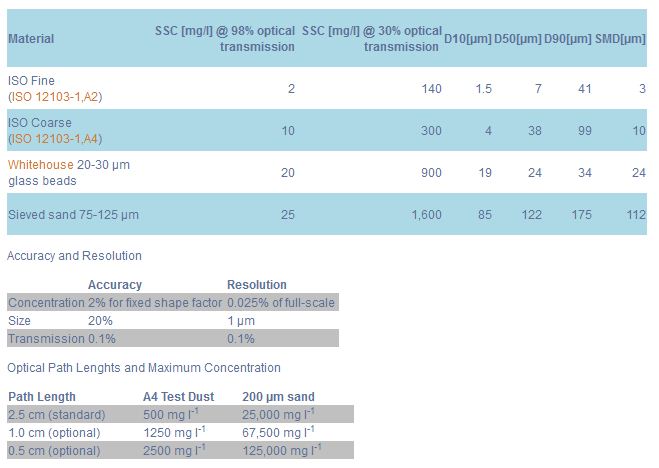
- Concentration range 2-1,600 mg/l. NOTE: Actual range is dependent on the grain-size and size distribution of the suspended particles. See table below for details and examples of concentration ranges based on measurements using ISO particle standards and easily obtained reference materials. SMD: Sauter Mean Diameter.
- Resolution < 1 mg/l
Weight and Dimensions
- Dimensions: 10.0 cm diameter x 61.7 cm long (3.95″ x 24.3″)
- Weight: 4.5 kg (10 lbs) in air; 1.4 kg (3 lbs) in water
- 300 m depth rating
- Serial interface: RS232C @ 9600 baud
- Internal battery pack: 4 × 9V batteries, alkaline or lithium
- External power input (optional): 6-12VDC @ max 250 mA
- Power drain: 147 mA/3.5 mA/140 µA (measuring/quiescent/sleeping)