

Aikan - Integrated Waste Technology
Aikan technology manages 60 % of the total volume of waste from cities in a cost effective and environmental friendly way. That is why Aikan is a good robust place to start. See how it works. Biodegradable waste makes up for at least half of the total waste volume from cities. When the organic waste is spread on landfills it creates huge environmental and climatic impacts due to methane and nutrient leaching. When threated by Aikan it creates renewable energy and nutrients recycled to compost.
The major challenge of waste management in cities are where, in the value chain, to start. Why not start, where the greatest benefits can be achieved with the lowest costs. That’s where the most waste can be turned to valuable goods and this is by separating Biowaste!
Source separation of bio-waste and green waste makes sense for several reasons. It is valuable, clean and easy recognized resource, and by removing it from the waste stream, other wastes become much easier to handle.
An Aikan plant makes out a focal point in the transition from mixed waste to source separation.
More information:
Due to its unique design, Aikan Technology allows for batch processing of waste, producing both biogas and compost, without moving the solid waste fraction. An Aikan plant is one of the most effective and flexible solutions available for integration with mechanical biological treatment (MBT). It is a hybrid solution which brings anaerobic digestion and in-vessel composting into a single highly flexible production work flow.
An Aikan system is laid out in such a way that it physically separates hydrolysis (“leaching out”) and methane generation, the two main processes that constitute what is generally known as dry anaerobic digestion.
The performance of an Aikan system relies on the following 3 steps:
Hydrolysis: Inside the process module fresh waste is sprayed with degasified percolate drawn from the biogas reactor. This induces bacterial hydrolysis, leaching out fatty acids. Percolate is drained from the bottom of the process module, effectively separating the waste into dry and wet fractions.
Methane production: The wet fraction (the percolate), with its content of fatty acids, is pumped back to the biogas reactor where methane production takes place, physically separated from the solid waste fraction. Steps 1 and 2 are continued as long as the percolate has potential for methane production.
Composting: When the potential for methane production has decreased, the process module switches to forced ventilation (negative aeration) of the remaining solid waste. Aeration rapidly initiates a highly effective composting process. Heat from the composting ensures complete sanitization and evaporation of excess humidity.
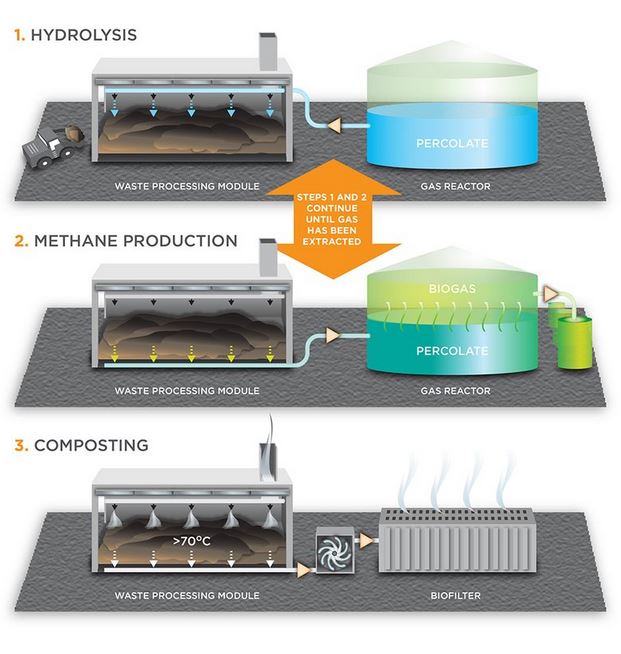
During all 3 steps, the process module remains closed. No solid waste is moved, with only fluids and air circulating between the process module and the gas reactor in a closed system. The system design ensures that the processes of hydrolysis, percolation, methane generation and composting are separate and occur rapidly and extremely efficiently. There is no need for inoculation using earlier processed material to start fresh batches. This insures full traceability.
Aikan Technology optimizes transformation processes that occur naturally in the decomposition of biological waste and makes sure that the outputs can be captured, upgraded and turned into valuable resources that can be recycled. The unique design of the Aikan process allows for the use of reliable and readily available standard technology.
The term “Dry AD” can be a little confusing as the process as such is not dry. “Dry AD” means that the solid waste is handled in solid form whereas “Wet AD” means that the waste is made into a pulp which are pumped around.