


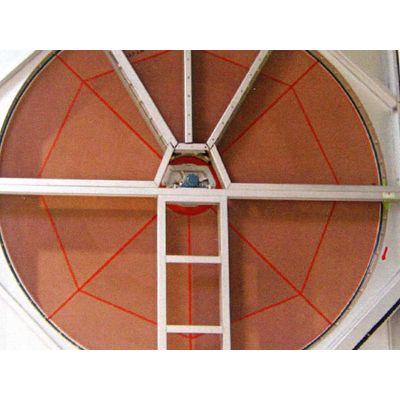
airTReco - Roto-concentrator: VOC Reduction System
The Roto-concentrator is an advanced variable flow rate adsorption system designed for the continuous removal of volatile organic compounds (VOCs) from industrial exhaust streams, featuring a self-supporting design. Utilizing waterproof zeolite adsorbent material, it effectively concentrates VOCs from low concentration air flows for subsequent treatment in a reduced, heated air stream. The system employs an innovative process where VOC-laden air passes through a rotor, adsorbing pollutants and producing purified air. The adsorbed VOCs are then desorbed using a counter-flow of reduced hot air, concentrating the pollutants for efficient thermal oxidation. This method allows for the use of smaller, energy-efficient combustors, reducing operational energy consumption and potentially enabling the system to be self-sustaining. The Roto-concentrator is widely applied in industries such as automotive, plastics, and fiber processing, known for handling solvents and styrene emissions, thereby aiding compliance with environmental regulations.
The rotor concentrator is a variable flow rate adsorption plant for the continuous elimination of volatile organic compounds (VOCs) from a low concentration air flow, via the adsorption of VOCs with waterproof zeolite adsorbent material and later release of the VOCs in a reduced heated air flow, but more concentrated, for subsequent treatment.
The low VOCs concentration air enters the inlet chamber through a filter which removes the excess dust and particles. From the inlet chamber the air passes through the rotor where the VOCs are adsorbed, then the purified air reaches the outlet chamber and via specific pipes, is released into the air.
The adsorbed VOCs, are removed from the rotor by passing a reduced flow of hot air through part of the rotor in the opposite direction of the main air flow to be treated, with the result of obtaining a reduced air flow but with a high VOCs concentration (the concentration ratios which can be obtained range from 5 to 1 to 15 to 1).
The air flow used for this operation is tapped upstream from the rotor, and is the same which guarantees the rotor cooling phase after regeneration (see the operating diagram)
The further treatment to which the concentrated flow is treated is an incineration process. Normally a regenerative-thermal plant is used for this purpose.
Thanks to the suitably reduced and concentrated flow of air to be treated, it is possible to use a combustor that is considerably smaller than those required when there is not roto concentrator.
This results in an economical advantage from the viewpoint of energy savings relative to combustor management (self-supporting of the incineration/combustion system).