


- Home
- Companies
- CeramTec Group
- Products
- CeramTec - Aluminum Titanate (Al2TiO5) ...
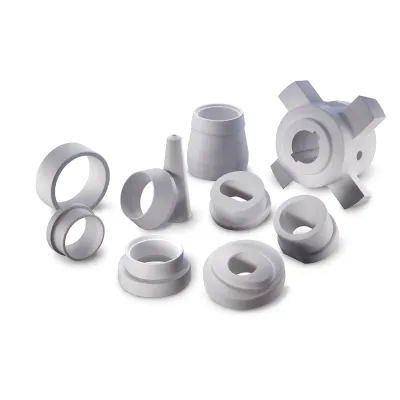
CeramTec - Aluminum Titanate (Al2TiO5) Components for Industrial Applications
Aluminum Titanate (Al2TiO5) is notable for its excellent thermal shock resistance, allowing it to withstand rapid temperature changes without damage despite its low strength. This property arises from its low thermal expansion and a degree of porosity within its structure. Due to its low wettability with molten metals, Aluminum Titanate is highly suitable for use in foundry technology and metallurgical melting processes. This ceramic material is increasingly significant in automotive and energy sectors, potentially enhancing exhaust gas aftertreatment systems and thermal insulation in fuel cell components. CeramTec produces essential components for metal flow control, including riser tubes for low-pressure die casting, dosing tubes for dosing furnaces, and various elements such as slide plates and closure plates. Additionally, their product range features mould inserts, nozzles, bushes, break rings for continuous casting, and insulating rings.
The special property of aluminium titanate (Al2TiO5) is its very good thermal shock resistance.Components made from this material can withstand even abrupt temperature changes of several hundred degrees without damage, even though they have low strength.
The good thermal shock resistance results from the very low thermal expansion and a certain porosity in the structure. The low wettability of this ceramic material with molten metals also makes it ideal for use in foundry technology and metallurgical melting. In the future, aluminium titanate could play a greater role in automotive and energy technology, for example for exhaust gas aftertreatment and thermal insulation of fuel cell components.
- Excellent thermal shock resistance
- Max. Operating temperature: 900 °C
- Very low thermal expansion (<1x10⁻⁶K-1 between 20 and 600°C)
- High thermal insulation (1.5 W/mK)
- Low Young’s modulus (17 to 20 GPa)
- Good chemical resistance
- Poor wettability with molten metals