


Advanced Measurement Instruments (AMI)

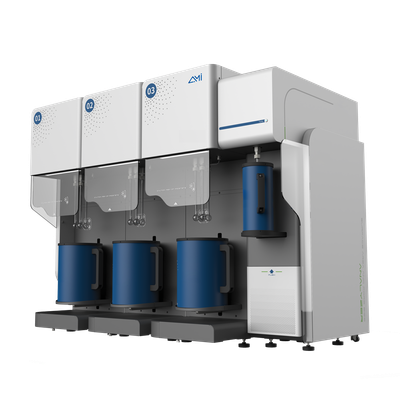
AMIModel Matrix 1000 -Gas Adsorption Analysis System

SHARE
The Matrix 1000 Series by Advanced Measurement Instruments is a sophisticated gas adsorption analysis system designed for precision and reliability in evaluating adsorption properties. Its advanced software capabilities allow users to configure various station options, making it versatile for different analytical needs. The system is engineered to provide accurate measurements of adsorption isotherms, essential for industries such as catalysts, pharmaceuticals, and nanomaterials. The Matrix 1000 Series supports comprehensive adsorption analysis, including surface characterization and pore size distribution, enabling detailed insights into material properties. With robust specifications, the Matrix series serves a wide range of applications, from academic research to industrial quality control, offering users a reliable solution for complex adsorption analyses.
Most popular related searches

The Matrix 1000 is a next-generation gas sorption analyzer platform engineered for laboratories demanding flexible configuration, high throughput, and precision micropore resolution. Each unit supports up to four independently operated analysis stations, giving users the freedom to design the system around their specific applications.
The system is ideal for research centers, QC labs, and advanced materials teams who require reliable, scalable, and highresolution data for gas adsorption and pore characterization.
Key measurement capabilities include BET, Langmuir, BJH, DFT, HK, SF, MP, DR, T-Plot, isotherms, and heat of adsorption. Surface area can be measured down to 0.05 m2/g (mesopore) and 0.0005 m2/g (micropore), with pore sizes from 0.35 to 500 nm resolved with high precision.

The Matrix 1000 empowers users to:

  • Configure mesopore, micropore, or mixed-mode stations in a single unit
  • Run simultaneous, independent analyses without cross-interference
  • Scale up or specialize based on research demands
  • Customize precision sensor packages to match experimental needs
  • Expand modularly to a total of up to 3 connected units (12 stations) for maximum throughput and flexibility


Key measurement capabilities include BET, Langmuir, BJH, DFT, HK, SF, MP, DR, T-Plot, isotherms, and heat of adsorption.
Surface area can be measured down to 0.05 m2/g (mesopore) and 0.0005 m2/g (micropore), with repeatability ≤1.0% RSD. Pore sizes from 0.35 to 500 nm are resolved with repeatability as fine as 0.02 nm (high-res micropore).

Multi-Station Architecture
Run up to four fully independent analysis stations per unit—each with dedicated dosing, pressure control, and data acquisition. Scale up to 12 stations by connecting three Matrix 1000 units. Ideal for high-throughput labs and multi-user environments.

Micropore & Mesopore Flexibility
Configure any combination of micropore or mesopore analysis stations based on your application needs. High-resolution pressure sensors—down to 0.1 Torr—enable accurate characterization of ultrafine pores, while broader pressure ranges allow robust mesopore and macropore analysis.

Smart Safety & Status System
The Matrix 1000 is built for safe, intuitive operation. Each work unit includes multicolor LED indicators for quick visualization of instrument status:

  • White – Standby
  • Orange – Heating
  • Green – Test in Progress
  • Red – Alarm Condition


Real-time monitoring of pressure and temperature ensures that any anomaly automatically triggers an alarm, switches the unit to red warning status, and halts the experiment for safety. A retractable front safety shield protects users from cryogenic splashes during operation.

Smart Degassing with Pressure Feedback
The Matrix 1000 system continuously monitors vacuum pressure during degassing and compares it to user-defined stabilization thresholds. This intelligent feedback mechanism automatically detects when activation is complete, improving reproducibility and avoiding over- or undertreatment of samples.

Advanced Gas Dosing
Each analysis station features dedicated dosing and evacuation control for independent test execution. The system supports both pressure-based and volumebased dosing, with user-selectable options for quantitative or constant-pressure dosing. Smart sequencing ensures efficient dosing across multiple stations while avoiding gas cross-talk so that each station can run a different test (i.e. BET, isotherm), but with the same adsorbate.

Integrated Degassing Furnace
Every Matrix 1000 unit includes one built-in, high-temperature degassing furnace with programmable ramp/soak control and realtime pressure feedback—no external systems required. For high-volume workflows, pair with an external Prep Series degasser for bulk pre-treatment, using the built-in unit for final polishing prior to analysis.

Harsh Chemistry Option
Equipped with a passivation coating and seals upgraded to FFKM for aggressive or corrosive chemistries.

  • Model Options: 1, 2, or 3 analysis units (up to 12 ports total)
  • Analysis Ports per Unit: Up to 4
  • Measurement Capabilities: BET (single and multi-point), Langmuir, BJH, STSA, t-plot, DFT, NLDFT, HK, SF, MP, DR, DA, Isotherms, Heat of Adsorption, Total Pore Volume, Adsorption Kinetics
  • Pore Volume Resolution: ≥ 0.0001 cm3/g
  • Pressure Range (P/P0): 10-4 to 0.998 (meso); 10-8 to 0.998 (High Res micropore)
  • P0 Transducers: 1 per unit, 1000 Torr, 0.25% FS
  • Degassing Ports: In-situ - 4 / 8 / 12 (based on configuration)
  • Degassing Temp (Max): 400°C ±1°C (active cooling included)
  • Degassing Ramp Control: Yes – programmable ramp and soak
  • Degas Pressure Monitoring: Yes – user-defined thresholds
  • Vacuum System: Mechanical: 10-1 Pa; Optional Turbo: 10-8 Pa
  • Temperature Control: Air bath + valve box; Max 45°C ±0.1°C
  • Gas Compatibility: N2, CO2, Ar, Kr, H2, O2, CO, CH4 (non-corrosive gases)
  • Optional: Harsh Chemistry model with passivation coating and FFKM seals
  • Vapor Sorption Option: Available
  • Dewar Capacity: 3L
  • BET Throughput: 4 samples/5-point BET <~40 min fully optimized
  • Dosing & Equilibrium Control: Supports user-defined pressure tables and quick-start templates. Gas is introduced stepwise to target relative pressures, with adsorption equilibrium determined by pressure stability over a fixed time window.
  • Cold Space Calibration: Automatic
  • Station Independence: Four workstations per unit; independent test types with same adsorbate. Synchronized start/finish with alternating gas dosing. Independent dosing, vacuum, and control per station.
  • Software: APAS software with analysis models, leak detection, and vacuum diagnostics
  • Data Export: Excel, TXT, RAW, PDF; full reprocessing supported
  • Gas Inlet Ports: 2 per unit (Helium and Adsorption Gas); expandable to 18
  • Power Requirements: 220 VAC, 16 A
  • Dimensions (L × W × H): 27.6 × 27.6 × 41.3 in (70 × 70 × 105 cm)
  • Weight: 242 lbs (110 kg)
  • Compliance: CE, EMC, RoHS