

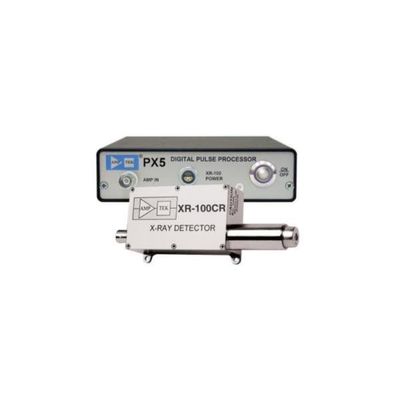
Amptek - Model Si-PIN -X-Ray Detector
Amptek recently brought silicon wafer manufacturing in-house and improved the process. The result is a detector with lower noise, lower leakage current, better charge collection, and uniformity from detector to detector. This makes it the best performing Si-PIN detector available.
The Si-PIN is a high performance thermoelectrically cooled X-ray detector and can be combined with several preamplifier and digital pulse processor configurations. It is typically used in laboratory X-ray spectroscopy applications requiring moderate energy resolution and moderate count rates where cost is important. It is well suited to many XRF applications such as identifying metal alloys, verifying RoHS/WEEE compliance, and detecting lead in paint.
The energy resolution of the SiPIN ranges from 139 to 190 eV FWHM depending on the detector area. It is best at count rates below 30 kcps and is suited to X-rays between 1.5 and 30 keV. It uses a fully depleted 500 um Si-PIN photodiode, and is available with 1 or 0.5 mil Be windows.
- X-Ray Fluorescence (XRF)
- RoHS/WEEE
- Portable Instruments
- OEM
- Nuclear Medicine
- Teaching and Research
- Art and Archaeology
- Process Control
- Mössbauer Spectrometers
- Space and Astronomy
- Environmental Monitoring
- Nuclear Plant Monitoring
- Toxic Dump Site Monitoring
- PIXE
- Si-PIN Photodiode
- Available in 6, 13 and 25 mm2
- 2-Stage Thermoelectric Cooler
- Temperature Monitor
- Beryllium Window
- Multilayer Collimator
- Hermetic Package (TO-8)
- Wide Detection Range
- Easy to Operate
The XR-100CR was a breakthrough in X-ray detector technology, providing “off-the-shelf” performance previously available only from expensive cryogenically cooled systems. Although newer detector technologies are now available, including Amptek’s XR-100SDD and the FastSDD®, the XR-100CR is still the workhorse of the XRF industry because of the combination of good performance and low cost.
The heart of Amptek’s XR-100CR is a thermoelectrically cooled Si-PIN photodiode which senses the X-rays. The two stage thermoelectric cooler keeps the detector and its input JFET at approximately -55 °C, reducing electronic noise without cryogenic liquid nitrogen. This cooling is key to the XR-100CR since it permits high performance in a compact, convenient package.
The hermetic TO-8 package of the detector has a light tight, vacuum tight, thin Be window to enable soft X-ray detection. There is vacuum inside the enclosure for optimum cooling. The XR-100CR detector includes an internal multilayer collimator to minimize background and spectral artifacts. It has a reset-style preamplifier, using a unique method of resetting through the high voltage connection to minimize noise.
In the XR-100CR the preamplifier is enclosed in a metal box, 3.0 x 1.75 x 1.125 inches, with the detector on an extender (available lengths: no extender, 1.5″, 5″, and 9”). The XR-100CR with a 5” or 9” extender is suitable for vacuum measurements, using the optional CP75 vacuum flange. Alternate preamplifiers are available, recommended for OEMs or where space is limited.
X-rays interact with silicon atoms to create an average of one electron/hole pair for every 3.62 eV of energy lost in the silicon. Depending on the energy of the incoming radiation, this loss is dominated by either the Photoelectric Effect or Compton scattering. The probability or efficiency of the detector to “stop” an x-ray and create electron/hole pairs increases with the thickness of the silicon. For more information, please refer to the Efficiency Curves on the “Performance” tab.
In order to facilitate the electron/hole collection process, a 100-200 volt bias voltage is applied across the silicon depending on the detector thickness. This voltage is too high for operation at room temperature, as it will cause excessive leakage, and eventually breakdown. Since the detector in the XR-100CR is cooled, the leakage current is reduced considerably, thus permitting the high bias voltage. This higher voltage decreases the capacitance of the detector, which lowers system noise.
The thermoelectric cooler cools both the silicon detector and the input FET transistor to the charge sensitive preamplifier. Cooling the FET reduces its leakage current and increases the transconductance, both of which reduce the electronic noise of the system.
Since optical reset is not practical when the detector is a photodiode, the XR-100CR incorporates a novel feedback method for the reset to the charge sensitive preamplifier. The reset transistor, which is typically used in most other systems has been eliminated. Instead, the reset is done through the high voltage connection to the detector by injecting a precise charge pulse through the detector capacitance to the input FET. This method eliminates the noise contribution of the reset transistor and further improves the energy resolution of the system.
A temperature monitor diode chip is mounted on the cooled substrate to provide a direct reading of the temperature of the internal components, which will vary with room temperature. Below -20 °C, the performance of the XR-100CR will not change with a temperature variation of a few degrees. Hence, closed loop temperature control is not necessary when using the XR-100CR at normal room temperature. For OEM applications or hand held XRF instrumentation a closed loop temperature control is recommended. The Active Temperature Control is standard in Amptek electronics such as the PX5 and DP5/PC5.