


ANDRITZ Separation - ANDRITZ Group
- Home
- Companies
- ANDRITZ Separation - ANDRITZ Group
- Products
- Andritz - Model Krauss-Maffei DCF - ...
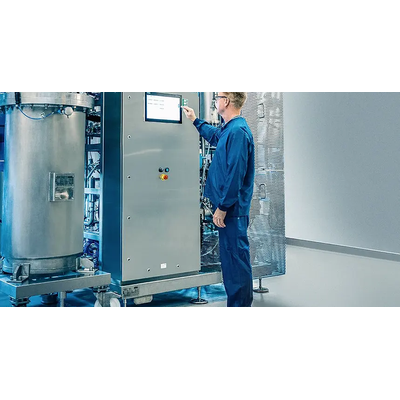
Andritz - Model Krauss-Maffei DCF -Dynamic Crossflow Filter
The Krauss-Maffei Dynamic Crossflow Filter (DCF) is engineered for efficient clarification of liquids and for concentrating and washing solids across a wide range of chemical and biochemical applications. Whether your valuable product is a liquid or a solid, the DCF technology ensures maximum yield and superior product quality.
Most popular related searches
dynamic crossflow filter
cross-flow filter
laboratory homogenizer
drum filter
dry evaporator
pressure reducer
membrane treatment
disc filter
- Highest possible yields by processing of highly concentrated suspensions up to viscosities of 7,000 mPas
- Optimum product quality due to single-pass filtration concept, short residence times, no contact with gases, and minimum thermal and mechanical impact
- Highly accurate membranes with different cut-offs achieve a clear filtrate, typically with residual turbidity of less than 1NTU
- Smaller installed filtration area due to higher permeate flux
- 80% reduction in energy consumption compared to traditional membranes
- Reduced thermal product treatment
- Lower energy costs
- Little or no suspension cooling
- Substantial savings, in any subsequent evaporation or drying
- Reduced operating costs and wider range of applications
- Reduced feed pressure due to more effective prevention of clogging layer
- Homogeneous trans-membrane pressure across the entire surface (no inlet or outlet zones in membranes)
- Easy inspection as the filtration surface is on the outside of the membrane
- Very low retention volume in relation to the membrane surface
- Hermetic design
- Designs for basic chemical to high-end, sterile pharmaceutical applications
- Full CIP and SIP available, GMP enabled
- Small footprint, easy transport and installation
- Easy maintenance
- Hanging shaft design eliminates the risk of gases at the membranes and in the permeate
- Lowest mechanical stress on product due to minimized process volume
- Feed bottom and discharge top: easy cleaning due to hygienic design
- Avoidance of retentate recirculation by means of dead-end operation (single-pass process)