


- Home
- Companies
- Jiangsu Guangyang Dynamic Environmental ...
- Products
- Anion and Cation Exchanger
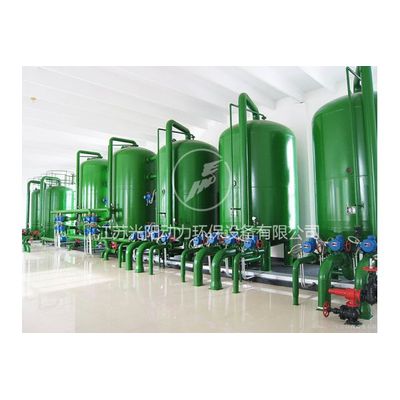
Anion and Cation Exchanger
Anion and cation exchangers are exchangers filled with anion resin and cation resin respectively. Calion exchangers are used lo remove positively charged ions (cations), and anion resins are used to remove negatively charged ions (anions). Cation exchange resin replaces H+ ions with cations, such as calcium, magnesium and sodium ions; anion exchange resin replaces OH-ions with anions, such as chloride ions, sulfate ions and bicarbonate ions, replacing H+ and OH- Synthesis forms water and removes ions from water. The exchange capacity of the resin is limited and must be regenerated after its exchange capacity is exhausted.
Depletion of exchange capacity occurs when an equilibrium state is reached between adsorbed ions. The regeneration of cationic resin is treated with acid, usually hydrochloric acid is used to regenerate, that is, it is filled with H+ ions. The regeneration of anionic resin generally uses sodium hydroxide, that is, it is filled with OH- ions. Regeneration can be performed within the column by installing regenerable deionization equipment and regeneration equipment as well as chemicals.
Regeneration principle
The ion exchanger regeneration process adopts a counter-current method without top pressure, which has the advantages of simple operation, external piping system, and does not require any top pressure facilities. During regeneration, the diluted regenerant flows through the resin layer in reverse direction from bottom to top, and the resins in different layers will be regenerated from bottom to top. This method can achieve better regeneration effect of the resin layer, and the regeneration liquid can obtain higher Utilization rate, secondly, it has the advantages of less waste liquid discharge and low self-water rate.
Technical parameters
- Inlet water turbidity: <1-2NTU
- Outlet water quality:
Strong acid anode bed: sodium leakage is not more than 10Oug/l, usually 20-30ug/l
Strong alkali cathode bed: Si02 leakage is not greater than lOOug/i, generally 20-50ug/l, and the outlet water conductivity is less than 2 us/cm
- Working pressure: <0.6MPa
- Working temperature: 5-50°C
- Operating flow speed: 20-30m/h
- Water backwash intensity: cation resin 10-l5m/h, anion resin 8-10m/h
- Regeneration flow rate: 5m/h
- Regeneration solution concentration: 3-5%
Structural form
The ion exchanger shell is generally made of hard polyvinyl chloride, hard polyvinyl chloride composite fiberglass, plexiglass, plexiglass composite transparent fiberglass, steel lining, stainless steel lining and other materials. The water inlet device is a T-shaped wire-wound type of mother branch pipe, the middle drainage device is a T-shaped wire-wound type of mother branch pipe, and the lower part is a porous plate + water cap water collection device.
The outside of the equipment body is equipped with various control valves and various instrument interfaces to facilitate on-site installation by users and ensure the normal operation of the water station.
- Main uses
- Produce pure water
- Seawater desalination, brackish water desalination
- Fluoride removal and wastewater treatment
- Demineralization of water supply for power equipment