


- Home
- Companies
- HMS Industrial Networks AB
- Products
- Anybus - Wireless Bridge II – Ethernet
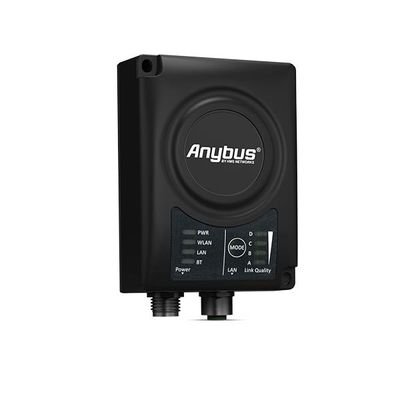
Anybus - Wireless Bridge II – Ethernet
Anybus® Wireless Bridge enables you create an industrial wireless connection in an industrial Ethernet network. This second generation of the proven and trusted Wireless Bridge can communicate via both Bluetooth and Wireless LAN and is ideal for communication through hazardous areas or hard-to-reach locations where cables are not desirable.
BRIDGING TCP/IP ETHERNET
The Wireless Bridge makes it possible to operate leading TCP/IP based industrial Ethernet networks, such as BACnet/IP, PROFINET, EtherNet/IP and Modbus TCP, over Bluetooth and Wireless LAN 2.4 / 5 GHz.
POINT-TO-POINT OR MULTIPOINT
Point-to-point or multipoint Anybus Wireless Bridge is often used as an Ethernet cable replacement (point-to-point communication). But it can also be used as an access point for up to seven Wireless LAN/Bluetooth clients.
- Use with point-to-point wireless Industrial Ethernet installations through hazardous or hard-to-reach locations
- Use as an Access Point for up to seven clients
- Suitable for AGV’s (Automatic Guided Vehicle)
- Fast Roaming (IEEE 802.11r), High link speed (IEEE 802.11n), Robustness (three internal antennas, including MIMO)
- Eliminates the need for expensive or maintenance-heavy cabling
- Bridges TCP/IP Ethernet and protocols such as: BACnet/IP, EtherNet/IP, Modbus-TCP and PROFINET
- Full compatibility with Anybus Wireless Bolt — a wireless product for machine mounting
- Easy setup via push button or web interface
- Advanced configuration with AT commands
- Compatible with PROFIsafe requirements
- Rugged IP65 rated industrial design
- Security features for a secure industrial operation
- Three built in antennas for higher performance and better robustness
- Operation with Wirelesss LAN, Bluetooth classic and Bluetooth Low Energy.
- CLI (Command Line Interface) for configuration and diagnostics
- Starterkit available
- Wireless standards: WLAN 802.11 a, b, g, n, d.
- Operation modes: Access point or Client
- WiFi channels: 2.4 GHz, channel 1-11 + 12-13 depending on regulatory domain scan.
- 5 GHz Access Point: 36-48 (U-NII-1), 5 GHz Client: 100-116 + 132-140 and 120-128 depending on regulatory domain scan. (U-NII-1, U-NII-2, U-NII-2e).
- RF output power: 18 dBm EIRP (including max antenna gain 3dBi)
- Max number of slaves for access point: 7
- Power consumption: 54mA@24VDC
- Net data throughput: 20 Mbps. Link speed: max 130 Mbps (802.11n 2x2 MIMO)
- Security: WEP 64/128, WPA, WPA-PSK and WPA2, TKIP and AES/CCMP, LEAP, PEAP.
Bluetooth Interface
- Wireless standards (profiles): PAN (PANU & NAP)
- Operation modes: Access point or Client
- RF output power: 14 dBm EIRP (including max antenna gain 3dBi)
- Max number of slaves for access point: 7
- Power consumption: 36 mA@24VDC
- Net data throughput: ~1 Mbps
- Bluetooth version support: Classic Bluetooth v2.1
- Security: Authentication & Authorization, Encryption & Data Protection, Privacy & Confidentiality, NIST Compliant, FIPS Approved
Bluetooth Low Energy
- Wireless standards (profiles): GATT
- Operation modes: Central or Peripheral (pending)
- RF output power: 10 dBm EIRP (including max antenna gain 3dBi)
- Max number of simultaneous connections for Central: 7
- Power consumption: 36 mA@24VDC
- Net data throughput: ~200 kbps
- Bluetooth Low Energy version: 4.0 dual-mode
- Security: AES-CCM cryptography
Ethernet Interface
- Supports Ethernet protocols: IP, TCP, UDP, HTTP, LLDP, ARP, DHCP Client/Server
- Supports wireless bridging of Industrial Ethernet protocols: BACnet/IP, EtherNet/IP, Modbus-TCP, PROFINET
- Ethernet interface: 10/100BASE-T with automatic MDI/MDIX cross-over