


- Home
- Companies
- lino Biotech AG
- Products
- lino-Biotech - Architecture Universal ...
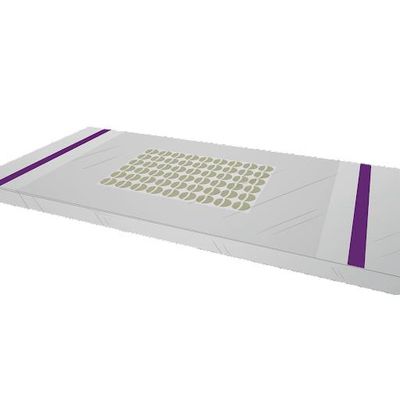
lino-Biotech - Architecture Universal Chip Chip
- One Chip Design.
- Endless Opportunities
Our universal chip architecture can tackle various applications addressing major pain points in novel cell and gene therapy. Biological functionalization of a MoloChip can be easily achieved by DNA-directed immobilization with a set of well characterized DNA sequences.
Orthogonal nature of the DNA directed immobilization in combination with the provided single – or six channel flow chambers allows for various subset combinations of lino´s MoloChips.
1 capture single stranded DNA (ssDNA) sequence* fabricated by dip-coating or flow chamber modification.
Launch 2022
6 orthogonal capture ssDNA sequences fabricated by flow chamber modification or micro spotting.
Launch 2023
54 orthogonal capture ssDNA sequences fabricated by micro spotting.
Launch 2024
Improve your assay performance with our Protein A/G Sensor Chips. Our backfilled Chips allow you to measure directly in complex samples.
Streptavidin Sensor Chipslino Biotech´s Streptavidin Sensor Chips are perfect for immobilizing biotinylated ligands (e.g. proteins, antibodies, and more).
Biological molecules, including proteins and nucleic acids, can be biotinylated using established protocols and immobilized onto the Streptavidin biosensor surface for custom assay development. There are many biotinylated biomolecules commercially available.
More about our sensor chips, e.g. a schematric illustration of the reactive immersion lithography (RIL), which allows the creation of the biomolecular recognition structure of the mologram on a light-sensitive non-fouling graft copolymer layer, can be found in our publication.
For more answered questions regarding our products, visit our FAQ.
Our sensor chips are ready for you to be used or they can be functionalized according to our customers needs in a simple process using established conjugation techniques. Each sensor chip has 54 mologram structures which can be functionalized in various ways. Since every mologram has its own focal point, parallel label-free multiplexing can be achieved easily. In combination with a single or six-chanell fluidic chamber, different sensor chip formats can be implemented via simple combinatorics.