


- Home
- Companies
- ARCoptix S.A
- Products
- ARCoptix - Model LCVR - Liquid Crystal ...
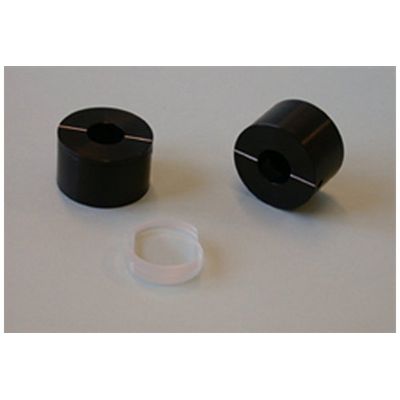
ARCoptix - Model LCVR -Liquid Crystal Variable Phase Retarder
The Arcoptix Liquid crystal variable phase retarder (LCVR) is a transmissive element with an electrically tunable optical phase retardance. Optical retardations are often obtained with piezoelectric mirrors. However, this option is not ideal if robust and compact design is necessary. This product offer an interesting alternative especially when working with polarized light (which is often the case when working with lasers). The ARCoptix phase retarder is a thin transmissive element causing minimal losses and can be simply placed within the optical path of your system.
The more, its optical retardation is electrically tunable with the LC driver of ARCoptix (but it can also be driven with simple laboratory alternative power supply). Alternatively, it can also be used as optical valve (for a narrow wavelength range) or as Polarization state controller (PSC). To summarize :
- Electrically Tunable
- Transmissive element
- No moving parts
- Compact and robust device
- Weak absorption in VIS
- Needs polarized light
- Optical tunable valve (with extra polarizers)
- Polarization state controller
The liquid crystal variable phase shifter can be compared to a variable waveplate. By addressing it with the right voltage, it is able to provide any phase shift from zero to several times the light wavelength. They can be used throughout the visible and the near infrared region (400nm to 1800nm) without losses higher than 15%. Thanks to the use of thick substrate (scientific grade) and a special liquid crystal bend were are capable to offer robust equipment with minimal wavefront distortion and power absorption.
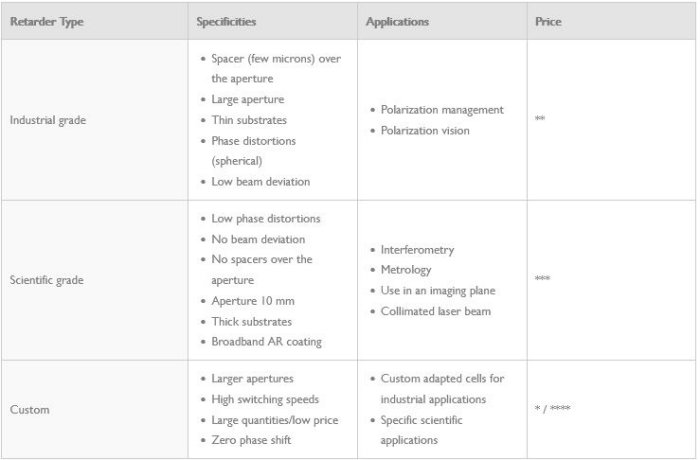
According to your needs, you can select essentially between three categories of products:
The Arcoptix LCVR are manufactured with standard liquid crystal technology. As depicted in figure 1, they are principally made of a liquid crystal layer sandwiched between two flat glass plates coated with a transparent electrode (ITO) and an alignment layer. The two glass plates are precisely spaced apart with a matrix of glass fibers. The cavity formed by these plates is filled with a special blend of liquid crystals optimized for high birefringence, small temperature dependence and high stability. The cell is hermetically sealed with a polymer frame. The alignment layer is a gently rubbed polyamide layer necessary for the alignment of the LC molecules. The electric field that can be induced by applying a voltage on the transparent ITO electrodes (0-7V) modifies the alignment of the LC molecules and by the same way, the apparent retardance of the cell. Figure (a) shows the alignment of the LC molecules when no voltage is applied. In this case, the molecules are aligned along the glass plates and the retardance (along the optical axis) is maximum. Figure (c) shows the other extreme case where a "high" voltage (7V) is applied and the electric field forces the LC molecules to align perpendicularly to the glass plates (parallel to the electric field). Figure (b) shows an intermediate state where we apply a small voltage of about 3V. In this case the molecules have an oblique orientation and the apparent retardation is somewhere in between the maximum retardation (several times the wavelength) and the minimum retardation (almost zero).
- Phase shift range : 50-1200 nm (more on demand)
- Wavelength range : 350-1700 nm up to 2600 nm on demand for IR version (with more than 40% tranmsission).
- Active area : Scientific grade: 10 mm (diam.) Industrial grade: 22 mm (square)
- Transmission : About 85% (VIS)
- Retarder material : Nematic Liquid-Crystal Dn=0.14
- Substrates : Glass (2x3mm)
- Wavefront distortion : Scientific grade: < l/4 (over 10 mm 0r 20mm)
- Industrial grade: < 2l (over 23 mm)
- Temperature range : 15° - 35°
- Retardance temperature dependency : About 0.5%/°C (wavelength dependent)
- Phase shift adjustment precision : 10nm
- Maximum modulation frequency of the phase shift : < 5Hz
- Phase shift stability (with arcoptix LC driver and at thermal equilibrium) : Better than 10 nm.
- Save operating limit : 500 W/cm2 CW 1 J/cm2 10 ns, pulsed (above 500nm) 60 mJ/cm2 40fs, 800 nm
- Anti-reflection coating (scientific grade only) : Broadband.
- Total size (with housing) : Scientific grade: 25mm diameter, 16mm long Industrial grade: 31mmx25mmx2.2mm (without housing).