


RVC Foams
Most popular related searches
X-ray diffraction
research sampling
scanning microscopy
elemental analysis
microscopy
microscopy scanning
tunnelling
monochromator
calibration instrument
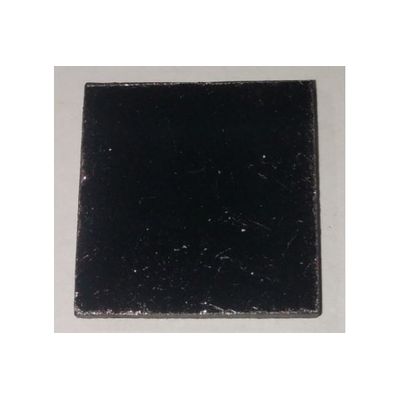
HOPG is widely used as a substrate for specimens to be examined in scanning probe microscopy. It is also used as a calibration specimen and cleaves almost like mica because of its layered structure. Unlike mica, HOPG is non-polar and, for samples where elemental analysis is required, it provides a carbon-only background. It consists of highly ordered planes of carbon atoms in (002) orientation and the quality of these parallel planes is defined by the mosaic spread angle.
Highly oriented pyrolytic graphite is a metal. The layers are stacked together via van der Waals interactions and can be exfoliated into thin 2D layers.
- Crystal size : ~1.2 cm square, 2 mm thickness
- Electrical properties : Metal
- Crystal structure : Hexagonal
- Unit cell parameters : a = b =0.246, c = 0.667 nm, α = β = 90°, γ =120°
- Type : Synthetic
- Purity : >99.995 %
- Scanning tunneling microscopy-calibration and substrates
- Graphite Monochromators
- X-Ray diffraction
- Neutron scattering and diffraction
- Materials : HOPG Grade ZYB
- Stock No : RVC-117-39
- CAS : 7440-44-0
- Mosaic spread angle : 0.8° +/- 0.2°
- Thickness : 2 mm, 1.6 mm
- Size : 12 x 12 mm
- Density : 2.255-2.265/cm3
- Thermal Expansion (C) : Slightly negative (Parallel), 20 X 10 -6 (Perpendicular)
- Thermal Conductivity (W/mK) : 1600-2000 (Parallel), ~8 (Perpendicular)
- Electrical resistivity (ohm-cm) : 3.5-4.5 x 10⁻⁵ (Parallel), 0.15-0.25 (Perpendicular)